Coyle Peter V, Chemaitelly Hiam, Ben Hadj Kacem Mohamed Ali, Abdulla Al Molawi Naema Hassan, El Kahlout Reham Awni, Gilliani Imtiaz, Younes Nourah, Al Anssari Ghada Ali A A, Al Kanaani Zaina, Al Khal Abdullatif, Al Kuwari Einas, Butt Adeel A, Jeremijenko Andrew, Kaleeckal Anvar Hassan, Latif Ali Nizar, Shaik Riyazuddin Mohammad, Abdul Rahim Hanan F, Nasrallah Gheyath K, Yassine Hadi M, Al Kuwari Mohamed Ghaith, Al Romaihi Hamad Eid, Al-Thani Mohamed H, Bertollini Roberto, Abu-Raddad Laith J
Hamad Medical Corporation, Doha, P.O. Box 3050, Qatar.
Biomedical Research Center, Qatar University, Doha, P.O. Box 2713, Qatar.
iScience. 2021 Jun 25;24(6):102646. doi: 10.1016/j.isci.2021.102646. Epub 2021 May 24.
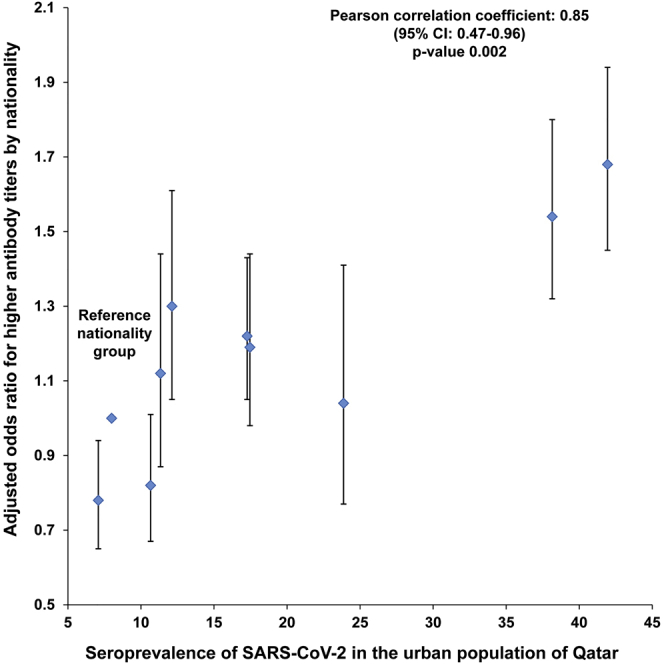
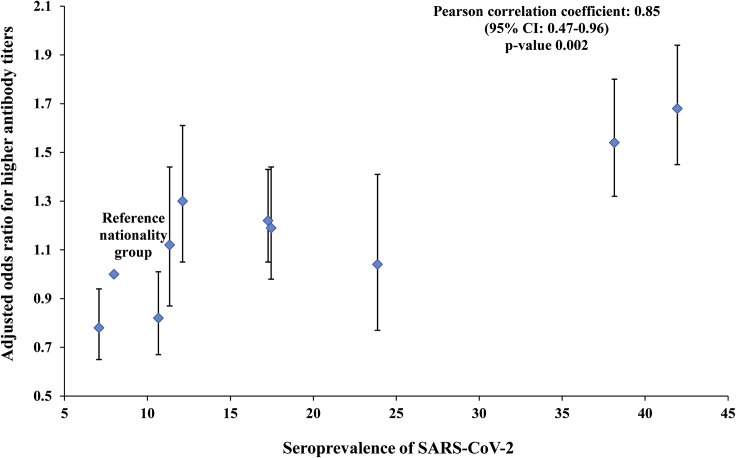
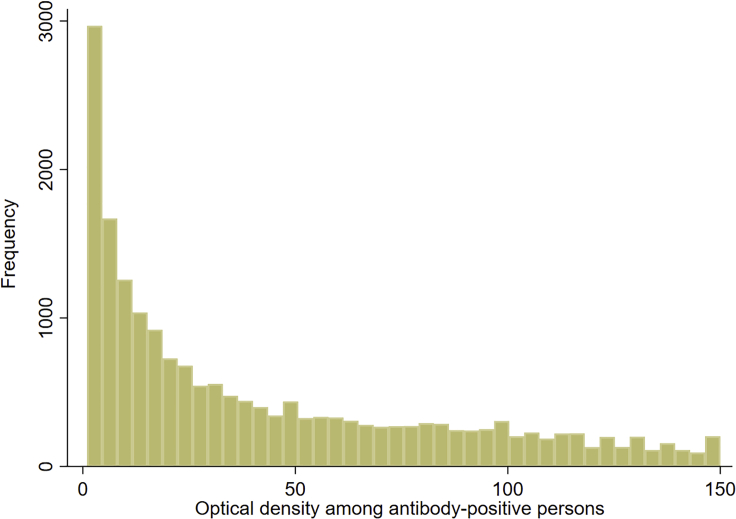
The study objective was to the assess level of detectable severe acute respiratory syndrome coronavirus 2 (SARS-CoV-2) antibodies in the urban population of Qatar. Antibody testing was performed on residual blood specimens for 112,941 individuals (∼10% of Qatar's urban population) attending for routine/other clinical care between May 12 and September 9, 2020. Seropositivity was 13.3% (95% confidence interval [CI] = 13.1-13.6%) and was independently associated with sex, age, nationality, clinical care encounter type, and testing date. Median optical density (antibody titer) among antibody-positive persons was 27.0 (range = 1.0-150.0), with higher values associated with age, nationality, clinical care encounter type, and testing date. Seropositivity by nationality was positively correlated with the likelihood of having higher antibody titers (Pearson correlation coefficient = 0.85; 95% CI = 0.47-0.96). Less than two in every 10 individuals in Qatar's urban population had detectable antibodies against SARS-CoV-2, suggesting this population is still far from herd immunity and at risk of subsequent infection waves. Higher antibody titer appears to be a biomarker of repeated exposures to the infection.
该研究的目的是评估卡塔尔城市人口中可检测到的严重急性呼吸综合征冠状病毒2(SARS-CoV-2)抗体水平。对2020年5月12日至9月9日期间接受常规/其他临床护理的112,941人(约占卡塔尔城市人口的10%)的残余血样进行了抗体检测。血清阳性率为13.3%(95%置信区间[CI]=13.1-13.6%),且与性别、年龄、国籍、临床护理接触类型和检测日期独立相关。抗体阳性者的中位光密度(抗体滴度)为27.0(范围=1.0-150.0),较高的值与年龄、国籍、临床护理接触类型和检测日期相关。按国籍划分的血清阳性率与抗体滴度较高的可能性呈正相关(Pearson相关系数=0.85;95%CI=0.47-0.96)。卡塔尔城市人口中每10个人中不到两人有可检测到的抗SARS-CoV-2抗体,这表明该人群仍远未达到群体免疫,并有遭受后续感染浪潮的风险。较高的抗体滴度似乎是反复接触该感染的一个生物标志物。