Chen J H, Seeman N C, Kallenbach N R
Department of Chemistry, New York University, New York 10003.
Nucleic Acids Res. 1988 Jul 25;16(14B):6803-12. doi: 10.1093/nar/16.14.6803.
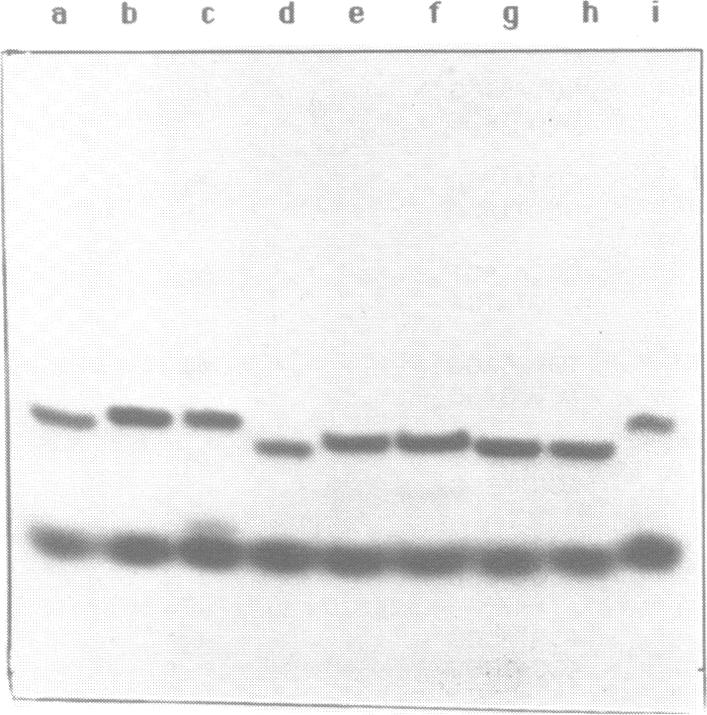
An investigation of the mobility of short duplexes of DNA -octamers and decamers-on polyacrylamide gels is presented, showing that molecules containing less than one helical turn exhibit sequence dependent mobilities. Analysis of chains with different sequences indicates that any arrangement of two or more adjacent A.T base pairs causes a duplex to move more slowly than does any combination of isolated A.T pairs This behavior appears to be an intrinsic property of these sequences, since the anomaly persists in the absence of magnesium or presence of spermine and is not due to strand dissociation. In two decamers we studied, the position of A.T tracts within a duplex can be shown to influence mobility: the sequence GA4T4C associated with bending or curvature of the helix axis when ligated into polymers migrates more slowly than the corresponding sequence GT4A4C, polymers of which migrate as linear B DNA.
本文介绍了对DNA八聚体和十聚体短双链在聚丙烯酰胺凝胶上迁移率的研究,结果表明,包含少于一圈螺旋的分子呈现出序列依赖性迁移率。对不同序列链的分析表明,两个或更多相邻A.T碱基对的任何排列都会使双链迁移得比孤立A.T对的任何组合更慢。这种行为似乎是这些序列的固有特性,因为在没有镁或存在精胺的情况下这种异常现象仍然存在,并且不是由于链解离。在我们研究的两个十聚体中,可以证明双链内A.T序列的位置会影响迁移率:当连接到聚合物中时,与螺旋轴弯曲或曲率相关的序列GA4T4C迁移得比相应序列GT4A4C更慢,后者的聚合物以线性B-DNA形式迁移。