Ajčević Miloš, Furlanis Giovanni, Naccarato Marcello, Caruso Paola, Polverino Paola, Marsich Alessandro, Accardo Agostino, Manganotti Paolo
Department of Engineering and Architecture, University of Trieste, Via A. Valerio, 10 - 34127, Trieste, Italy.
Clinical Unit of Neurology, Department of Medicine, Surgery and Health Sciences, University Hospital and Health Services of Trieste - ASUGI, University of Trieste, Strada di Fiume, 447 - 34149, Trieste, Italy.
Int J Med Inform. 2021 Aug;152:104442. doi: 10.1016/j.ijmedinf.2021.104442. Epub 2021 Mar 24.
When it comes to critical early post-acute TIA/stroke phase, there is a lack of a comprehensive multi-parametric telemonitoring system. The COVID-19 emergency, its related global mobility restrictions and fear of hospitalization further highlighted the need of a comprehensive solution.
We aimed to design and test a pragmatic e-Health system based on multiparametric telemonitoring to support of TIA/stroke patients in sub-acute phase during the COVID-19 pandemic.
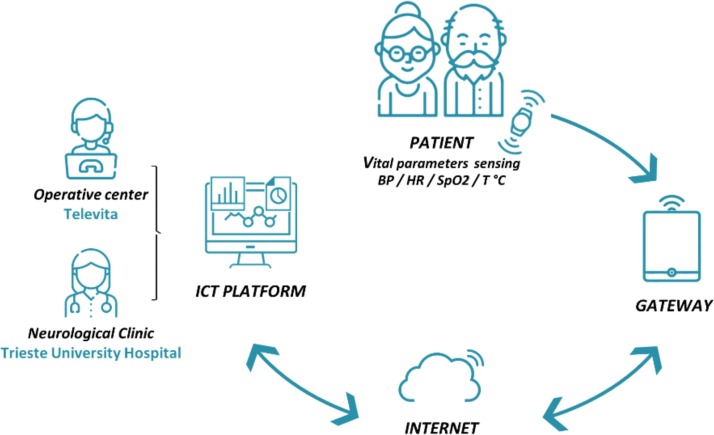
We proposed a telemonitoring system and protocol for TIA/minor stroke patients during COVID-19 pandemic for patients at risk of stroke recurrence. This system involves the use of portable devices for BP/HR/SpO/temperature sensing, panic-button, gateway, and a dedicated ICT platform. The protocol is a 14-day multiparametric telemonitoring, therapy, and emergency intervention based on vital sign alteration notifications. We conducted a proof-of-concept validation test on 8 TIA/minor stroke patients in the early post-acute phase (< 14 days from ischemic event).
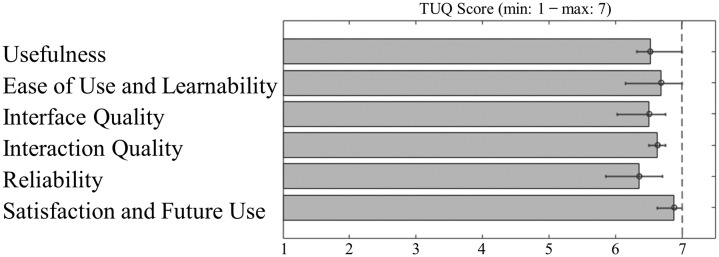
The proposed solution allowed to promptly and remotely identify vital sign alterations at home during the early post-acute phase, allowing therapy and behavioral intervention adjustments. Also, we observed a significant improvement of quality of life, as well as a significant reduction of anxiety and depression status. TUQ showed ease of use, good interface quality and high user satisfaction of the proposed solution. The 3-month follow-up showed total adherence of prescribed therapy and no stroke/TIA recurrence or other emergency department admissions.
The proposed e-Health solution and telemonitoring protocol may be highly useful for early post-acute remote patient management, thus supporting constant monitoring and patient adherence to the treatment pathway, especially during the COVID-19 emergency.
在急性后短暂性脑缺血发作/中风的关键早期阶段,缺乏全面的多参数远程监测系统。新冠疫情及其相关的全球出行限制以及对住院的恐惧进一步凸显了全面解决方案的必要性。
我们旨在设计并测试一种基于多参数远程监测的实用电子健康系统,以在新冠疫情期间支持亚急性期短暂性脑缺血发作/中风患者。
我们为新冠疫情期间有中风复发风险的短暂性脑缺血发作/轻度中风患者提出了一种远程监测系统和方案。该系统包括使用用于血压/心率/血氧饱和度/体温传感的便携式设备、紧急按钮、网关以及一个专用的信息通信技术平台。该方案是基于生命体征变化通知的为期14天的多参数远程监测、治疗和紧急干预。我们对8例急性后期早期(缺血事件发生后<14天)的短暂性脑缺血发作/轻度中风患者进行了概念验证性测试。
所提出的解决方案能够在急性后期早期在家中及时远程识别生命体征变化,从而允许调整治疗和行为干预。此外,我们观察到生活质量有显著改善,焦虑和抑郁状态也显著降低。用户体验问卷显示所提出的解决方案易于使用、界面质量良好且用户满意度高。3个月的随访显示患者完全遵守规定治疗,无中风/短暂性脑缺血发作复发或其他急诊入院情况。
所提出的电子健康解决方案和远程监测方案对于急性后期早期的远程患者管理可能非常有用,从而支持持续监测和患者对治疗路径的依从性,尤其是在新冠疫情期间。