Hanley Janet, Fairbrother Peter, Krishan Ashma, McCloughan Lucy, Padfield Paul, Paterson Mary, Pinnock Hilary, Sheikh Aziz, Sudlow Cathie, Todd Allison, McKinstry Brian
Edinburgh Napier University, Sighthill Campus, Sighthill Court, Edinburgh, EH11 4BN, UK.
Edinburgh Health Services Research Unit/Edinburgh Clinical Trials Unit, Western General Hospital, Crewe Road, Edinburgh, EH4 2XU, UK.
Trials. 2015 Mar 25;16:117. doi: 10.1186/s13063-015-0628-y.
Good blood pressure (BP) control reduces the risk of recurrence of stroke/transient ischaemic attack (TIA). Although there is strong evidence that BP telemonitoring helps achieve good control, none of the major trials have considered the effectiveness in stroke/TIA survivors. We therefore conducted a feasibility study for a trial of BP telemonitoring for stroke/TIA survivors with uncontrolled BP in primary care.
Phase 1 was a pilot trial involving 55 patients stratified by stroke/TIA randomised 3:1 to BP telemonitoring for 6 months or usual care. Phase 2 was a qualitative evaluation and comprised semi-structured interviews with 16 trial participants who received telemonitoring and 3 focus groups with 23 members of stroke support groups and 7 carers.
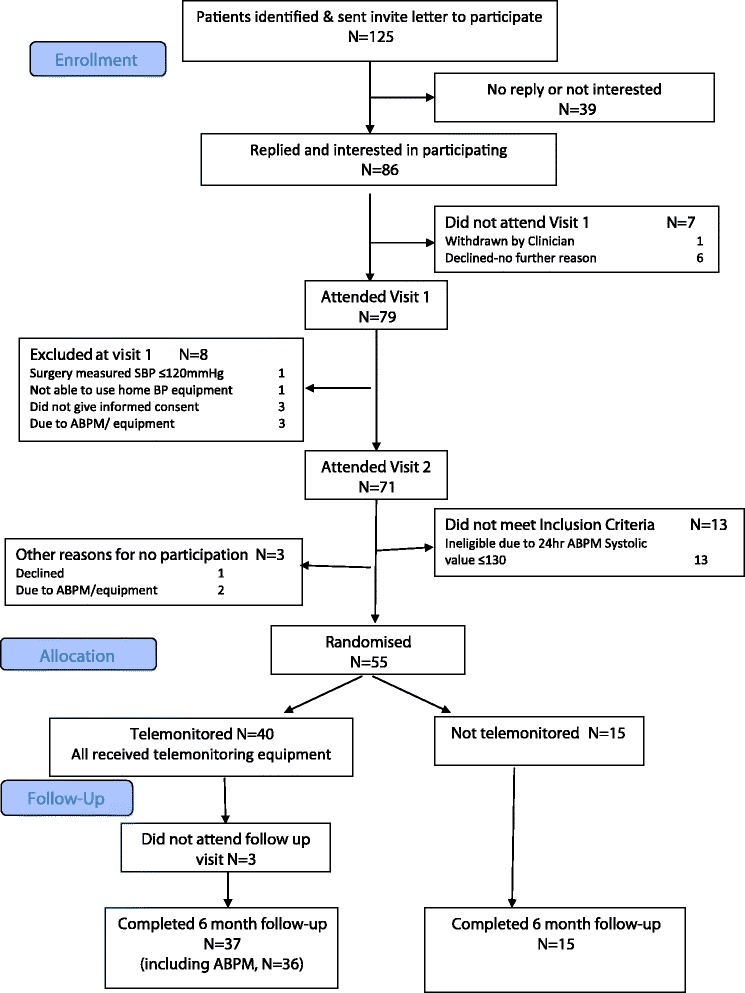
Overall, 125 patients (60 stroke patients, 65 TIA patients) were approached and 55 (44%) patients were randomised including 27 stroke patients and 28 TIA patients. Fifty-two participants (95%) attended the 6-month follow-up appointment, but one declined the second daytime ambulatory blood pressure monitoring (ABPM) measurement resulting in a 93% completion rate for ABPM - the proposed primary outcome measure for a full trial. Adherence to telemonitoring was good; of the 40 participants who were telemonitoring, 38 continued to provide readings throughout the 6 months. There was a mean reduction of 10.1 mmHg in systolic ABPM in the telemonitoring group compared with 3.8 mmHg in the control group, which suggested the potential for a substantial effect from telemonitoring. Our qualitative analysis found that many stroke patients were concerned about their BP and telemonitoring increased their engagement, was easy, convenient and reassuring.
A full-scale trial is feasible, likely to recruit well and have good rates of compliance and follow-up.
ISRCTN61528726 15/12/2011.
良好的血压(BP)控制可降低中风/短暂性脑缺血发作(TIA)复发的风险。尽管有强有力的证据表明血压远程监测有助于实现良好的控制,但没有一项主要试验考虑过其对中风/TIA幸存者的有效性。因此,我们针对基层医疗中血压未得到控制的中风/TIA幸存者进行了一项血压远程监测试验的可行性研究。
第1阶段是一项试点试验,纳入55例患者,按中风/TIA分层,以3:1的比例随机分配至接受6个月的血压远程监测或常规护理。第2阶段是一项定性评估,包括对16名接受远程监测的试验参与者进行半结构化访谈,以及对23名中风支持小组成员和7名护理人员组成的3个焦点小组进行访谈。
总体而言,共接触了125例患者(60例中风患者,65例TIA患者),55例(44%)患者被随机分组,其中包括27例中风患者和28例TIA患者。52名参与者(95%)参加了6个月的随访预约,但1人拒绝了第二次日间动态血压监测(ABPM)测量,导致ABPM的完成率为93%,ABPM是全面试验提议的主要结局指标。对远程监测的依从性良好;在40名接受远程监测的参与者中,38人在6个月内持续提供读数。与对照组收缩压ABPM平均降低3.8 mmHg相比,远程监测组收缩压ABPM平均降低10.1 mmHg,这表明远程监测可能产生显著效果。我们的定性分析发现,许多中风患者担心自己的血压,远程监测增加了他们的参与度,既简单又方便,还让人安心。
全面试验是可行的,可能招募到足够的患者,且依从性和随访率良好。
ISRCTN61528726 2011年12月15日。