Plymouth Marine Laboratory, Plymouth, PL13DH, UK.
The Marine Biological Association (MBA), The Laboratory, Plymouth, PL12PB, UK.
Commun Biol. 2021 May 31;4(1):644. doi: 10.1038/s42003-021-02159-1.
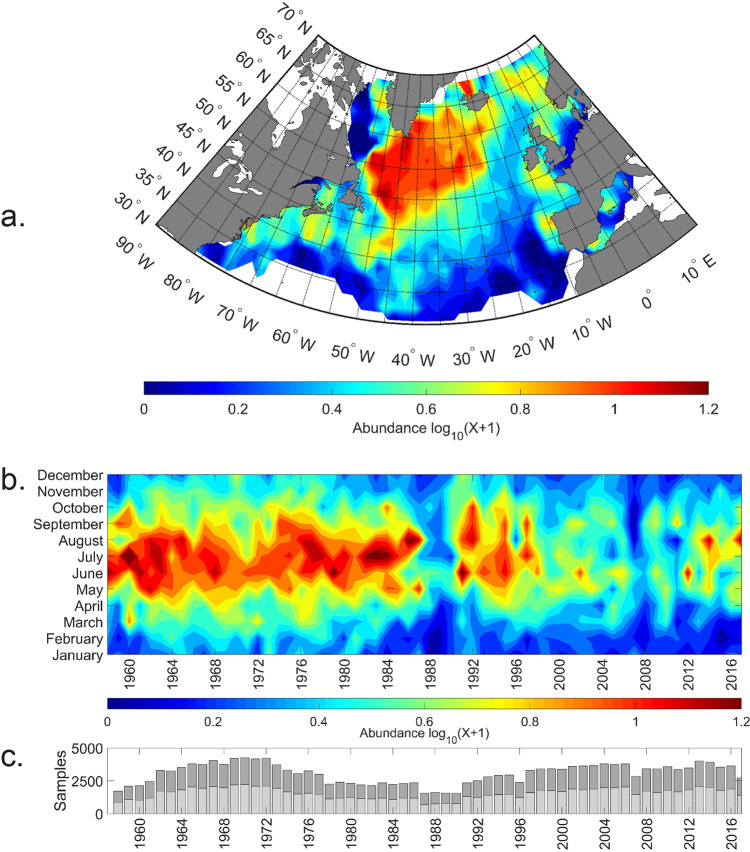
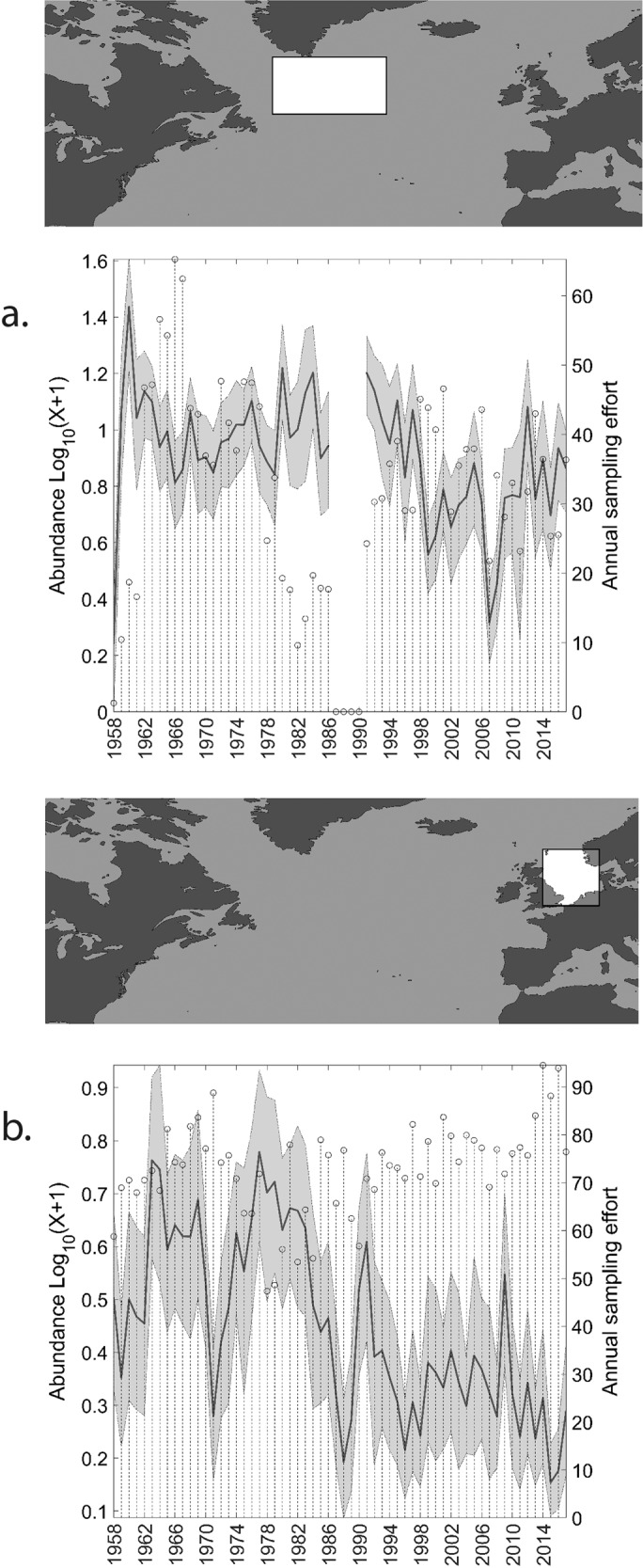
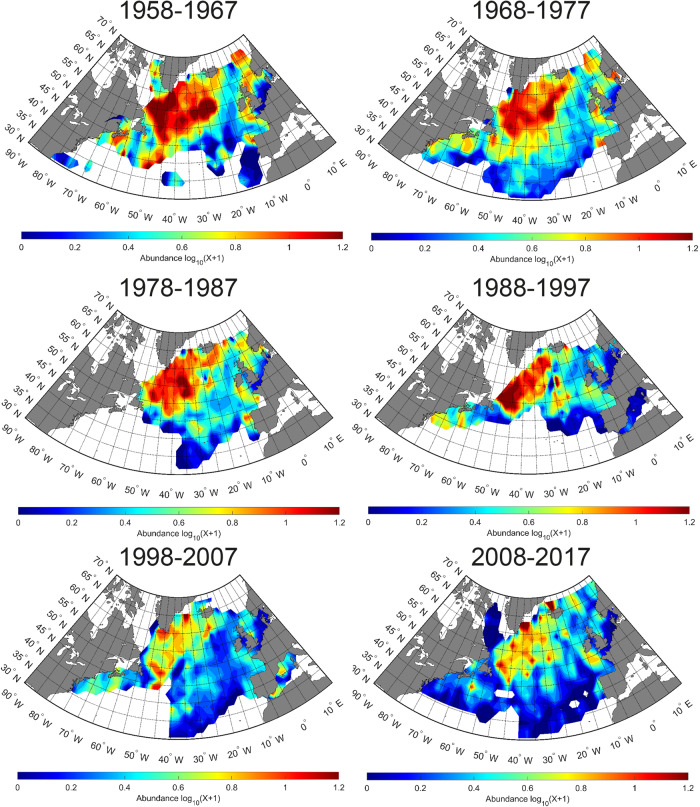
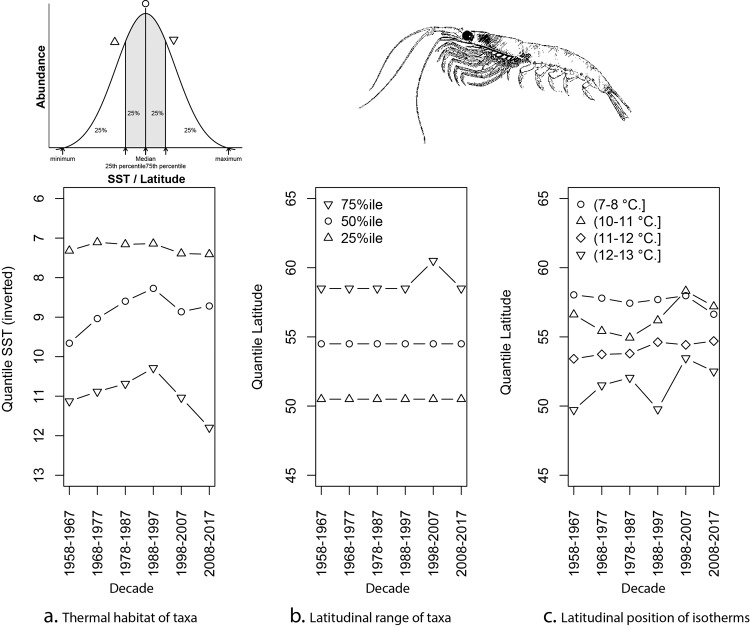
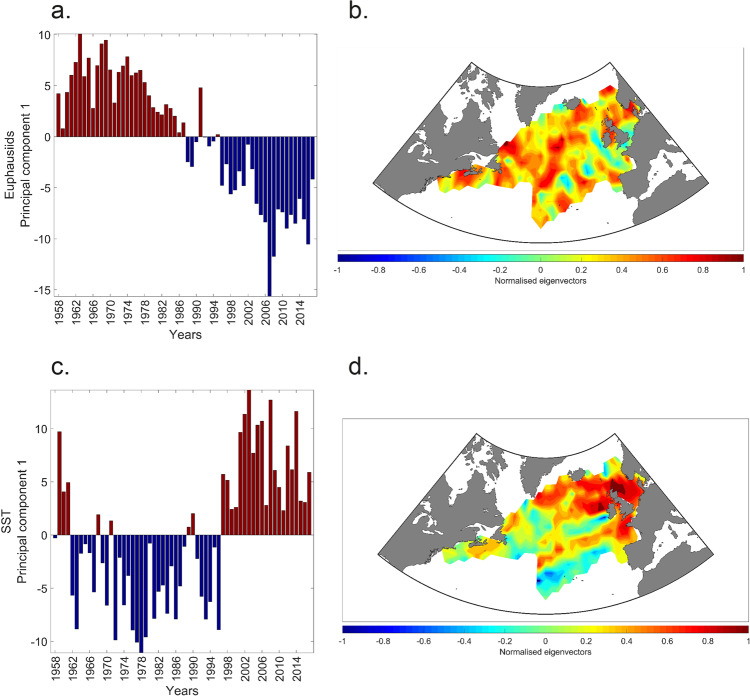
In the North Atlantic, euphausiids (krill) form a major link between primary production and predators including commercially exploited fish. This basin is warming very rapidly, with species expected to shift northwards following their thermal tolerances. Here we show, however, that there has been a 50% decline in surface krill abundance over the last 60 years that occurred in situ, with no associated range shift. While we relate these changes to the warming climate, our study is the first to document an in situ squeeze on living space within this system. The warmer isotherms are shifting measurably northwards but cooler isotherms have remained relatively static, stalled by the subpolar fronts in the NW Atlantic. Consequently the two temperatures defining the core of krill distribution (7-13 °C) were 8° of latitude apart 60 years ago but are presently only 4° apart. Over the 60 year period the core latitudinal distribution of euphausiids has remained relatively stable so a 'habitat squeeze', with loss of 4° of latitude in living space, could explain the decline in krill. This highlights that, as the temperature warms, not all species can track isotherms and shift northward at the same rate with both losers and winners emerging under the 'Atlantification' of the sub-Arctic.
在北大西洋,磷虾(糠虾)形成了初级生产力和包括商业开发鱼类在内的捕食者之间的主要联系。这个盆地正在迅速升温,预计随着物种的耐热性变化,它们会向北迁移。然而,我们在这里表明,在过去的 60 年里,该海域的表层磷虾数量已经减少了 50%,而且没有出现相关的分布范围转移。虽然我们将这些变化与气候变暖联系起来,但我们的研究首次记录了该系统内生物生存空间的原位挤压。变暖的等水温线正在向北移动,但较冷的等水温线相对静止,被北大西洋西北部的亚极地锋阻挡。因此,60 年前定义磷虾分布核心的两个温度(7-13°C)相差 8 个纬度,但现在仅相差 4 个纬度。在过去的 60 年里,磷虾的核心纬度分布相对稳定,因此“栖息地挤压”,即生物生存空间减少了 4 个纬度,可能解释了磷虾数量的减少。这表明,随着温度的升高,并非所有物种都能跟踪等水温线,以相同的速度向北迁移,在亚北极地区的“大西洋化”下,既有输家也有赢家。