Department of Cardiology, Fuwai Hospital, National Center for Cardiovascular Diseases, Chinese Academy of Medical Sciences and Peking Union Medical College, Beijing, China.
Clin Cardiol. 2021 Jul;44(7):1011-1018. doi: 10.1002/clc.23650. Epub 2021 Jun 1.
Little is known about risk stratification in patients with myocardial infarction with nonobstructive coronary arteries (MINOCA). We investigated whether the age, creatinine, and ejection fraction (ACEF) score (age [years]/ejection fraction [%] + 1 [if creatinine >176 μmol/L]) might predict long-term outcomes after MINOCA.
The ACEF score enables accurate risk prediction in patients with MINOCA.
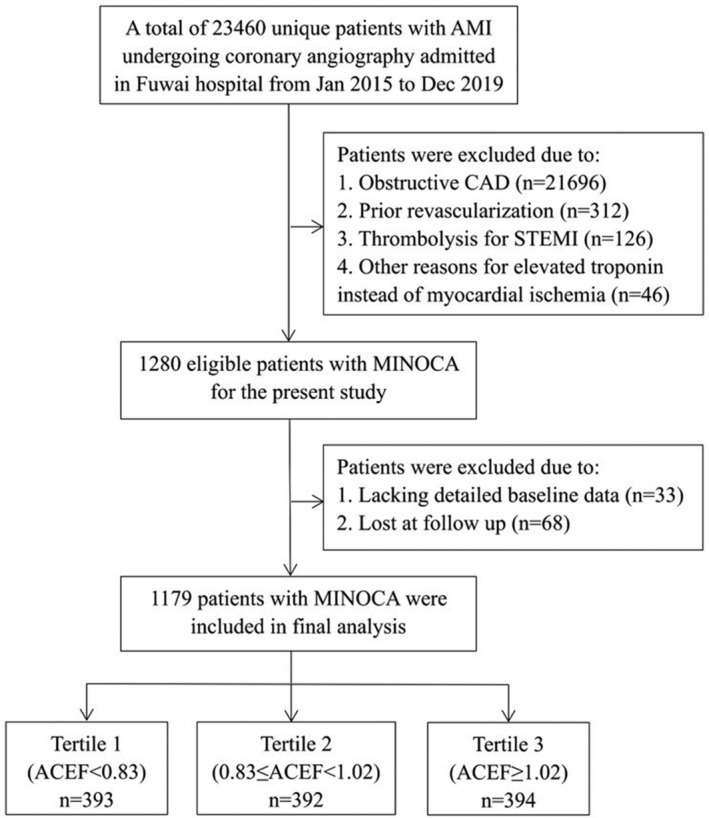
A total of 1179 patients with MINOCA were enrolled and divided based on their ACEF score tertile levels. The primary endpoint was a composite of major adverse cardiovascular events (MACE), including all-cause death, nonfatal MI, nonfatal stroke, revascularization, and hospitalization for unstable angina or heart failure. Kaplan-Meier and Cox regression analyses were performed. Discrimination was defined as the area under the curve (AUC) using receiver operating characteristic analysis.
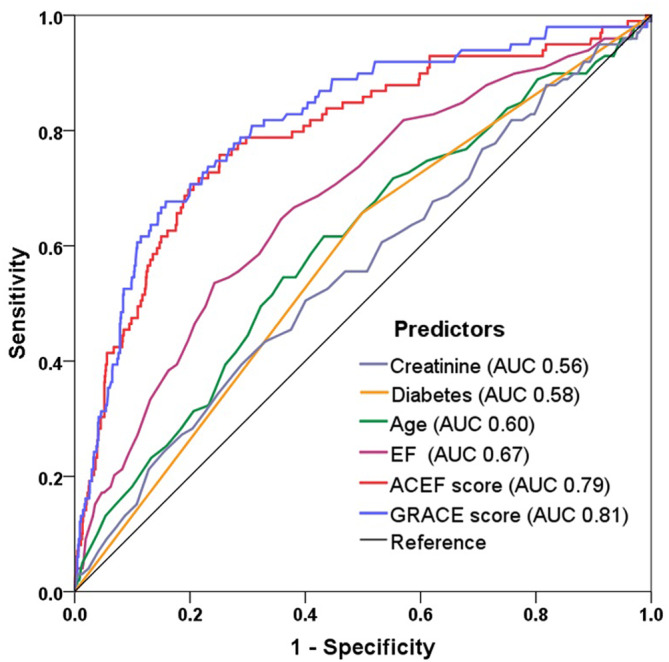
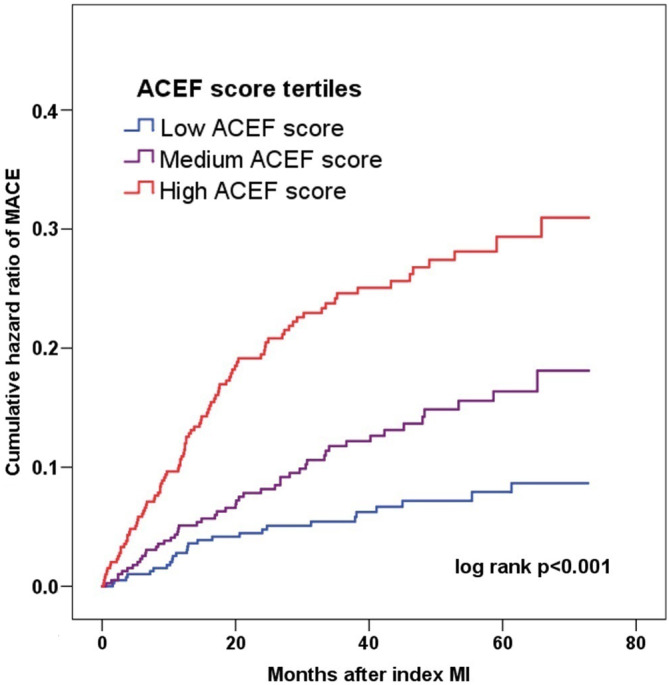
During the median follow-up of 41.7 months, patients with MINOCA with higher ACEF score tertiles had a significantly higher incidence of MACE (6.3%, 12.5%, and 23.8%, respectively; p < .001). The adjusted risk of MACE increased with the rising ACEF score tertiles (1st tertile as reference; 2nd tertile: HR 2.70, 95% CI: 1.38-5.29, p = .004; and 3rd tertile: HR 5.35, 95% CI: 2.72-10.51, p < .001). Moreover, an elevated ACEF score was closely associated with an increased risk of MACE overall (HR 4.23, 95% CI: 3.37-5.30, p < .001) and in subgroups (all p < .05). The ACEF score also yielded a good predictive value (AUC 0.79) for MACE.
Elevated ACEF scores were strongly associated with a poor prognosis after MINOCA. This simple and valid risk score may facilitate risk stratification and decision making in the population with MINOCA.
对于非阻塞性冠状动脉心肌梗死(MINOCA)患者的风险分层知之甚少。我们研究了年龄、肌酐和射血分数(ACEF)评分(年龄[岁]/射血分数[%]+1[如果肌酐>176μmol/L])是否可以预测 MINOCA 后的长期结局。
ACEF 评分可准确预测 MINOCA 患者的风险。
共纳入 1179 例 MINOCA 患者,根据 ACEF 评分三分位水平进行分组。主要终点是主要不良心血管事件(MACE)的复合终点,包括全因死亡、非致死性心肌梗死、非致死性卒中和血运重建,以及不稳定型心绞痛或心力衰竭住院。进行 Kaplan-Meier 分析和 Cox 回归分析。采用受试者工作特征曲线下面积(AUC)评估区分度。
在中位随访 41.7 个月期间,ACEF 评分较高三分位的 MINOCA 患者 MACE 的发生率显著更高(分别为 6.3%、12.5%和 23.8%;p<0.001)。随着 ACEF 评分三分位的升高,MACE 的调整风险也随之增加(以第 1 三分位为参照;第 2 三分位:HR 2.70,95%CI:1.38-5.29,p=0.004;第 3 三分位:HR 5.35,95%CI:2.72-10.51,p<0.001)。此外,升高的 ACEF 评分与 MACE 的整体风险增加密切相关(HR 4.23,95%CI:3.37-5.30,p<0.001),且在各亚组中也是如此(均 p<0.05)。ACEF 评分对 MACE 也具有良好的预测价值(AUC 0.79)。
升高的 ACEF 评分与 MINOCA 后不良预后密切相关。这种简单有效的风险评分有助于对 MINOCA 患者进行风险分层和决策。