Department of Cardiology, Fuwai Hospital, National Center for Cardiovascular Diseases, Chinese Academy of Medical Sciences and Peking Union Medical College, Beijing, China.
Ann Med. 2021 Dec;53(1):741-749. doi: 10.1080/07853890.2021.1931428.
Low triiodothyronine syndrome (LT3S), frequently seen in patients with acute myocardial infarction (AMI), has been regarded as a predictor of poor outcomes after AMI. However, little is known about the prognostic value of LT3S in euthyroid patients with myocardial infarction with nonobstructive coronary arteries (MINOCA).
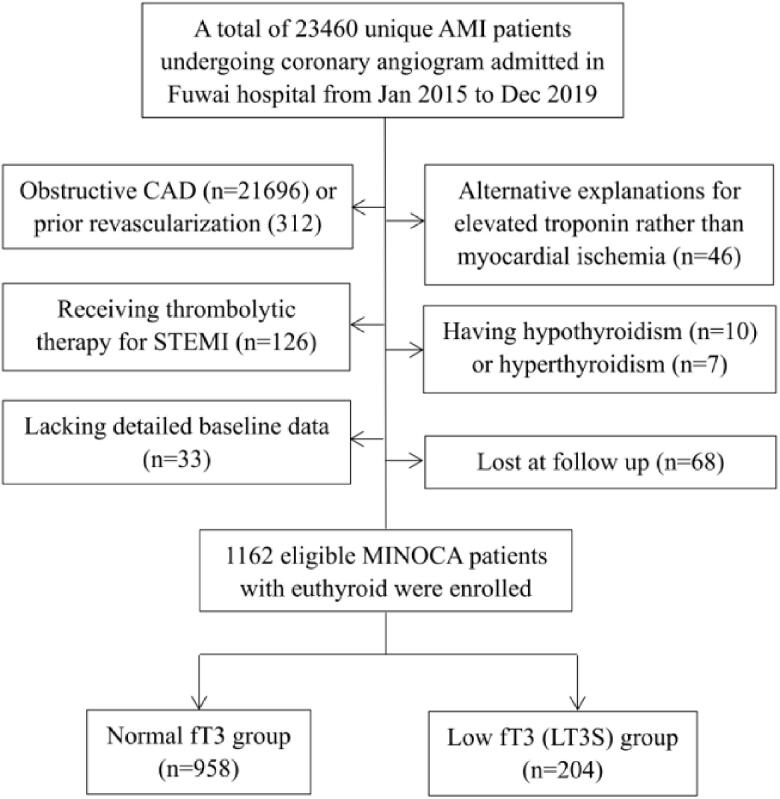
A total of 1162 MINOCA patients were enrolled and divided into LT3S and no-LT3S groups. LT3S was defined as decreased free T3 (fT3 < 2.36 pg/mL) with normal values of thyroid-stimulating hormone. The primary endpoint was a composite of major adverse cardiovascular events (MACE), including all-cause death, nonfatal MI, stroke, revascularization, and hospitalization for unstable angina or heart failure. Kaplan-Meier, Cox regression, propensity score matching (PSM), and receiver-operating characteristic analyses were performed.
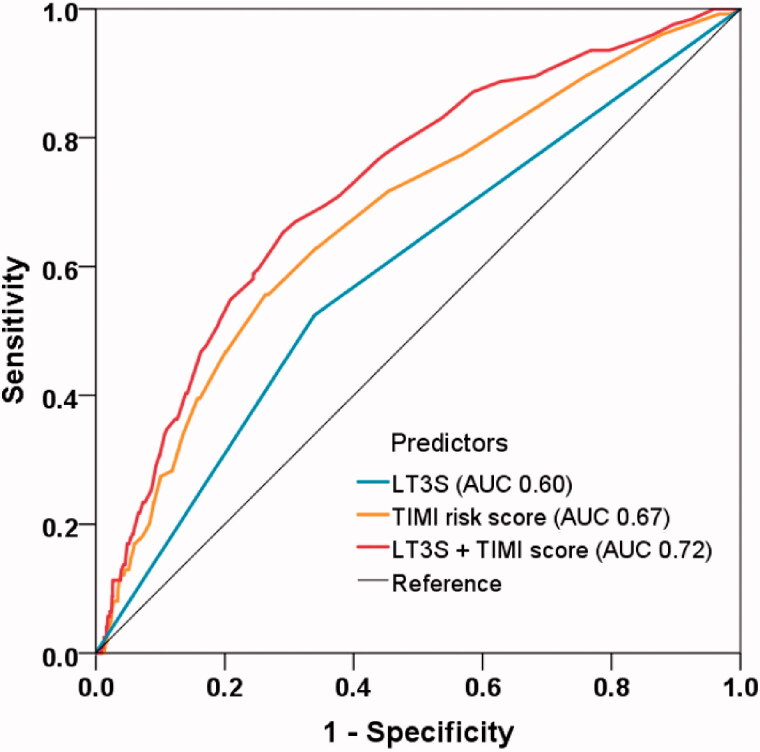
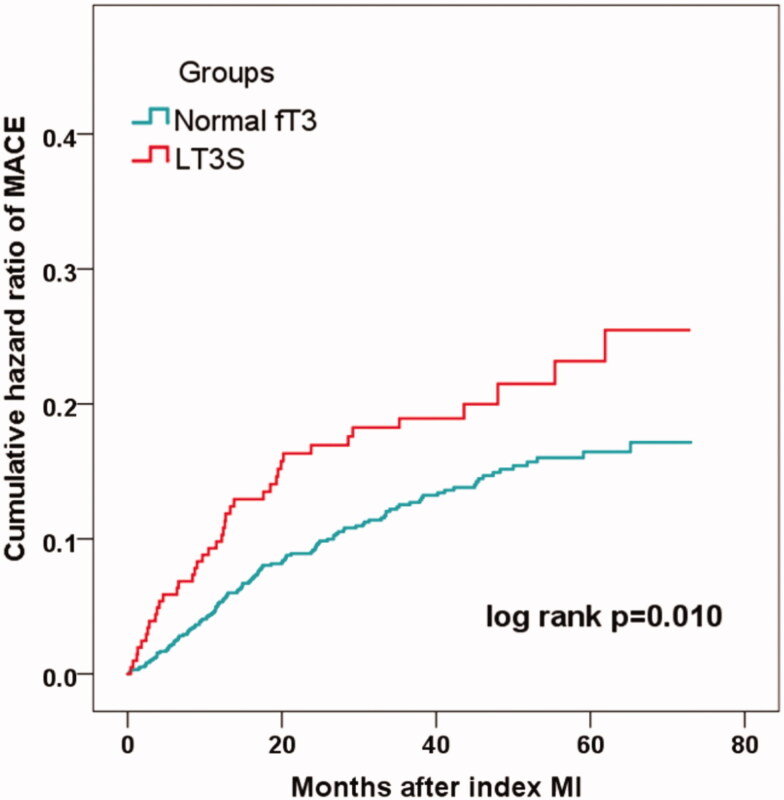
Patients with LT3S (prevalence of 17.5%) had a significantly higher incidence of MACE (19.6% vs. 12.9%; = .013) than patients without during the median follow-up of 41.7 months. LT3S was closely associated with an increased risk of MACE even after multivariable adjustment (HR 1.50, 95% CI: 1.03-2.18, = .037). After PSM, 197 pairs of patients with or without LT3S were identified, and LT3S remained a robust risk factor of worse outcomes (HR 1.53, 95% CI: 1.02-2.65, = .042). Moreover, LT3S had an area under the curve (AUC) of 0.60 for predicting MACE. When adding LT3S to the thrombolysis in myocardial infarction (TIMI) risk score, the combined model yielded a significant improvement in discrimination for MACE.
LT3S was independently associated with poor outcomes after MINOCA. Routine assessment of LT3S may provide valuable prognostic information in this specific population.
低三碘甲状腺原氨酸综合征(LT3S)在急性心肌梗死(AMI)患者中很常见,被认为是 AMI 后预后不良的预测因素。然而,对于非阻塞性冠状动脉心肌梗死(MINOCA)的甲状腺功能正常的心肌梗死患者,LT3S 的预后价值知之甚少。
共纳入 1162 例 MINOCA 患者,分为 LT3S 组和非 LT3S 组。LT3S 定义为游离三碘甲状腺原氨酸(fT3)降低(<2.36pg/mL),而甲状腺刺激激素正常。主要终点是主要不良心血管事件(MACE)的复合终点,包括全因死亡、非致死性心肌梗死、卒中和血运重建,以及不稳定型心绞痛或心力衰竭住院。采用 Kaplan-Meier、Cox 回归、倾向评分匹配(PSM)和受试者工作特征分析。
LT3S 组(患病率为 17.5%)的 MACE 发生率(19.6%比 12.9%;=0.013)显著高于非 LT3S 组,中位随访时间为 41.7 个月。即使在多变量调整后,LT3S 与 MACE 风险增加密切相关(HR 1.50,95%CI:1.03-2.18,=0.037)。经过 PSM 后,共匹配了 197 对有或没有 LT3S 的患者,LT3S 仍然是预后不良的一个强有力的危险因素(HR 1.53,95%CI:1.02-2.65,=0.042)。此外,LT3S 对预测 MACE 的曲线下面积(AUC)为 0.60。当将 LT3S 加入到心肌梗死溶栓治疗(TIMI)风险评分中时,联合模型对 MACE 的预测能力显著提高。
LT3S 与 MINOCA 后不良结局独立相关。在这一特定人群中,常规评估 LT3S 可能提供有价值的预后信息。