Department of Infectious Diseases, Genentech, Inc., South San Francisco, California, USA.
Department of Biochemical and Cellular Pharmacology, Genentech, Inc., South San Francisco, California, USA.
mBio. 2021 Jun 29;12(3):e0020221. doi: 10.1128/mBio.00202-21. Epub 2021 Jun 1.
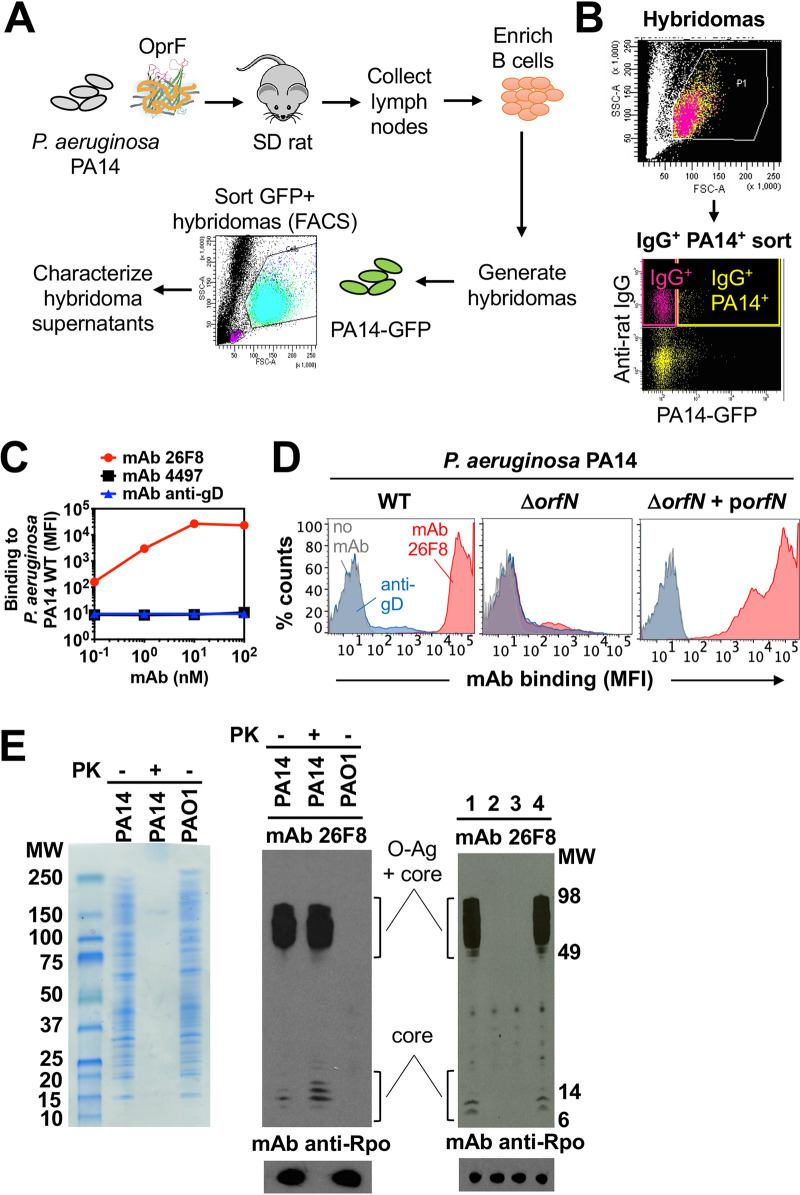
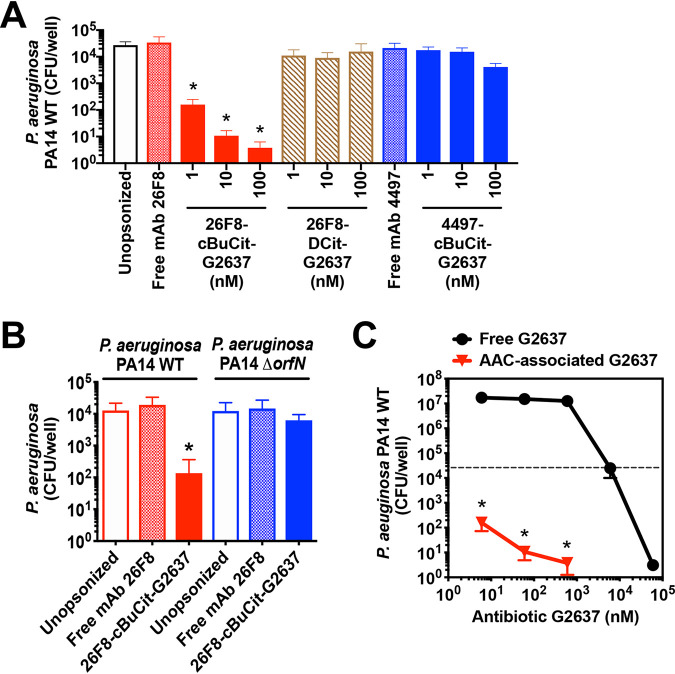
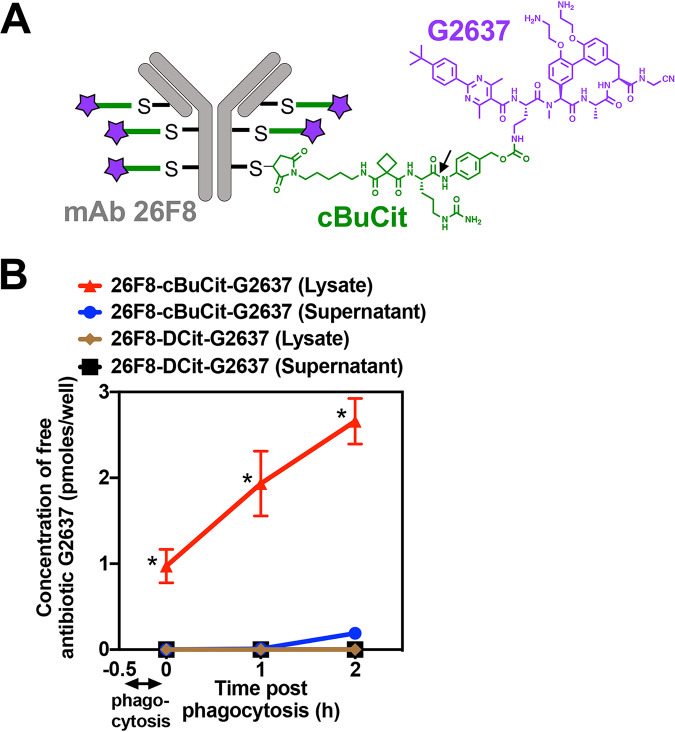
Pseudomonas aeruginosa causes life-threatening infections that are associated with antibiotic failure. Previously, we identified the antibiotic G2637, an analog of arylomycin, targeting bacterial type I signal peptidase, which has moderate potency against P. aeruginosa. We hypothesized that an antibody-antibiotic conjugate (AAC) could increase its activity by colocalizing P. aeruginosa bacteria with high local concentrations of G2637 antibiotic in the intracellular environment of phagocytes. Using a novel technology of screening for hybridomas recognizing intact bacteria, we identified monoclonal antibody 26F8, which binds to lipopolysaccharide O antigen on the surface of P. aeruginosa bacteria. This antibody was engineered to contain 6 cysteines and was conjugated to the G2637 antibiotic via a lysosomal cathepsin-cleavable linker, yielding a drug-to-antibody ratio of approximately 6. The resulting AAC delivered a high intracellular concentration of free G2637 upon phagocytosis of AAC-bound P. aeruginosa by macrophages, and potently cleared viable P. aeruginosa bacteria intracellularly. The molar concentration of AAC-associated G2637 antibiotic that resulted in elimination of bacteria inside macrophages was approximately 2 orders of magnitude lower than the concentration of free G2637 required to eliminate extracellular bacteria. This study demonstrates that an anti-P. aeruginosa AAC can locally concentrate antibiotic and kill P. aeruginosa inside phagocytes, providing additional therapeutic options for antibiotics that are moderately active or have an unfavorable pharmacokinetics or toxicity profile. Antibiotic treatment of life-threatening P. aeruginosa infections is associated with low clinical success, despite the availability of antibiotics that are active in standard microbiological assays, affirming the need for new therapeutic approaches. Antibiotics often fail in the preclinical stage due to insufficient efficacy against P. aeruginosa. One potential strategy is to enhance the local concentration of antibiotics with limited inherent anti-P. aeruginosa activity. This study presents proof of concept for an antibody-antibiotic conjugate, which releases a high local antibiotic concentration inside macrophages upon phagocytosis, resulting in potent intracellular killing of phagocytosed P. aeruginosa bacteria. This approach may provide new therapeutic options for antibiotics that are dose limited.
铜绿假单胞菌引起危及生命的感染,与抗生素治疗失败有关。此前,我们发现了抗生素 G2637,一种芳基霉素类似物,靶向细菌 I 型信号肽酶,对铜绿假单胞菌具有中等活性。我们假设,抗体-抗生素偶联物(AAC)可以通过将铜绿假单胞菌与吞噬细胞内环境中高浓度的 G2637 抗生素共定位,从而增加其活性。我们使用一种识别完整细菌的杂交瘤筛选的新技术,鉴定出了单克隆抗体 26F8,它与铜绿假单胞菌表面的脂多糖 O 抗原结合。该抗体被设计成包含 6 个半胱氨酸,并通过溶酶体组织蛋白酶可切割的接头与 G2637 抗生素偶联,得到的药物与抗体的比值约为 6。当巨噬细胞吞噬结合 AAC 的铜绿假单胞菌时,所得 AAC 会将高浓度的游离 G2637 递送至细胞内,并有效地清除细胞内的存活铜绿假单胞菌。导致巨噬细胞内细菌消除的 AAC 相关 G2637 抗生素的摩尔浓度比消除细胞外细菌所需的游离 G2637 抗生素的浓度低约 2 个数量级。这项研究表明,一种抗铜绿假单胞菌的 AAC 可以在吞噬细胞内局部浓缩抗生素并杀死铜绿假单胞菌,为那些活性适中或药代动力学或毒性特征不理想的抗生素提供了额外的治疗选择。尽管有在标准微生物测定中有效的抗生素,但危及生命的铜绿假单胞菌感染的抗生素治疗成功率仍然很低,这证实了需要新的治疗方法。抗生素在临床前阶段往往因对铜绿假单胞菌的疗效不足而失败。一种潜在的策略是用有限的固有抗铜绿假单胞菌活性来增强抗生素的局部浓度。本研究为抗体-抗生素偶联物提供了概念验证,该偶联物在吞噬作用时在巨噬细胞内释放高浓度的局部抗生素,从而有效地杀死吞噬的铜绿假单胞菌。这种方法可能为那些剂量受限的抗生素提供新的治疗选择。