Department of Veterinary Surgery and Animal Reproduction, School of Veterinary Medicine and Animal Science, São Paulo State University (UNESP), Botucatu, São Paulo, Brazil.
The Royal (Dick) School of Veterinary Studies and The Roslin Institute, The University of Edinburgh, Midlothian, United Kingdom.
PLoS One. 2021 Jun 1;16(6):e0251909. doi: 10.1371/journal.pone.0251909. eCollection 2021.
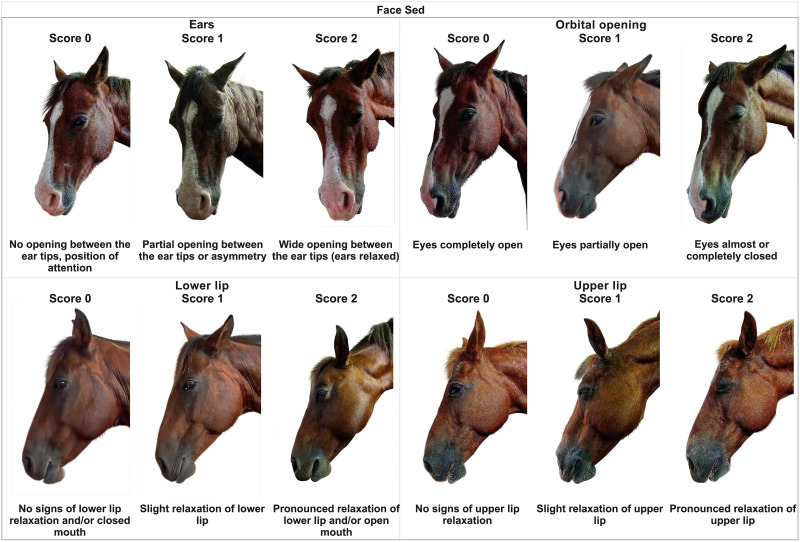
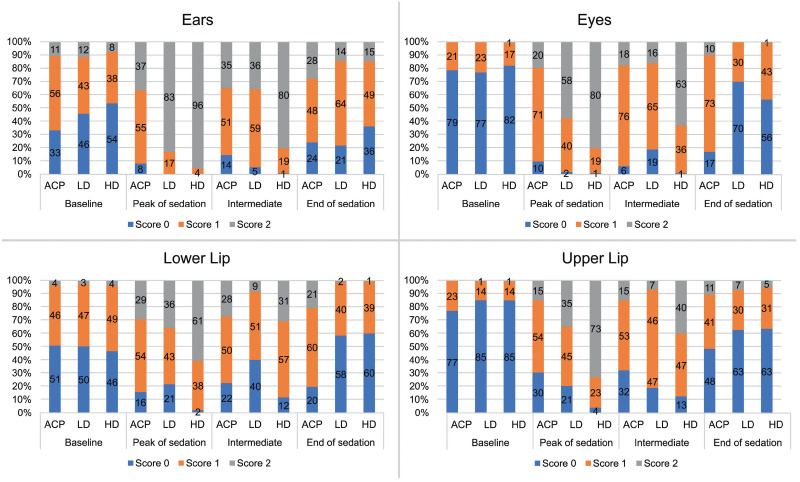
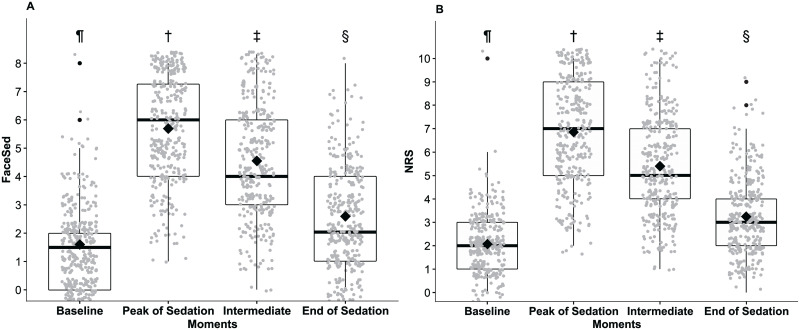
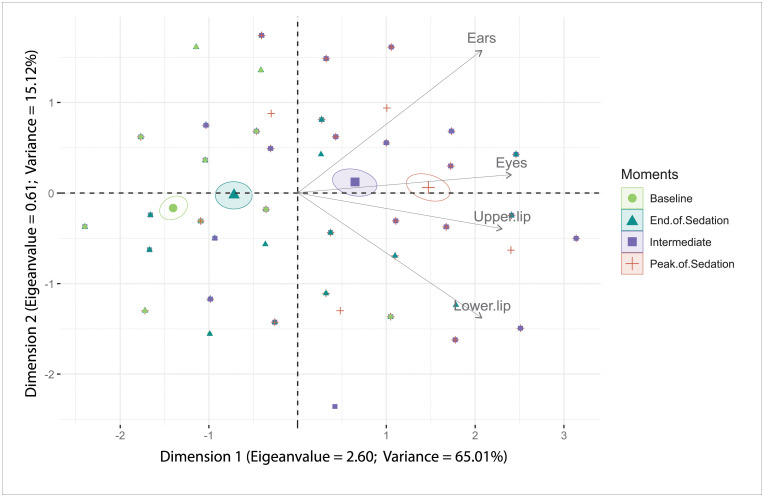
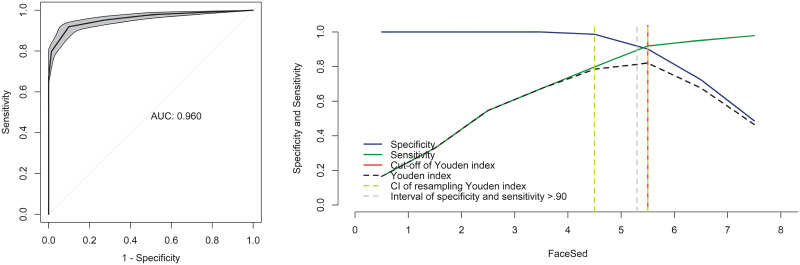
Although facial characteristics are used to estimate horse sedation, there are no studies measuring their reliability and validity. This randomised controlled, prospective, horizontal study aimed to validate a facial sedation scale for horses (FaceSed). Seven horses received detomidine infusion i.v. in low or high doses/rates alone (DL 2.5 μg/kg+6.25 μg/kg/h; DH 5 μg/kg+12.5 μg/kg/h) or combined with methadone (DLM and DHM, 0.2 mg/kg+0.05 mg/kg/h) for 120 min, or acepromazine boli i.v. in low (ACPL 0.02 mg/kg) or high doses (ACPH 0.09 mg/kg). Horses' faces were photographed at i) baseline, ii) peak, iii) intermediate, and iv) end of sedation. After randomisation of moments and treatments, photos were sent to four evaluators to assess the FaceSed items (ear position, orbital opening, relaxation of the lower and upper lip) twice, within a one-month interval. The intraclass correlation coefficient of intra- and interobserver reliability of FaceSed scores were good to very good (0.74-0.94) and moderate to very good (0.57-0.87), respectively. Criterion validity based on Spearman correlation between the FaceSed versus the numerical rating scale and head height above the ground were 0.92 and -0.75, respectively. All items and the FaceSed total score showed responsiveness (construct validity). According to the principal component analysis all FaceSed items had load factors >0.50 at the first dimension. The high internal consistency (Cronbach´s α = 0.83) indicated good intercorrelation among items. Item-total Spearman correlation was adequate (rho 0.3-0.73), indicating homogeneity of the scale. All items showed sensitivity (0.82-0.97) to detect sedation, however only orbital opening (0.79) and upper lip relaxation (0.82) were specific to detect absence of sedation. The limitations were that the facial expression was performed using photos, which do not represent the facial movement and the horses were docile, which may have reduced specificity. The FaceSed is a valid and reliable tool to assess tranquilisation and sedation in horses.
虽然面部特征被用于评估马镇静,但目前还没有研究测量其可靠性和有效性。本随机对照、前瞻性、水平研究旨在验证一种用于马匹的面部镇静评分量表(FaceSed)。七匹马单独接受静脉内注射低或高剂量/速率的氯胺酮(DL 2.5 μg/kg+6.25 μg/kg/h;DH 5 μg/kg+12.5 μg/kg/h)或与美沙酮联合(DLM 和 DHM,0.2 mg/kg+0.05 mg/kg/h)120 分钟,或静脉内注射低剂量(ACPL 0.02 mg/kg)或高剂量(ACPH 0.09 mg/kg)的乙酰丙嗪。在镇静的 i)基线、ii)峰值、iii)中间和 iv)结束时,对马匹的面部进行拍照。在随机化时刻和处理后,将照片发送给四位评估员,在一个月的间隔内两次评估 FaceSed 项目(耳朵位置、眼眶张开、下唇和上唇松弛)。FaceSed 评分的观察者内和观察者间可靠性的组内相关系数为良好至非常好(0.74-0.94)和中度至非常好(0.57-0.87)。基于 FaceSed 与数字评分量表和头部离地高度之间的 Spearman 相关性的效标效度分别为 0.92 和-0.75。所有项目和 FaceSed 总分均表现出反应性(结构效度)。根据主成分分析,在第一维度,所有 FaceSed 项目的负荷因素均大于 0.50。高内部一致性(Cronbach's α = 0.83)表明项目之间的相关性良好。项目-总分的 Spearman 相关系数适中(rho 0.3-0.73),表明量表的同质性。所有项目均显示出检测镇静的敏感性(0.82-0.97),但只有眼眶张开(0.79)和上唇松弛(0.82)对检测无镇静具有特异性。局限性在于,面部表情是通过照片进行的,这不能代表面部运动,而且马匹温顺,这可能降低了特异性。FaceSed 是一种评估马匹镇静和镇静的有效且可靠的工具。