Institute of Medical Physics, Friedrich-Alexander University of Erlangen-Nürnberg, 91054 Erlangen, Germany.
Department of Medicine III, Friedrich-Alexander University of Erlangen-Nürnberg, University Hospital Erlangen, Ulmenweg 18, 91054 Erlangen, Germany.
Nutrients. 2021 May 1;13(5):1528. doi: 10.3390/nu13051528.
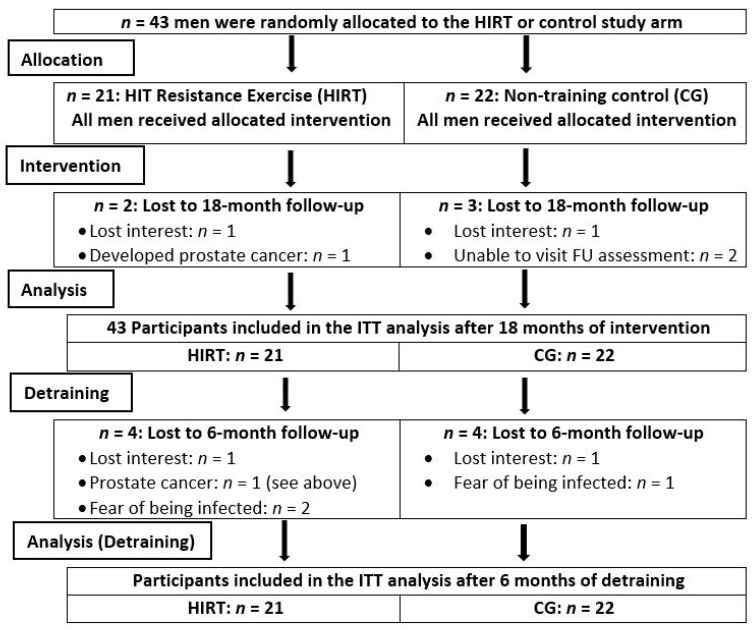
The present study aimed to determine the effect of detraining on muscle quality (MQ) in older men with osteosarcopenia. Forty-three community-dwelling older men (78 ± 4 years) were randomly allocated to a consistently supervised high-intensity resistance exercise training (HIRT) group ( = 21) or a control group (CG, = 22). The HIRT scheduled a periodized single set protocol twice weekly. After the intervention, the men were subjected to six months of detraining. Muscle quality (MQ), defined as maximum isokinetic hip/leg extensor strength per unit of mid-thigh intra-fascia volume, was determined by magnetic resonance imaging (MRI) or per unit of thigh muscle mass assessed by dual-energy X-ray absorptiometry (DXA). Intention-to-treat analysis with multiple imputations was applied. We observed significant exercise effects for MQ ( = 0.001). During detraining, the HIRT group lost about one-third of the intervention-induced gain and displayed significantly ( = 0.001) higher MQ reductions compared to the CG. Nevertheless, after training and detraining, the overall intervention effect on MQ remained significant ( ≤ 0.004). In summary, six months of absence from HIRT induce a significant deleterious effect on MQ in older osteosarcopenic men. We conclude that intermitted training programs with training breaks of six months and longer should be replaced by largely continuous exercise programs, at least when addressing MQ parameters.
本研究旨在确定去训练(detraining)对患有骨质疏松-肌少症的老年男性肌肉质量(MQ)的影响。43 名居住在社区的老年男性(78 ± 4 岁)被随机分配到持续监督的高强度阻力训练(HIRT)组(n = 21)或对照组(CG,n = 22)。HIRT 计划每周进行两次周期性单组方案。干预结束后,这些男性进行了六个月的去训练。肌肉质量(MQ)定义为单位大腿中段筋膜内体积的最大等速髋关节/腿部伸展力量,通过磁共振成像(MRI)或双能 X 射线吸收法(DXA)评估单位大腿肌肉质量来确定。采用意向治疗分析和多重插补法。我们观察到 MQ 存在显著的运动效应( = 0.001)。在去训练期间,HIRT 组失去了大约三分之一的干预引起的增益,并且与 CG 相比,MQ 减少的幅度显著更大( = 0.001)。尽管如此,在训练和去训练后,对 MQ 的整体干预效果仍然显著( ≤ 0.004)。综上所述,六个月不进行 HIRT 会对老年骨质疏松-肌少症男性的 MQ 产生显著的有害影响。我们得出结论,训练间隔为六个月或更长时间的间歇性训练计划应被更大程度的连续运动计划所取代,至少在解决 MQ 参数时是这样。