Hortobágyi Tibor, Vetrovsky Tomas, Brach Jennifer S, van Haren Martijn, Volesky Krystof, Radaelli Regis, Lopez Pedro, Granacher Urs
Department of Kinesiology, Hungarian University of Sports Science, Budapest, Hungary.
Institute of Sport Sciences and Physical Education, University of Pécs, Pecs, Hungary.
Sports Med Open. 2023 Jun 6;9(1):41. doi: 10.1186/s40798-023-00585-5.
The quantity and quality of skeletal muscle are important determinants of daily function and metabolic health. Various forms of physical exercise can improve muscle function, but this effect can be inconsistent and has not been systematically examined across the health-neurological disease continuum. The purpose of this systematic scoping review with meta-analyses was to determine the effects and potential moderators of exercise training on morphological and neuromuscular muscle quality (MMQ, NMQ) in healthy older individuals. In addition and in the form of a scoping review, we examined the effects of exercise training on NMQ and MMQ in individuals with neurological conditions.
A systematic literature search was performed in the electronic databases Medline, Embase, and Web of Science. Randomized controlled trials were included that examined the effects of exercise training on muscle quality (MQ) in older individuals with and without neurological conditions. Risk of bias and study quality were assessed (Cochrane Risk of Bias Tool 2.0). We performed random-effects models using robust variance estimation and tested moderators using the approximate Hotelling-Zhang test.
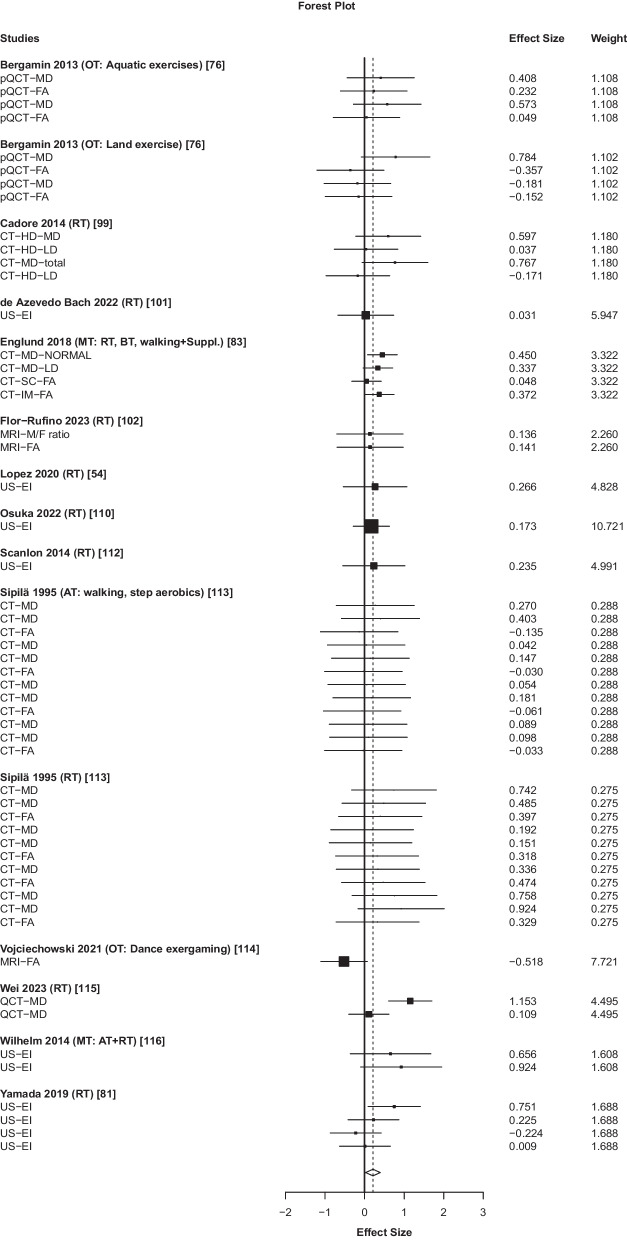
Thirty studies (n = 1494, 34% females) in healthy older individuals and no studies in individuals with neurological conditions were eligible for inclusion. Exercise training had small effects on MMQ (g = 0.21, 95% confidence interval [CI]: 0.03-0.40, p = 0.029). Heterogeneity was low (median I = 16%). Training and demographic variables did not moderate the effects of exercise on MMQ. There was no association between changes in MMQ and changes in functional outcomes. Exercise training improved NMQ (g = 0.68, 95% CI 0.35-1.01, p < 0.000) across all studies, in particular in higher-functioning older individuals (g = 0.72, 95% CI 0.38-1.06, p < 0.001), in lower extremity muscles (g = 0.74, 95% CI 0.35-1.13, p = 0.001), and after resistance training (g = 0.91; 95% CI 0.42-1.41, p = 0.001). Heterogeneity was very high (median I = 79%). Of the training and demographic variables, only resistance training moderated the exercise-effects on NMQ. High- versus low-intensity exercise moderated the exercise-effects on NMQ, but these effects were considered unreliable due to a low number of studies at high intensity. There was no association between changes in NMQ and changes in functional outcomes.
Exercise training has small effects on MMQ and medium-large effects on NMQ in healthy older individuals. There was no association between improvements in MQ and increases in muscle strength, mobility, and balance. Information on dose-response relations following training is currently lacking. There is a critical gap in muscle quality data for older individuals with lower function and neurological conditions after exercise training. Health practitioners should use resistance training to improve muscle function in older individuals. Well-designed studies are needed to examine the relevance of exercise training-induced changes in MQ in daily function in older individuals, especially to those with lower function and neurological conditions.
骨骼肌的数量和质量是日常功能和代谢健康的重要决定因素。各种形式的体育锻炼可以改善肌肉功能,但这种效果可能并不一致,且尚未在健康 - 神经疾病连续体中进行系统研究。本系统综述及荟萃分析的目的是确定运动训练对健康老年人形态学和神经肌肉质量(MMQ,NMQ)的影响及潜在调节因素。此外,作为综述的一部分,我们研究了运动训练对患有神经系统疾病个体的NMQ和MMQ的影响。
在电子数据库Medline、Embase和Web of Science中进行了系统的文献检索。纳入了研究运动训练对有或无神经系统疾病的老年人肌肉质量(MQ)影响的随机对照试验。评估了偏倚风险和研究质量(Cochrane偏倚风险工具2.0)。我们使用稳健方差估计进行随机效应模型,并使用近似Hotelling - Zhang检验测试调节因素。
30项针对健康老年人的研究(n = 1494,34%为女性)符合纳入标准,没有针对患有神经系统疾病个体的研究符合标准。运动训练对MMQ有较小影响(g = 0.21,95%置信区间[CI]:0.03 - 0.40,p = 0.029)。异质性较低(中位数I² = 16%)。训练和人口统计学变量并未调节运动对MMQ的影响。MMQ的变化与功能结局的变化之间没有关联。在所有研究中,运动训练改善了NMQ(g = 0.68,95% CI 0.35 - 1.01,p < 0.000),特别是在功能较高的老年人中(g = 0.72,95% CI 0.38 - 1.06,p < 0.001),在下肢肌肉中(g = 0.74,95% CI 0.35 - 1.13,p = 0.001),以及在进行阻力训练后(g = 0.91;95% CI 0.42 - 1.41,p = 0.001)。异质性非常高(中位数I² = 79%)。在训练和人口统计学变量中,只有阻力训练调节了运动对NMQ的影响。高强度与低强度运动调节了运动对NMQ的影响,但由于高强度研究数量较少,这些影响被认为不可靠。NMQ的变化与功能结局的变化之间没有关联。
运动训练对健康老年人的MMQ有较小影响,对NMQ有中等至较大影响。MQ的改善与肌肉力量、活动能力和平衡的增加之间没有关联。目前缺乏训练后剂量 - 反应关系的信息。对于功能较低和患有神经系统疾病的老年人,运动训练后肌肉质量数据存在关键空白。健康从业者应使用阻力训练来改善老年人的肌肉功能。需要精心设计的研究来检验运动训练引起的MQ变化在老年人日常功能中的相关性,特别是对于功能较低和患有神经系统疾病的老年人。