Han Kaiyi, Francis Mark R, Zhang Ruiyun, Wang Qian, Xia Aichen, Lu Linyao, Yang Bingyi, Hou Zhiyuan
School of Public Health, Fudan University, Shanghai 200032, China.
Department of Infectious Disease Epidemiology, London School of Hygiene & Tropical Medicine, London WC1E 7HT, UK.
Vaccines (Basel). 2021 May 2;9(5):443. doi: 10.3390/vaccines9050443.
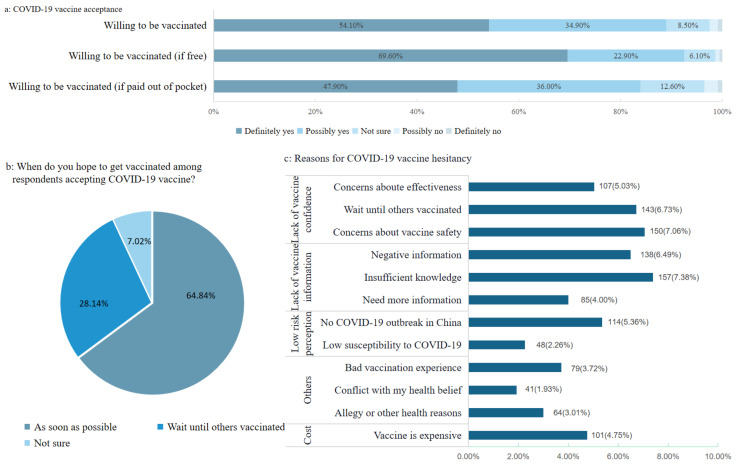
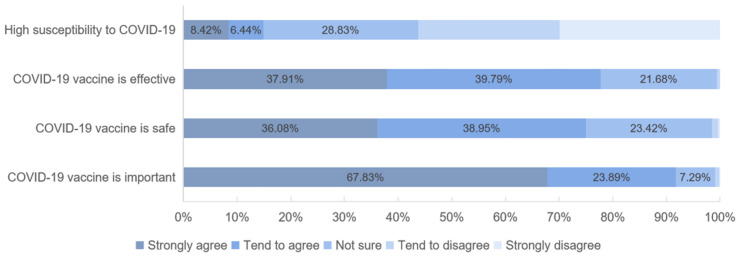
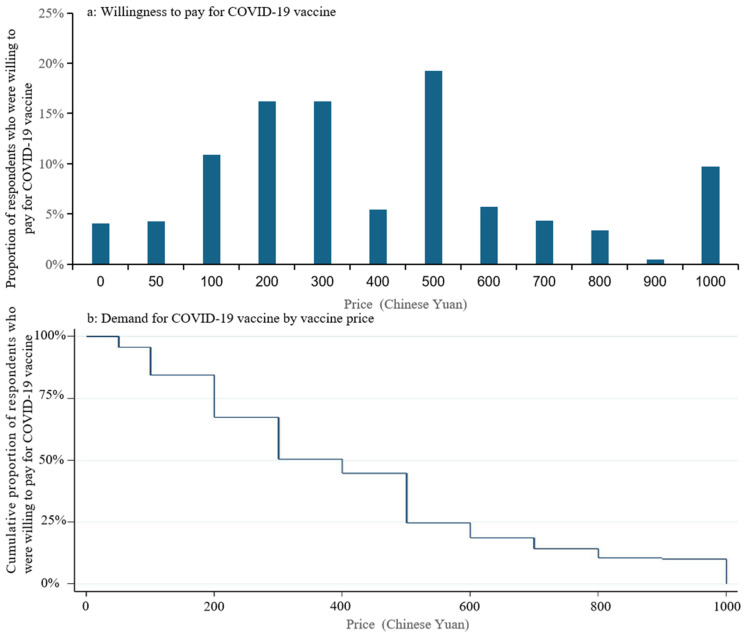
Understanding the public's attitude towards COVID-19 vaccination and their acceptance could help facilitate the COVID-19 rollout. This study aimed to assess the acceptance and willingness to pay (WTP) for the COVID-19 vaccine among migrants in Shanghai, China. A cross-sectional study was conducted among 2126 migrants in Shanghai for the period 1-20 November 2020. Convenience sampling was used to recruit respondents in workplaces with large numbers of migrant workers. Multivariable (ordered) logistic regressions were used to examine factors associated with acceptance and WTP of the COVID-19 vaccine. Most (89.1%) migrants would accept COVID-19 vaccination. Over 90.0% perceived the COVID-19 vaccine as important, while only 75.0% and 77.7% perceived vaccines safe and effective. Socio-demographic factors were not significantly associated with vaccine acceptance, but confidence in the importance (OR 8.71, 95% CI 5.89-12.89), safety (OR 1.80, 95% CI 1.24-2.61) and effectiveness (OR 2.66, 95% CI 1.83-3.87) of COVID-19 vaccine was significantly positively associated with vaccine acceptance. The top reasons for vaccine hesitancy were lack of vaccine information and confidence. The proportion of those definitely willing to get the COVID-19 vaccine was 20% lower if paid by themselves than free vaccination. Migrants were willing to pay a median amount of USD 46 for the COVID-19 vaccine. Results show that a high acceptance of the COVID-19 vaccine was universal among migrants in Shanghai. Concerns about vaccine safety, effectiveness and high costs of the COVID-19 vaccine may hinder their uptake. Effective health communication to build confidence in the COVID-19 vaccine and subsidies toward the costs of these vaccines are needed to improve uptake.
了解公众对新冠疫苗接种的态度及其接受程度有助于推动新冠疫苗的推广。本研究旨在评估中国上海外来务工人员对新冠疫苗的接受程度及支付意愿。2020年11月1日至20日期间,对上海的2126名外来务工人员进行了一项横断面研究。采用便利抽样法在有大量外来务工人员的工作场所招募受访者。使用多变量(有序)逻辑回归分析来研究与新冠疫苗接受程度和支付意愿相关的因素。大多数(89.1%)外来务工人员愿意接种新冠疫苗。超过90.0%的人认为新冠疫苗很重要,而只有75.0%和77.7%的人认为疫苗安全且有效。社会人口学因素与疫苗接受程度无显著关联,但对新冠疫苗重要性(比值比8.71,95%置信区间5.89 - 12.89)、安全性(比值比1.80,95%置信区间1.24 - 2.61)和有效性(比值比2.66,95%置信区间1.83 - 3.87)的信心与疫苗接受程度显著正相关。疫苗犹豫的主要原因是缺乏疫苗信息和信心。如果自费接种,明确愿意接种新冠疫苗的比例比免费接种低20%。外来务工人员愿意为新冠疫苗支付的中位数金额为46美元。结果表明,上海的外来务工人员对新冠疫苗的接受程度普遍较高。对新冠疫苗安全性、有效性和高成本的担忧可能会阻碍其接种。需要进行有效的健康宣传以增强对新冠疫苗的信心,并对这些疫苗的费用提供补贴,以提高接种率。