Izuo Naotaka, Nitta Atsumi
Department of Pharmaceutical Therapy and Neuropharmacology, School of Pharmaceutical Sciences, Graduate School of Pharmaceutical Sciences, University of Toyama, 2630 Sugitani, Toyama 930-0194, Japan.
J Pers Med. 2021 May 3;11(5):371. doi: 10.3390/jpm11050371.
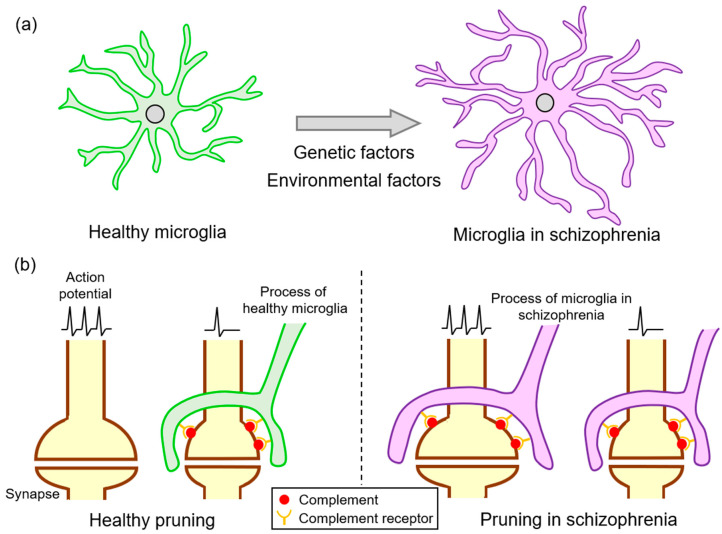
Schizophrenia is a common psychiatric disorder that usually develops during adolescence and young adulthood. Since genetic and environmental factors are involved in the disease, the molecular status of the pathology of schizophrenia differs across patients. Recent genetic studies have focused on the association between schizophrenia and the immune system, especially microglia-synapse interactions. Microglia physiologically eliminate unnecessary synapses during the developmental period. The overactivation of synaptic pruning by microglia is involved in the pathology of brain disease. This paper focuses on the synaptic pruning function and its molecular machinery and introduces the hypothesis that excessive synaptic pruning plays a role in the development of schizophrenia. Finally, we suggest a strategy for diagnosis and medication based on modulation of the interaction between microglia and synapses. This review provides updated information on the involvement of the immune system in schizophrenia and proposes novel insights regarding diagnostic and therapeutic strategies for this disease.
精神分裂症是一种常见的精神障碍,通常在青春期和青年期发病。由于遗传和环境因素都与该疾病有关,精神分裂症病理的分子状态在不同患者中存在差异。最近的遗传学研究聚焦于精神分裂症与免疫系统之间的关联,尤其是小胶质细胞与突触的相互作用。小胶质细胞在发育阶段会生理性地清除不必要的突触。小胶质细胞对突触修剪的过度激活与脑部疾病的病理过程有关。本文重点关注突触修剪功能及其分子机制,并提出过度的突触修剪在精神分裂症发展过程中起作用的假说。最后,我们基于调节小胶质细胞与突触之间的相互作用,提出了一种诊断和用药策略。这篇综述提供了关于免疫系统在精神分裂症中所起作用的最新信息,并针对该疾病的诊断和治疗策略提出了新的见解。