
肿瘤微环境中的JNK:当前研究成果及临床转化面临的挑战
JNK in Tumor Microenvironment: Present Findings and Challenges in Clinical Translation.
作者信息
Tam Shing Yau, Law Helen Ka-Wai
机构信息
Department of Health Technology and Informatics, Faculty of Health and Social Sciences, The Hong Kong Polytechnic University, Kowloon, Hong Kong.
出版信息
Cancers (Basel). 2021 May 3;13(9):2196. doi: 10.3390/cancers13092196.
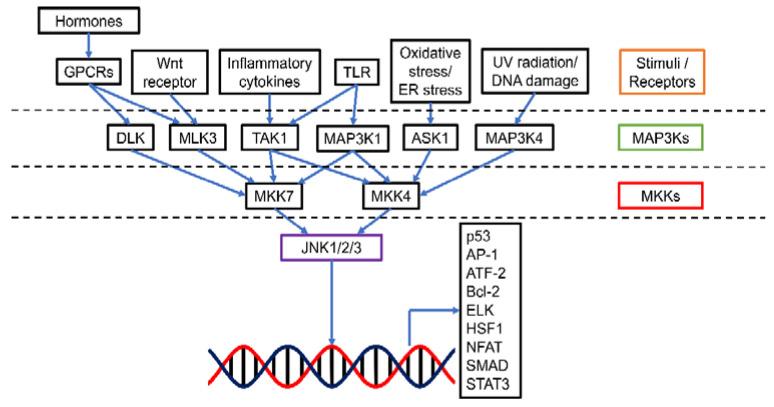
The c-Jun N-terminal kinases (JNKs) are a group of mitogen-activated protein kinases (MAPKs). JNK is mainly activated under stressful conditions or by inflammatory cytokines and has multiple downstream targets for mediating cell proliferation, differentiation, survival, apoptosis, and immune responses. JNK has been demonstrated to have both tumor promoting and tumor suppressing roles in different cancers depending on the focused pathway in each study. JNK also plays complex roles in the heterogeneous tumor microenvironment (TME). JNK is involved in different tumorigenesis pathways. TME closely relates with tumor development and consists of various stressful and chronic inflammatory conditions along with different cell populations, in which the JNK pathway may have various mediating roles. In this review, we aim to summarize the present knowledge of JNK-mediated processes in TME, including hypoxia, reactive oxygen species, inflammation, immune responses, angiogenesis, as well as the regulation of various cell populations within TME. This review also suggests future research directions for translating JNK modulation in pre-clinical findings to clinical benefits.
c-Jun氨基末端激酶(JNKs)是一组丝裂原活化蛋白激酶(MAPKs)。JNK主要在应激条件下或由炎性细胞因子激活,并且具有多个下游靶点,用于介导细胞增殖、分化、存活、凋亡和免疫反应。根据每项研究关注的途径,JNK在不同癌症中已被证明具有促肿瘤和抑肿瘤作用。JNK在异质性肿瘤微环境(TME)中也发挥着复杂作用。JNK参与不同的肿瘤发生途径。TME与肿瘤发展密切相关,由各种应激和慢性炎症条件以及不同细胞群体组成,其中JNK途径可能具有多种介导作用。在本综述中,我们旨在总结目前关于JNK在TME中介导的过程的知识,包括缺氧、活性氧、炎症、免疫反应、血管生成,以及TME内各种细胞群体的调节。本综述还提出了未来的研究方向,即将临床前研究中JNK调节转化为临床益处。


 Zotero 插件