Rad Fariba, Dabbagh Ali, Dorgalaleh Akbar, Biswas Arijit
Cellular and Molecular Research Center, Yasuj University of Medical Sciences, Yasuj 7591994799, Iran.
Anesthesia Research Center, Shahid Beheshti University of Medical Sciences, Tehran 1998734383, Iran.
J Clin Med. 2021 May 9;10(9):2020. doi: 10.3390/jcm10092020.
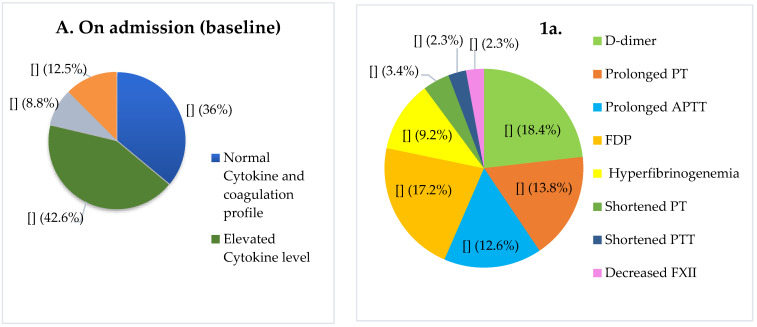
Coronavirus disease 2019 (COVID-19), with a broad range of clinical and laboratory findings, is currently the most prevalent medical challenge worldwide. In this disease, hypercoagulability and hyperinflammation, two common features, are accompanied by a higher rate of morbidity and mortality. We assessed the association between baseline inflammatory cytokine levels and coagulopathy and disease outcome in COVID-19. One hundred and thirty-seven consecutive patients hospitalized with COVID-19 were selected for the study. Baseline interleukin-1 (IL-1), IL-6, and tumor necrosis factor alpha (TNF-α) level were measured at time of admission. At the same time, baseline coagulation parameters were also assessed during the patient's hospitalization. Clinical findings, including development of thrombosis and clinical outcome, were recorded prospectively. Out of 136 patients, 87 (64%) had increased cytokine levels (one or more cytokines) or abnormal coagulation parameters. Among them, 58 (67%) had only increased inflammatory cytokines, 12 (~14%) had only coagulation abnormalities, and 17 (19.5%) had concomitant abnormalities in both systems. It seems that a high level of inflammatory cytokines at admission points to an increased risk of developing coagulopathy, thrombotic events, even death, over the course of COVID-19. Early measurement of these cytokines, and timely co-administration of anti-inflammatories with anticoagulants could decrease thrombotic events and related fatal consequences.
2019冠状病毒病(COVID-19)临床表现和实验室检查结果多种多样,是目前全球最普遍的医学挑战。在这种疾病中,高凝状态和炎症反应增强这两个常见特征伴随着更高的发病率和死亡率。我们评估了COVID-19患者基线炎症细胞因子水平与凝血病及疾病转归之间的关联。本研究选取了137例连续住院的COVID-19患者。入院时测定基线白细胞介素-1(IL-1)、IL-6和肿瘤坏死因子-α(TNF-α)水平。同时,在患者住院期间还评估了基线凝血参数。前瞻性记录包括血栓形成和临床转归在内的临床发现。136例患者中,87例(约64%)细胞因子水平升高(一种或多种细胞因子)或凝血参数异常。其中,58例(约67%)仅有炎症细胞因子升高,12例(约14%)仅有凝血异常,17例(19.5%)两个系统均有异常。入院时炎症细胞因子水平较高似乎表明在COVID-19病程中发生凝血病、血栓形成事件甚至死亡的风险增加。早期检测这些细胞因子,并及时联合使用抗炎药和抗凝药,可减少血栓形成事件及相关致命后果。