Santacroce Rosa, D'Andrea Giovanna, Maffione Angela Bruna, Margaglione Maurizio, d'Apolito Maria
Medical Genetics, Department of Clinical and Experimental Medicine, University of Foggia, 71122 Foggia, Italy.
Human Anatomy, Department of Clinical and Experimental Medicine, University of Foggia, 71122 Foggia, Italy.
J Clin Med. 2021 May 9;10(9):2023. doi: 10.3390/jcm10092023.
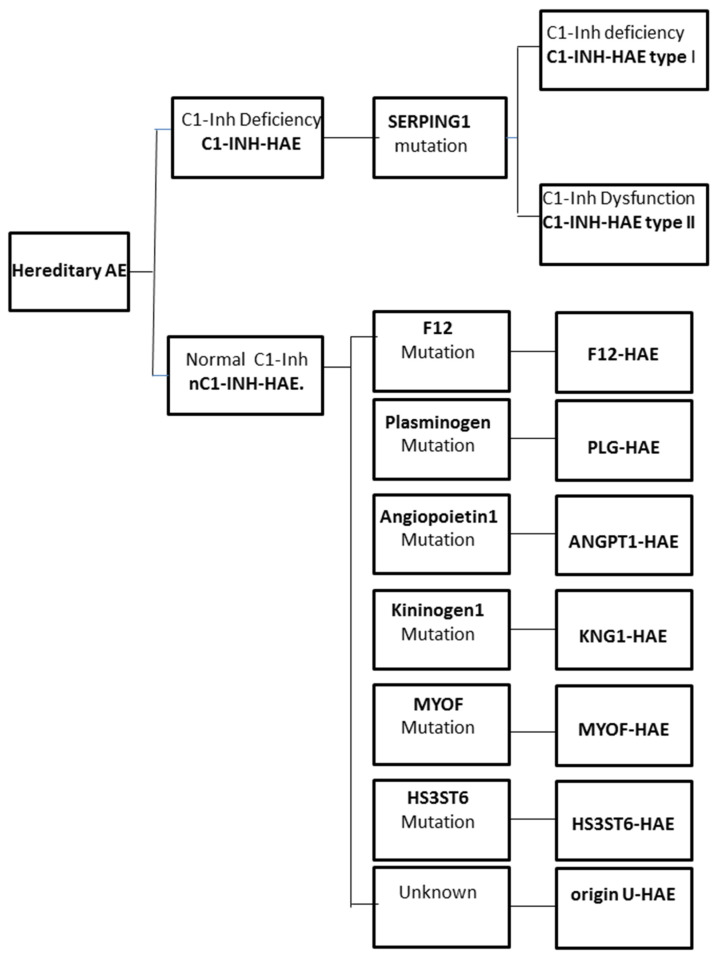
Hereditary angioedema is a rare inherited disorder characterized by recurrent episodes of the accumulation of fluids outside of the blood vessels, causing rapid swelling of tissues in the hands, feet, limbs, face, intestinal tract, or airway. Mutations in SERPING1, the gene that encodes C1-INH (C1 esterase inhibitor), are responsible for the majority of cases of hereditary angioedema. C1 esterase inhibitor (C1-INH) is a major regulator of critical enzymes that are implicated in the cascades of bradykinin generation, which increases the vascular permeability and allows the flow of fluids into the extracellular space and results in angioedema. Moreover, a dominantly inherited disease has been described that has a similar clinical picture to C1-INH-HAE (Hereditary angioedema due to C1 inhibitor deficiency), but with normal C1-INH level and activity. This new type of HAE has no mutation in the SERPING1 gene and it is classified as nC1-INH-HAE (HAE with normal C1-INH). Currently mutations in six different genes have been identified as causing nC1-INH-HAE: factor XII (F12), plasminogen (PLG), angiopoietin 1 (ANGPT1), Kininogen 1 (KNG1), Myoferlin (MYOF), and heparan sulfate (HS)-glucosamine 3-O-sulfotransferase 6 (HS3ST6). In this review we aim to summarize the recent advances in genetic characterization of angioedema and possible future prospects in the identification of new genetic defects in HAE. We also provide an overview of diagnostic applications of genetic biomarkers using NGS technologies ().
遗传性血管性水肿是一种罕见的遗传性疾病,其特征是血管外液体反复积聚,导致手部、足部、四肢、面部、肠道或气道组织迅速肿胀。编码C1-INH(C1酯酶抑制剂)的基因SERPING1发生突变是大多数遗传性血管性水肿病例的病因。C1酯酶抑制剂(C1-INH)是关键酶的主要调节因子,这些酶参与缓激肽生成级联反应,缓激肽生成级联反应会增加血管通透性,使液体流入细胞外间隙,从而导致血管性水肿。此外,还描述了一种显性遗传性疾病,其临床表现与C1-INH-HAE(C1抑制剂缺乏所致遗传性血管性水肿)相似,但C1-INH水平和活性正常。这种新型遗传性血管性水肿在SERPING1基因中没有突变,被归类为nC1-INH-HAE(C1-INH正常的遗传性血管性水肿)。目前已确定六种不同基因的突变可导致nC1-INH-HAE:凝血因子XII(F12)、纤溶酶原(PLG)、血管生成素1(ANGPT1)、激肽原1(KNG1)、肌铁蛋白(MYOF)和硫酸乙酰肝素(HS)-氨基葡萄糖3-O-磺基转移酶6(HS3ST6)。在本综述中,我们旨在总结血管性水肿基因特征的最新进展以及遗传性血管性水肿新基因缺陷鉴定的未来可能前景。我们还概述了使用NGS技术()的基因生物标志物的诊断应用。