Chargui Abderrahman, Belaid Amine, Ndiaye Papa Diogop, Imbert Véronique, Samson Michel, Guigonis Jean-Marie, Tauc Michel, Peyron Jean-François, Poujeol Philippe, Brest Patrick, Hofman Paul, Mograbi Baharia
Université Côte d'Azur, Institute of Research on Cancer and Aging in Nice (IRCAN), Centre National de la Recherche Scientifique (CNRS), Institut National de la Santé et de la Recherche Médicale (INSERM), Fédération Hospitalo-Universitaire (FHU) OncoAge, Centre Antoine Lacassagne, F-06189 Nice, France.
Higher School of Agriculture of Kef, University Jendouba, Le Kef and Laboratory of Histology, Embryology and Cell Biology, Faculty of Medicine Tunis, 7110 Le Kef, Tunisia.
Cancers (Basel). 2021 May 20;13(10):2490. doi: 10.3390/cancers13102490.
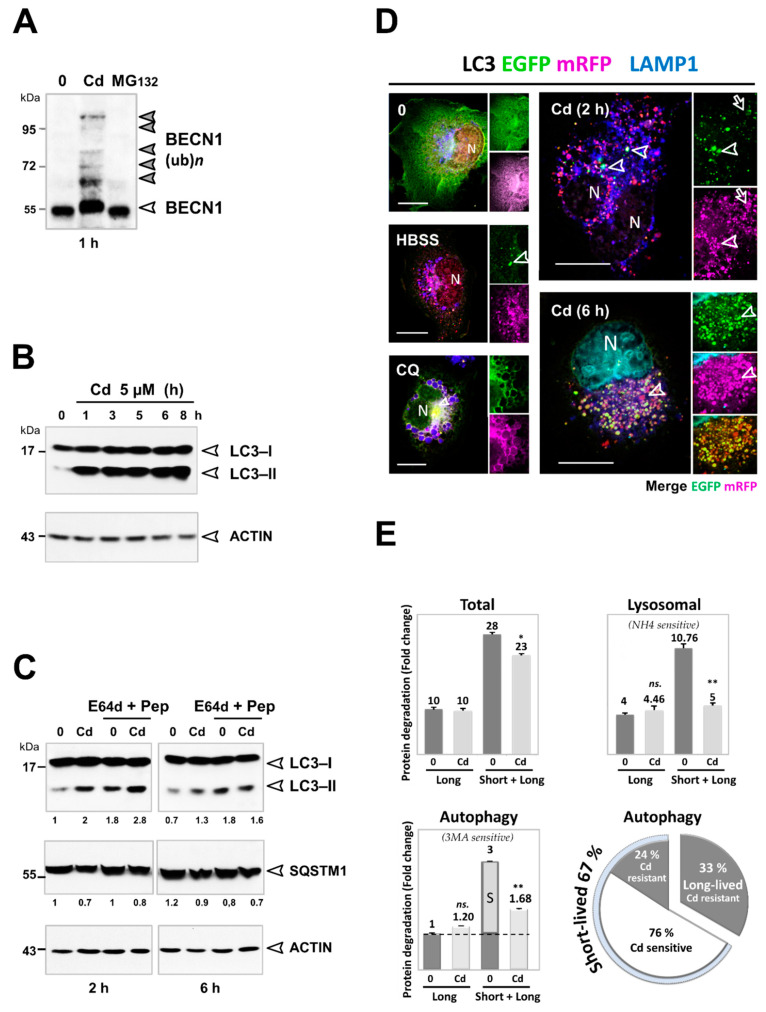
Signaling, proliferation, and inflammation are dependent on K63-linked ubiquitination-conjugation of a chain of ubiquitin molecules linked via lysine 63. However, very little information is currently available about how K63-linked ubiquitination is subverted in cancer. The present study provides, for the first time, evidence that cadmium (Cd), a widespread environmental carcinogen, is a potent activator of K63-linked ubiquitination, independently of oxidative damage, activation of ubiquitin ligase, or proteasome impairment. We show that Cd induces the formation of protein aggregates that sequester and inactivate cylindromatosis (CYLD) and selective autophagy, two tumor suppressors that deubiquitinate and degrade K63-ubiquitinated proteins, respectively. The aggregates are constituted of substrates of selective autophagy-SQSTM1, K63-ubiquitinated proteins, and mitochondria. These protein aggregates also cluster double-membrane remnants, which suggests an impairment in autophagosome maturation. However, failure to eliminate these selective cargos is not due to alterations in the general autophagy process, as degradation of long-lived proteins occurs normally. We propose that the simultaneous disruption of CYLD and selective autophagy by Cd feeds a vicious cycle that further amplifies K63-linked ubiquitination and downstream activation of the NF-κB pathway, processes that support cancer progression. These novel findings link together impairment of selective autophagy, K63-linked ubiquitination, and carcinogenesis.
信号传导、细胞增殖和炎症依赖于通过赖氨酸63连接的泛素分子链的K63连接泛素化修饰。然而,目前关于K63连接泛素化在癌症中如何被颠覆的信息非常少。本研究首次提供证据表明,镉(Cd)作为一种广泛存在的环境致癌物,是K63连接泛素化的有效激活剂,与氧化损伤、泛素连接酶激活或蛋白酶体损伤无关。我们发现,镉诱导形成蛋白质聚集体,这些聚集体隔离并使 cylindromatosis(CYLD)和选择性自噬失活,这两种肿瘤抑制因子分别对K63泛素化蛋白进行去泛素化和降解。这些聚集体由选择性自噬的底物——SQSTM1、K63泛素化蛋白和线粒体组成。这些蛋白质聚集体还聚集了双膜残余物,这表明自噬体成熟存在缺陷。然而,未能清除这些选择性货物并非由于一般自噬过程的改变,因为长寿命蛋白质的降解正常发生。我们提出,镉同时破坏CYLD和选择性自噬会形成一个恶性循环,进一步放大K63连接泛素化和NF-κB途径的下游激活,这些过程促进癌症进展。这些新发现将选择性自噬损伤、K63连接泛素化和致癌作用联系在一起。