Albrecht Annemarie, Porthun Jan, Eucker Jan, Coats Andrew J S, von Haehling Stephan, Pezzutto Antonio, Karakas Mahir, Riess Hanno, Keller Ulrich, Landmesser Ulf, Haverkamp Wilhelm, Anker Stefan D, Anker Markus S
Department of Cardiology (CVK), Charité Universitätsmedizin Berlin, 13353 Berlin, Germany.
Berlin Institute of Health Center for Regenerative Therapies (BCRT), 13353 Berlin, Germany.
Cancers (Basel). 2021 May 12;13(10):2303. doi: 10.3390/cancers13102303.
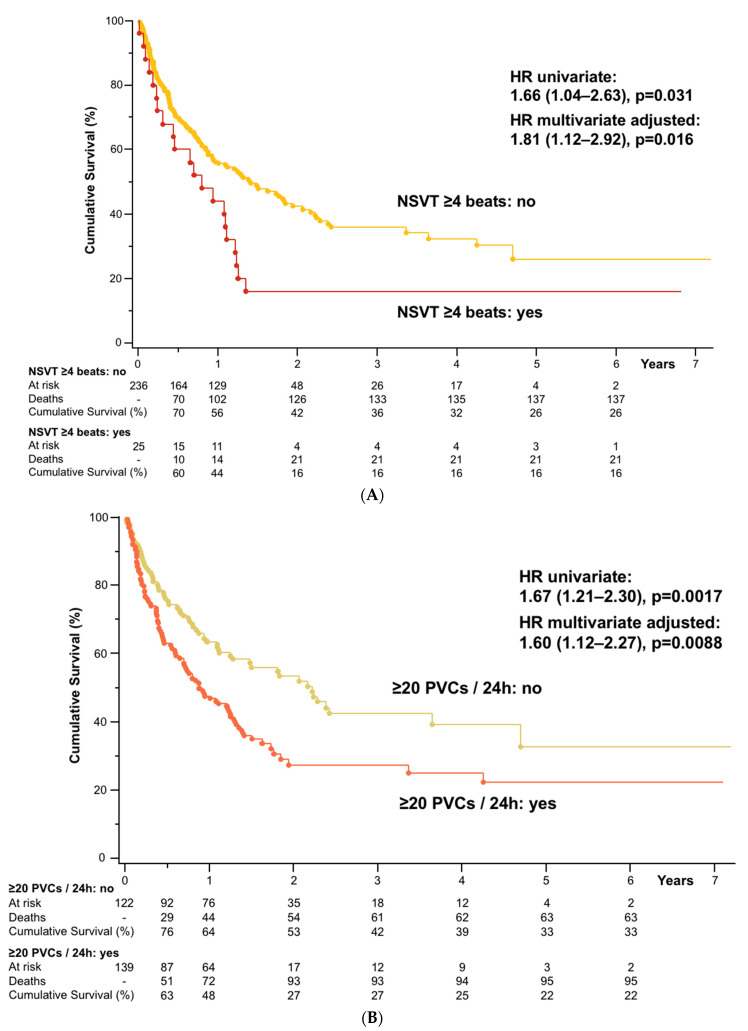
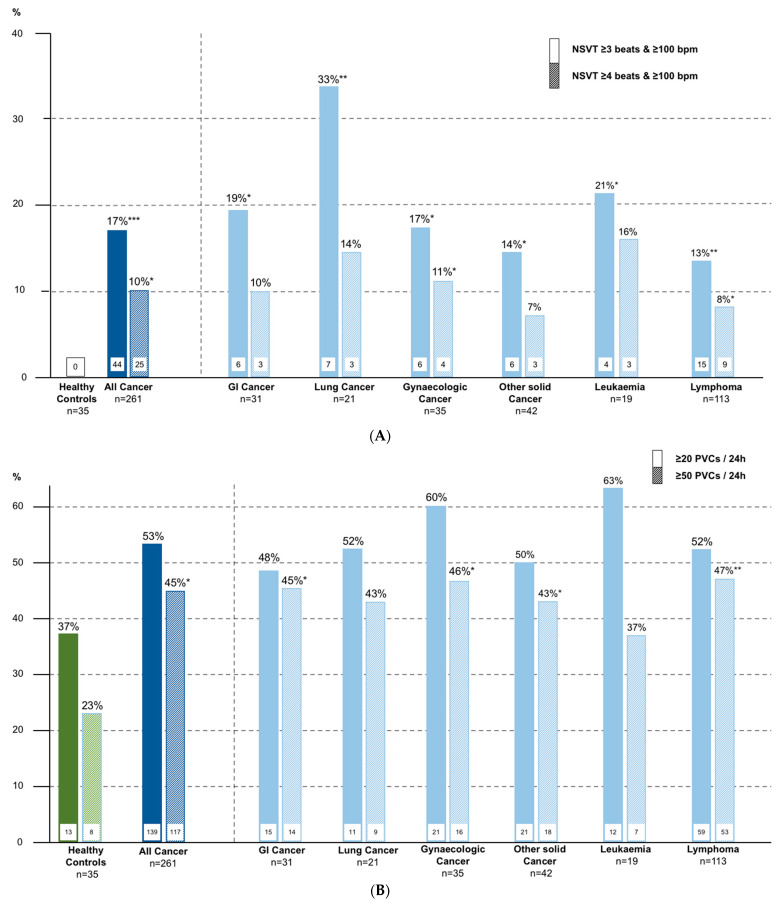
It is largely unknown whether cancer patients seen in routine care show ventricular arrhythmias in 24 h electrocardiograms (ECGs), and whether when they are detected they carry prognostic relevance. We included 261 consecutive cancer patients that were referred to the department of cardiology for 24 h ECG examination and 35 healthy controls of similar age and sex in the analysis. To reduce selection bias, cancer patients with known left ventricular ejection fraction <45% were not included in the analysis. Non-sustained ventricular tachycardia (NSVT) episodes of either ≥3 and ≥4 beats duration were more frequent in cancer patients than controls (17% vs. 0%, = 0.0008; 10% vs. 0%, = 0.016). Premature ventricular contractions (PVCs)/24 h were not more frequent in cancer patients compared to controls (median (IQR), 26 (2-360) vs. 9 (1-43), = 0.06; ≥20 PVCs 53% vs. 37%, = 0.07). During follow-up, (up to 7.2 years, median 15 months) of the cancer patients, 158 (61%) died (1-/3-/5-year mortality rates: 45% [95%CI 39-51%], 66% [95%CI 59-73%], 73% [95%CI 64-82%]). Both non-sustained ventricular tachycardia of ≥4 beats and ≥20 PVCs/24 h independently predicted mortality in univariate and multivariate survival analyses, adjusted for all other univariate predictors of mortality as well as relevant clinical factors, including cancer stage and type, performance status (ECOG), prior potentially cardiotoxic anti-cancer drug therapy, coronary artery disease, potassium concentration, and haemoglobin (multivariate adjusted hazard ratios: NSVT ≥4 beats [HR 1.76, = 0.022], ≥20 PVCs/24 h [HR 1.63, < 0.0064]). NSVT ≥4 beats and ≥20 PVCs/day seen in routine 24 h ECGs of patients with cancer carry prognostic relevance.
在常规护理中见到的癌症患者在24小时心电图(ECG)中是否会出现室性心律失常,以及当检测到这些心律失常时它们是否具有预后相关性,在很大程度上尚不清楚。我们纳入了261例连续的癌症患者,这些患者被转至心内科进行24小时心电图检查,并纳入了35名年龄和性别相似的健康对照者进行分析。为减少选择偏倚,已知左心室射血分数<45%的癌症患者未纳入分析。癌症患者中持续时间≥3和≥4个搏动的非持续性室性心动过速(NSVT)发作比对照组更频繁(17%对0%,P = 0.0008;10%对0%,P = 0.016)。与对照组相比,癌症患者每24小时的室性早搏(PVCs)并不更频繁(中位数(四分位间距),26(2 - 360)对9(1 - 43),P = 0.06;≥20次PVCs为53%对37%,P = 0.07)。在癌症患者的随访期间(长达7.2年,中位数15个月),158例(61%)死亡(1/3/5年死亡率:45%[95%CI 39 - 51%],66%[95%CI 59 - 73%],73%[95%CI 64 - 82%])。在单因素和多因素生存分析中,持续时间≥4个搏动的非持续性室性心动过速和每24小时≥20次PVCs均独立预测死亡率,对所有其他单因素死亡率预测因素以及相关临床因素进行了校正,包括癌症分期和类型、体能状态(ECOG)、既往可能具有心脏毒性的抗癌药物治疗、冠状动脉疾病、钾浓度和血红蛋白(多因素校正风险比:NSVT≥4个搏动[HR 1.76,P = 0.022],每24小时≥20次PVCs[HR 1.63,P < 0.0064])。在癌症患者常规24小时心电图中出现的持续时间≥4个搏动的NSVT和每天≥20次PVCs具有预后相关性。