Khaled Salma M, Petcu Catalina, Bader Lina, Amro Iman, Al-Hamadi Aisha Mohammed H A, Al Assi Marwa, Ali Amal Awadalla Mohamed, Le Trung Kien, Diop Abdoulaye, Bellaj Tarek, Al-Thani Mohamed H, Woodruff Peter W, Alabdulla Majid, Haddad Peter M
Social and Economic Survey Research Institute, Qatar University, Doha P.O. Box 2713, Qatar.
Department of Public Health, College of Health Sciences, Qatar University, Doha P.O. Box 2713, Qatar.
Vaccines (Basel). 2021 May 7;9(5):471. doi: 10.3390/vaccines9050471.
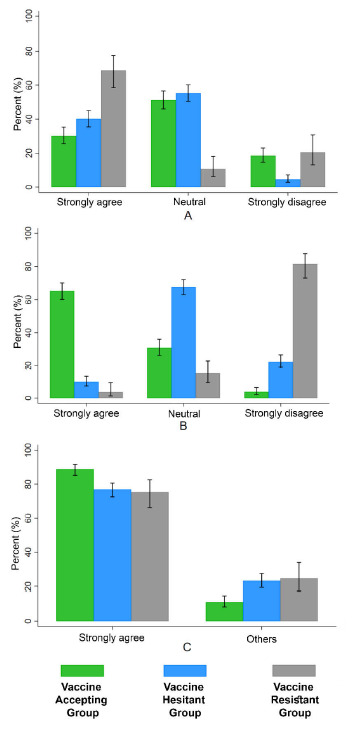
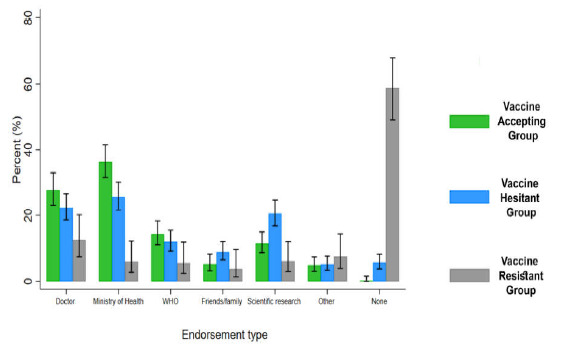
Global COVID-19 pandemic containment necessitates understanding the risk of hesitance or resistance to vaccine uptake in different populations. The Middle East and North Africa currently lack vital representative vaccine hesitancy data. We conducted the first representative national phone survey among the adult population of Qatar, between December 2020 and January 2021, to estimate the prevalence and identify potential determinants of vaccine willingness: acceptance (strongly agree), resistance (strongly disagree), and hesitance (somewhat agree, neutral, somewhat disagree). Bivariate and multinomial logistic regression models estimated associations between willingness groups and fifteen variables. In the total sample, 42.7% (95% CI: 39.5-46.1) were accepting, 45.2% (95% CI: 41.9-48.4) hesitant, and 12.1% (95% CI: 10.1-14.4) resistant. Vaccine resistant compared with hesistant and accepting groups reported no endorsement source will increase vaccine confidence (58.9% vs. 5.6% vs. 0.2%, respectively). Female gender, Arab ethnicity, migrant status/type, and vaccine side-effects concerns were associated with hesitancy and resistance. COVID-19 related bereavement, infection, and quarantine status were not significantly associated with any willingness group. Absence of or lack of concern about contracting the virus was solely associated with resistance. COVID-19 vaccine resistance, hesitance, and side-effects concerns are high in Qatar's population compared with those globally. Urgent public health engagement should focus on women, Qataris (non-migrants), and those of Arab ethnicity.
全球遏制新冠疫情需要了解不同人群对疫苗接种存在犹豫或抵触的风险。中东和北非目前缺乏重要的具有代表性的疫苗犹豫数据。2020年12月至2021年1月期间,我们在卡塔尔成年人群中开展了首次具有代表性的全国电话调查,以估计疫苗接种意愿的流行率并确定潜在决定因素:接受(强烈同意)、抵触(强烈不同意)和犹豫(有些同意、中立、有些不同意)。二元和多项逻辑回归模型估计了意愿组与15个变量之间的关联。在总样本中,42.7%(95%置信区间:39.5 - 46.1)的人接受,45.2%(95%置信区间:41.9 - 48.4)的人犹豫,12.1%(95%置信区间:10.1 - 14.4)的人抵触。与犹豫和接受组相比,抵触疫苗接种的人群中报告没有认可来源会增加疫苗信心的比例分别为58.9%、5.6%和0.2%。女性、阿拉伯族裔、移民身份/类型以及对疫苗副作用的担忧与犹豫和抵触有关。与新冠疫情相关的丧亲之痛、感染和隔离状态与任何意愿组均无显著关联。不担心感染病毒或对感染病毒缺乏担忧仅与抵触有关。与全球人群相比,卡塔尔人群中对新冠疫苗的抵触、犹豫以及对副作用的担忧程度较高。紧急的公共卫生工作应关注女性、卡塔尔人(非移民)以及阿拉伯族裔人群。