Eriksson Kimmo, Vartanova Irina
Center for Cultural Evolution, Stockholm University, Stockholm, Sweden.
School for Education, Culture and Communication, Mälardalen University, Västerås, Sweden.
Hum Vaccin Immunother. 2022 Dec 31;18(1):1-3. doi: 10.1080/21645515.2021.1883389. Epub 2021 Mar 11.
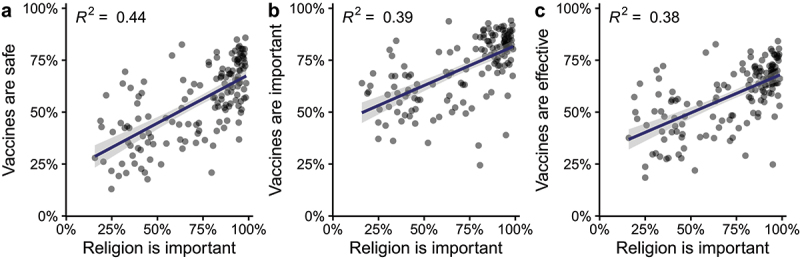
Vaccine hesitancy is a threat to global health, but it is not ubiquitous; depending on the country, the proportion that have confidence in vaccines ranges from a small minority to a huge majority. Little is known about what explains this dramatic variation in vaccine confidence. We hypothesize that variation in religiosity may play a role because traditional religious teachings are likely to be incompatible with the specific magical/spiritual health beliefs that often undergird anti-vaccination sentiments. In analyses of publicly available data in 147 countries, we find that a country measure of religiosity is strongly positively correlated with country measures of confidence in the safety, importance, and effectiveness of vaccines, and these associations are robust to controlling for measures of human development (education, economic development, and health). The underlying mechanism needs to be examined in future research.
疫苗犹豫对全球健康构成威胁,但并非普遍存在;根据国家不同,对疫苗有信心的比例从一小部分到绝大多数不等。对于造成这种疫苗信心巨大差异的原因,我们知之甚少。我们推测宗教虔诚度的差异可能起到了一定作用,因为传统宗教教义可能与那些常常支撑反疫苗情绪的特定神奇/精神健康信念不相容。在对147个国家公开可用数据的分析中,我们发现一个国家的宗教虔诚度衡量指标与该国对疫苗安全性、重要性和有效性的信心衡量指标呈强正相关,并且在控制了人类发展指标(教育、经济发展和健康)后,这些关联依然稳健。潜在机制有待未来研究去探究。