Department Human Performance, The Netherlands Organisation for Applied Scientific Research (TNO), 3769 DE Soesterberg, The Netherlands.
Circuits and Systems (CAS) Group, Delft University of Technology, 2628 CD Delft, The Netherlands.
Sensors (Basel). 2021 May 22;21(11):3616. doi: 10.3390/s21113616.
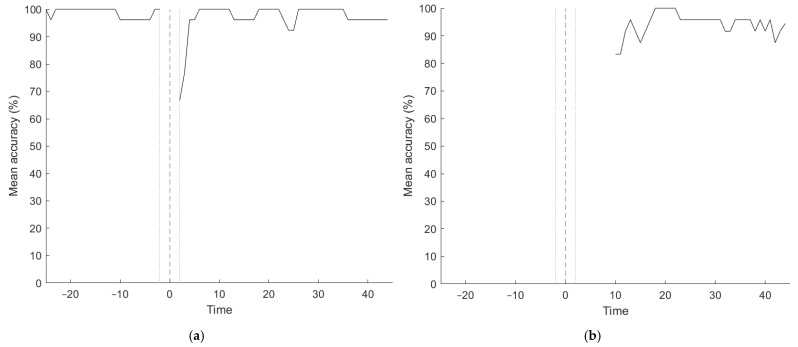
Early detection of exposure to a toxic chemical, e.g., in a military context, can be life-saving. We propose to use machine learning techniques and multiple continuously measured physiological signals to detect exposure, and to identify the chemical agent. Such detection and identification could be used to alert individuals to take appropriate medical counter measures in time. As a first step, we evaluated whether exposure to an opioid (fentanyl) or a nerve agent (VX) could be detected in freely moving guinea pigs using features from respiration, electrocardiography (ECG) and electroencephalography (EEG), where machine learning models were trained and tested on different sets (across subject classification). Results showed this to be possible with close to perfect accuracy, where respiratory features were most relevant. Exposure detection accuracy rose steeply to over 95% correct during the first five minutes after exposure. Additional models were trained to correctly classify an exposed state as being induced either by fentanyl or VX. This was possible with an accuracy of almost 95%, where EEG features proved to be most relevant. Exposure detection models that were trained on subsets of animals generalized to subsets of animals that were exposed to other dosages of different chemicals. While future work is required to validate the principle in other species and to assess the robustness of the approach under different, realistic circumstances, our results indicate that utilizing different continuously measured physiological signals for early detection and identification of toxic agents is promising.
早期检测暴露于有毒化学物质,例如在军事环境中,可以挽救生命。我们建议使用机器学习技术和多种连续测量的生理信号来检测暴露,并识别化学剂。这种检测和识别可以用于提醒个人及时采取适当的医疗对策。作为第一步,我们评估了使用来自呼吸、心电图(ECG)和脑电图(EEG)的特征,是否可以在自由移动的豚鼠中检测到阿片类药物(芬太尼)或神经毒剂(VX)的暴露,其中机器学习模型在不同的集合(跨主体分类)上进行了训练和测试。结果表明,这是可能的,接近完美的准确性,其中呼吸特征是最相关的。暴露检测的准确性在暴露后的前五分钟内急剧上升到 95%以上。另外的模型被训练为正确地将暴露状态分类为芬太尼或 VX 诱导的。这是可能的,准确性几乎达到 95%,其中 EEG 特征被证明是最相关的。在不同的动物子集上训练的暴露检测模型可以推广到暴露于其他剂量的不同化学物质的动物子集。虽然需要进一步的工作来验证其他物种的原理,并评估在不同的现实情况下该方法的稳健性,但我们的结果表明,利用不同的连续测量的生理信号进行早期检测和识别有毒剂是有希望的。