Hodges Sara D, Kezer Murat
Department of Psychology, University of Oregon, Eugene, OR 97403-1227, USA.
J Intell. 2021 May 17;9(2):27. doi: 10.3390/jintelligence9020027.
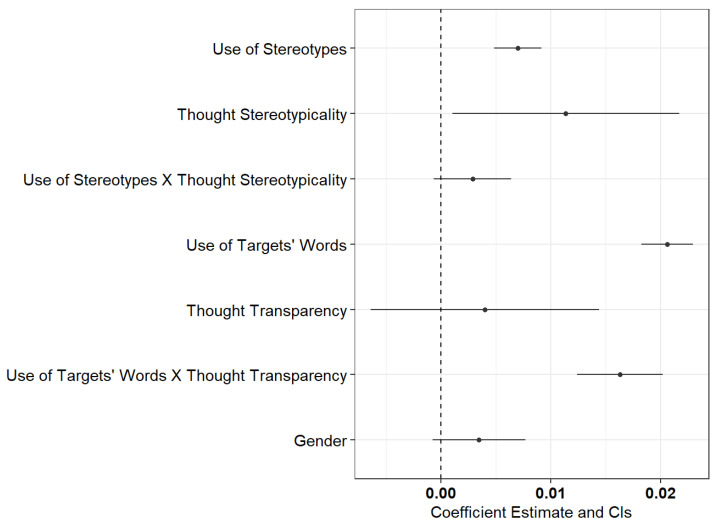
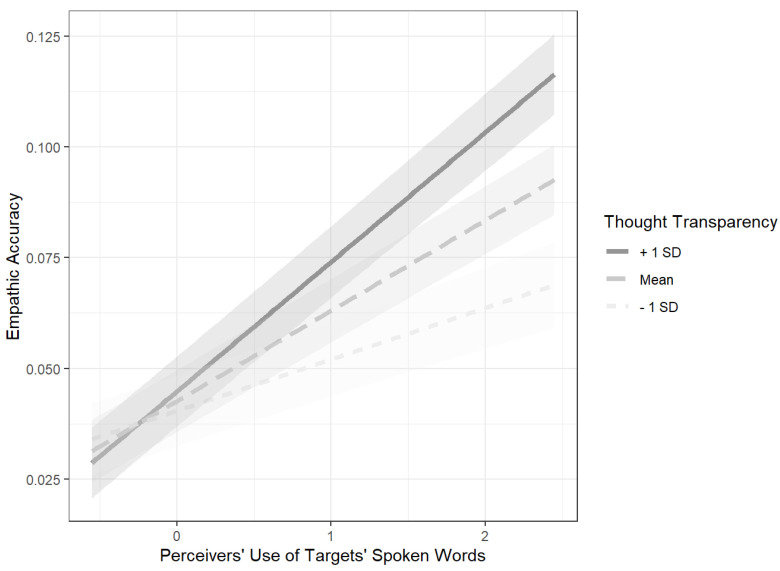
When faced with the task of trying to "read" a stranger's thoughts, what cues can perceivers use? We explore two predictors of empathic accuracy (the ability to accurately infer another person's thoughts): use of stereotypes about the target's group, and use of the target's own words. A sample of 326 White American undergraduate students were asked to infer the dynamic thoughts of Middle Eastern male targets, using Ickes' (Ickes et al. 1990) empathic accuracy paradigm. We predicted use of stereotypes would reduce empathic accuracy because the stereotypes would be negative and inaccurate. However, more stereotypical inferences about the target's thoughts actually predicted greater empathic accuracy, a pattern in line with past work on the role of stereotypes in empathic accuracy (Lewis et al. 2012), perhaps because the stereotypes of Middle Easterners (collected from a sample of 60 participants drawn from the same population) were less negative than expected. In addition, perceivers who inferred that the targets were thinking thoughts that more closely matched what the target was saying out loud were more empathically accurate. Despite the fact that words can be used intentionally to obscure what a target is thinking, they appear to be a useful cue to empathic accuracy, even in tricky contexts that cross cultural lines.
当面对试图“读懂”陌生人想法的任务时,感知者可以使用哪些线索呢?我们探究了共情准确性(准确推断他人想法的能力)的两个预测因素:对目标群体刻板印象的运用,以及对目标自身话语的运用。326名美国白人本科生被试被要求使用伊克斯(伊克斯等人,1990)的共情准确性范式来推断中东男性目标的动态想法。我们预测,刻板印象的运用会降低共情准确性,因为这些刻板印象会是负面且不准确的。然而,实际上,对目标想法的更多刻板印象推断却预示着更高的共情准确性,这一模式与过去关于刻板印象在共情准确性中作用的研究结果一致(刘易斯等人,2012),这可能是因为(从同一总体中抽取的60名参与者样本中收集到的)中东人的刻板印象没有预期的那么负面。此外,那些推断目标所想内容与目标大声说出的内容更相符的感知者,其共情准确性更高。尽管言语可能会被故意用来掩盖目标的想法,但即使在跨越文化界限的棘手情境中,言语似乎仍是共情准确性的一个有用线索。