Kode Divya, Nannapaneni Ramakrishna, Bansal Mohit, Chang Sam, Cheng Wen-Hsing, Sharma Chander S, Kiess Aaron
Department of Food Science, Nutrition and Health Promotion, Mississippi State University, Starkville, MS 39762, USA.
Poultry Science Department, Mississippi State University, Starkville, MS 39762, USA.
Microorganisms. 2021 May 13;9(5):1052. doi: 10.3390/microorganisms9051052.
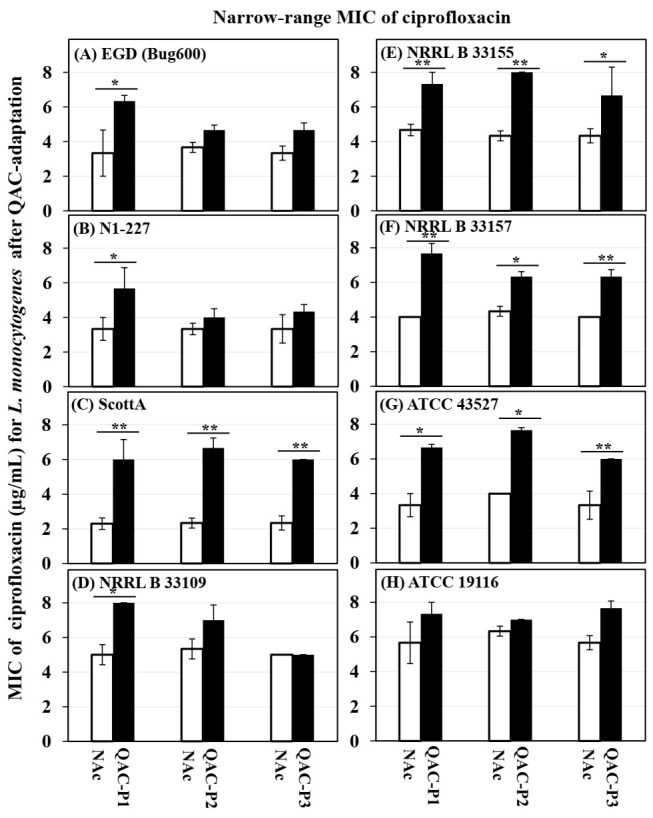
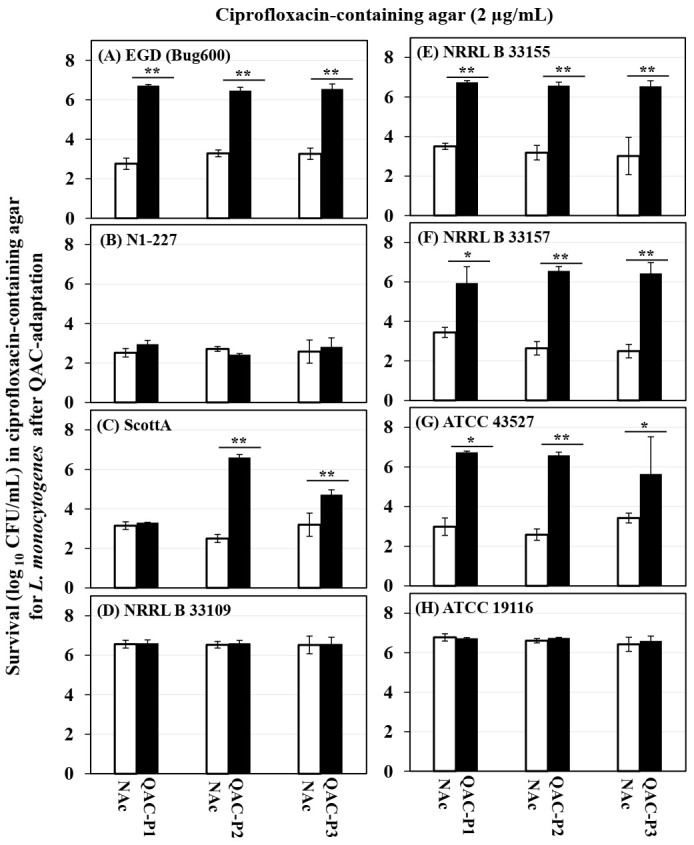
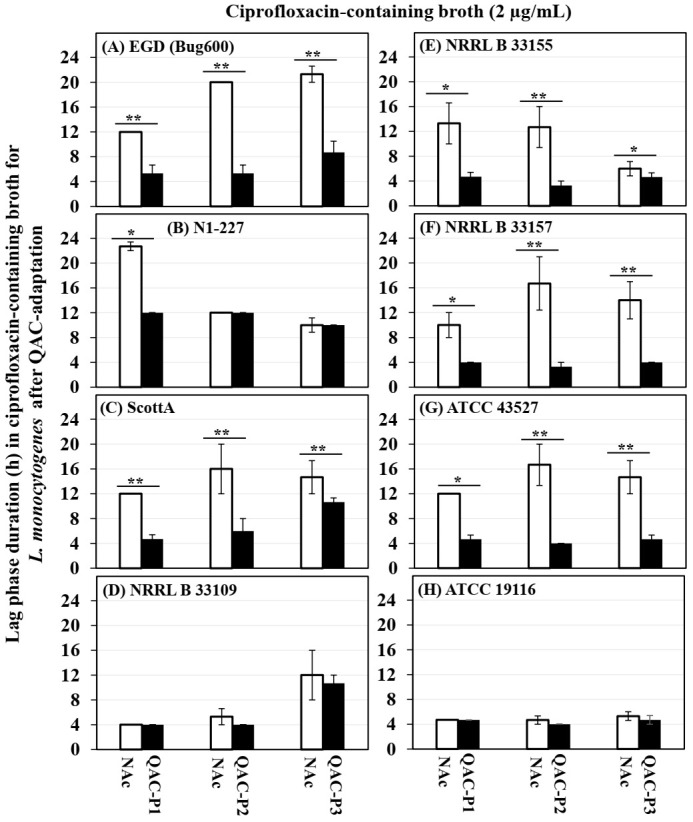
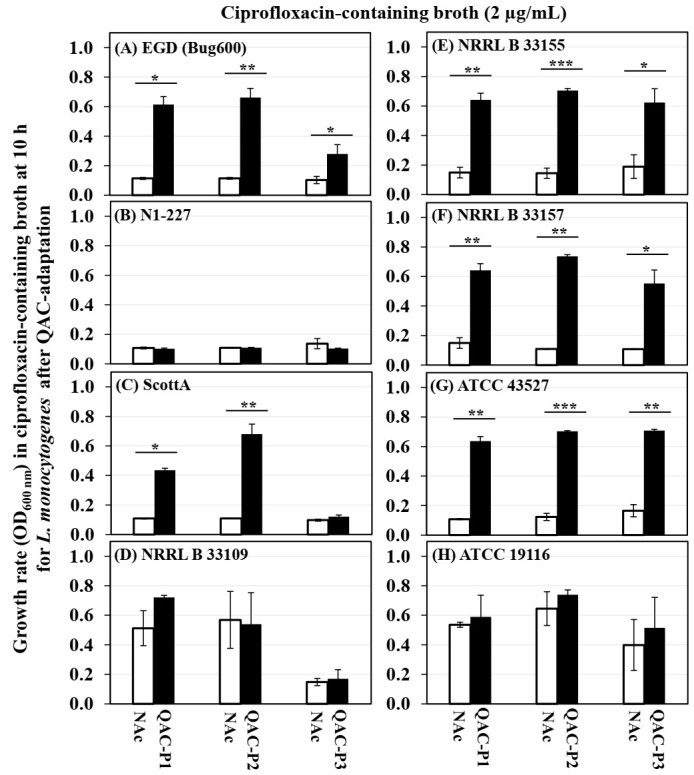
There was a development of low-level tolerance to fluoroquinolone antibiotic ciprofloxacin in after sublethal adaptation to quaternary ammonium compound (QAC). Using eight strains, we determined the changes in short-range MIC, growth rate, and survival for heterologous stress response to ciprofloxacin, after sublethal exposure to daily cycles of fixed or gradually increasing concentration of QAC. Three main findings were observed. (1) MIC increase-QAC-adapted subpopulations exhibited a significant increase in short-range MIC of ciprofloxacin, by 1.5 to 2.9 fold, as compared to non-adapted control for 4/8 strains ( < 0.05). (2) Growth rate increase-QAC-adapted subpopulations exhibited significant 2.1- to 6.8- fold increase in growth rate (OD at 10 h) in ciprofloxacin-containing broth, as compared to non-adapted control for 5/8 strains ( < 0.05). (3) Survival increase-QAC-adapted subpopulations of yielded significantly higher survival in ciprofloxacin-containing agar by 2.2 to 4.3 log CFU/mL for 4/8 strains, as compared to non-adapted control ( ˂ 0.05). However, for other 4/8 strains of , there was no increase in survival of QAC-adapted subpopulations, as compared to non-adapted control in ciprofloxacin. These findings suggest the potential formation of low-level ciprofloxacin-tolerant subpopulations in some strains when exposed to residual QAC concentrations (where QAC might be used widely) and such cells if not inactivated might create food safety risk.
在对季铵化合物(QAC)进行亚致死适应后,对氟喹诺酮抗生素环丙沙星产生了低水平耐受性。我们使用8株菌株,在亚致死暴露于固定或逐渐增加浓度的QAC每日循环后,测定了对环丙沙星异源应激反应的短程最低抑菌浓度(MIC)、生长速率和存活率的变化。观察到三个主要发现。(1)MIC增加——QAC适应的亚群对环丙沙星的短程MIC显著增加,与4/8株未适应的对照相比增加了1.5至2.9倍(P<0.05)。(2)生长速率增加——QAC适应的亚群在含环丙沙星的肉汤中生长速率(10小时的OD值)显著增加2.1至6.8倍,与5/8株未适应的对照相比(P<0.05)。(3)存活率增加——QAC适应的亚群在含环丙沙星的琼脂中存活率显著更高,与4/8株未适应的对照相比增加了2.2至4.3 log CFU/mL(P<0.05)。然而,对于其他4/8株,与环丙沙星中未适应的对照相比,QAC适应的亚群存活率没有增加。这些发现表明,当暴露于残留QAC浓度(QAC可能广泛使用的地方)时,某些菌株中可能形成低水平环丙沙星耐受亚群,并且这些细胞如果未被灭活可能会产生食品安全风险。