Scheau Cristian, Draghici Carmen, Ilie Mihaela Adriana, Lupu Mihai, Solomon Iulia, Tampa Mircea, Georgescu Simona Roxana, Caruntu Ana, Constantin Carolina, Neagu Monica, Caruntu Constantin
Department of Physiology, "Carol Davila" University of Medicine and Pharmacy, 050474 Bucharest, Romania.
Dermatology Research Laboratory, "Carol Davila" University of Medicine and Pharmacy, 050474 Bucharest, Romania.
Cancers (Basel). 2021 May 10;13(9):2277. doi: 10.3390/cancers13092277.
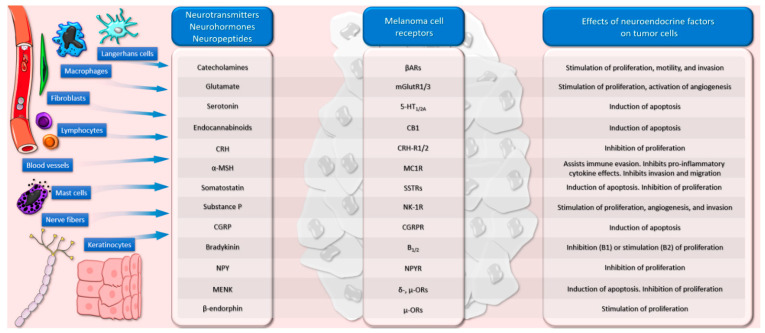
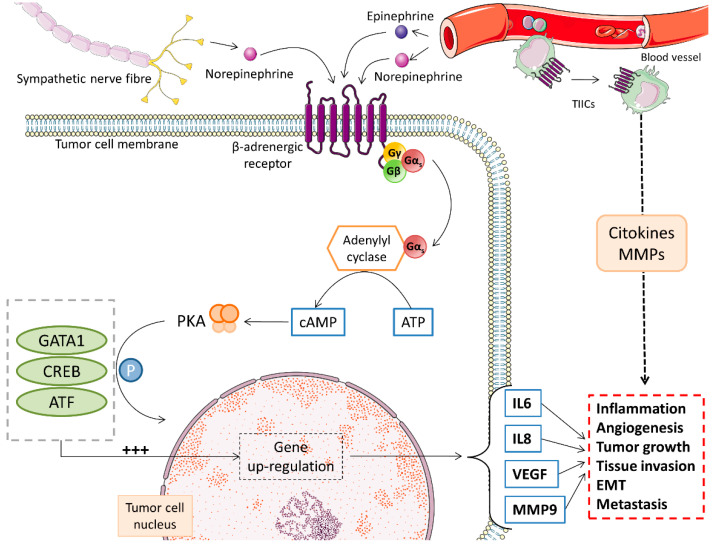
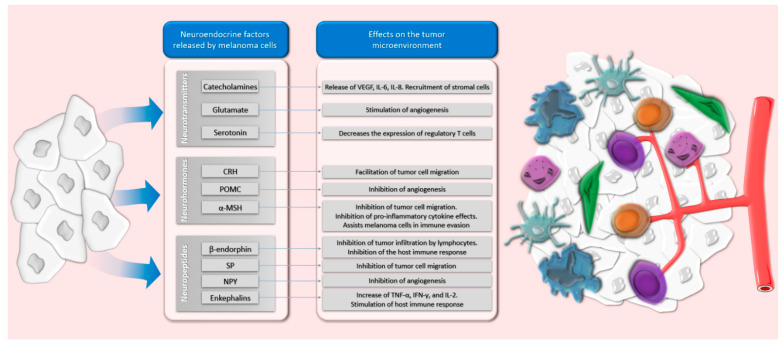
Melanoma is one of the most aggressive skin cancers with a sharp rise in incidence in the last decades, especially in young people. Recognized as a significant public health issue, melanoma is studied with increasing interest as new discoveries in molecular signaling and receptor modulation unlock innovative treatment options. Stress exposure is recognized as an important component in the immune-inflammatory interplay that can alter the progression of melanoma by regulating the release of neuroendocrine factors. Various neurotransmitters, such as catecholamines, glutamate, serotonin, or cannabinoids have also been assessed in experimental studies for their involvement in the biology of melanoma. Alpha-MSH and other neurohormones, as well as neuropeptides including substance P, CGRP, enkephalin, beta-endorphin, and even cellular and molecular agents (mast cells and nitric oxide, respectively), have all been implicated as potential factors in the development, growth, invasion, and dissemination of melanoma in a variety of in vitro and in vivo studies. In this review, we provide an overview of current evidence regarding the intricate effects of neuroendocrine factors in melanoma, including data reported in recent clinical trials, exploring the mechanisms involved, signaling pathways, and the recorded range of effects.
黑色素瘤是最具侵袭性的皮肤癌之一,在过去几十年中发病率急剧上升,尤其是在年轻人中。黑色素瘤被视为一个重大的公共卫生问题,随着分子信号传导和受体调节方面的新发现开启了创新治疗方案,对其研究的兴趣也与日俱增。应激暴露被认为是免疫-炎症相互作用中的一个重要组成部分,它可通过调节神经内分泌因子的释放来改变黑色素瘤的进展。在实验研究中,还评估了各种神经递质,如儿茶酚胺、谷氨酸、血清素或大麻素在黑色素瘤生物学中的作用。在各种体外和体内研究中,α-促黑素(α-MSH)和其他神经激素,以及包括P物质、降钙素基因相关肽(CGRP)、脑啡肽、β-内啡肽等神经肽,甚至细胞和分子因子(分别为肥大细胞和一氧化氮),都被认为是黑色素瘤发生、生长、侵袭和扩散的潜在因素。在本综述中,我们概述了有关神经内分泌因子在黑色素瘤中复杂作用的当前证据,包括近期临床试验报告的数据,探讨其中涉及的机制、信号通路以及所记录的效应范围。