Department of Physical Education, National Taiwan University of Sport, Taichung 40404, Taiwan.
School of Physical Education, Quanzhou Normal University, Quanzhou 362000, China.
Sensors (Basel). 2021 May 14;21(10):3422. doi: 10.3390/s21103422.
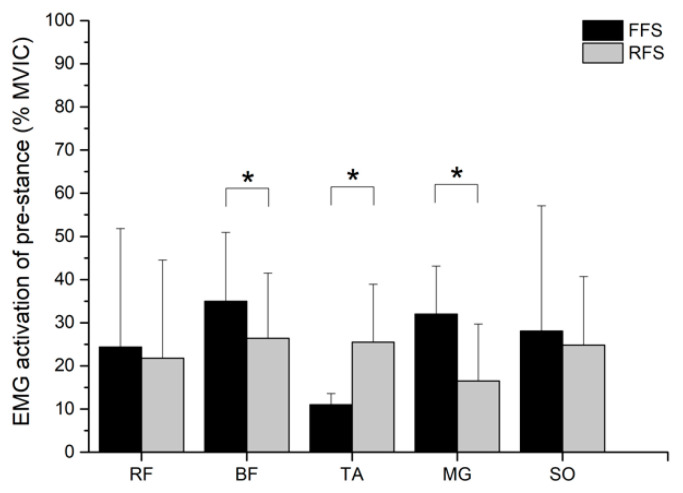
This study analysed the landing performance and muscle activity of athletes in forefoot strike (FFS) and rearfoot strike (RFS) patterns. Ten male college participants were asked to perform two foot strikes patterns, each at a running speed of 6 km/h. Three inertial sensors and five EMG sensors as well as one 24 G accelerometer were synchronised to acquire joint kinematics parameters as well as muscle activation, respectively. In both the FFS and RFS patterns, according to the intraclass correlation coefficient, excellent reliability was found for landing performance and muscle activation. Paired t tests indicated significantly higher ankle plantar flexion in the FFS pattern. Moreover, biceps femoris (BF) and gastrocnemius medialis (GM) activation increased in the pre-stance phase of the FFS compared with that of RFS. The FFS pattern had significantly decreased tibialis anterior (TA) muscle activity compared with the RFS pattern during the pre-stance phase. The results demonstrated that the ankle strategy focused on controlling the foot strike pattern. The influence of the FFS pattern on muscle activity likely indicates that an athlete can increase both BF and GM muscles activity. Altered landing strategy in cases of FFS pattern may contribute both to the running efficiency and muscle activation of the lower extremity. Therefore, neuromuscular training and education are required to enable activation in dynamic running tasks.
本研究分析了前足着地(FFS)和后足着地(RFS)两种模式下运动员的着地性能和肌肉活动。要求 10 名男性大学生以 6km/h 的速度分别进行两种足着地模式。三个惯性传感器和五个肌电图传感器以及一个 24G 加速度计同步采集关节运动学参数和肌肉激活情况。在 FFS 和 RFS 两种模式下,根据组内相关系数,发现着陆性能和肌肉激活的可靠性均非常高。配对 t 检验表明,FFS 模式下的踝关节跖屈角度明显更高。此外,与 RFS 相比,FFS 模式的腓肠肌(BF)和比目鱼肌(GM)在初始站立阶段的激活增加。与 RFS 模式相比,FFS 模式在初始站立阶段的胫骨前肌(TA)肌肉活动明显减少。研究结果表明,踝关节策略侧重于控制足着地模式。FFS 模式对肌肉活动的影响可能表明运动员可以增加 BF 和 GM 肌肉的活动。FFS 模式下的着陆策略改变可能有助于提高下肢的跑步效率和肌肉激活。因此,需要进行神经肌肉训练和教育,以在动态跑步任务中实现肌肉的激活。