Dipartimento di Scienze Umanistiche, Università Telematica Pegaso, 80143 Napoli, Italy.
Centro Italiano per la cura e il Benessere del Paziente con Obesità (C.I.B.O), Endocrinology Unit, Department of Clinical Medicine and Surgery, University Federico II, 80131 Naples, Italy.
Nutrients. 2021 May 14;13(5):1671. doi: 10.3390/nu13051671.
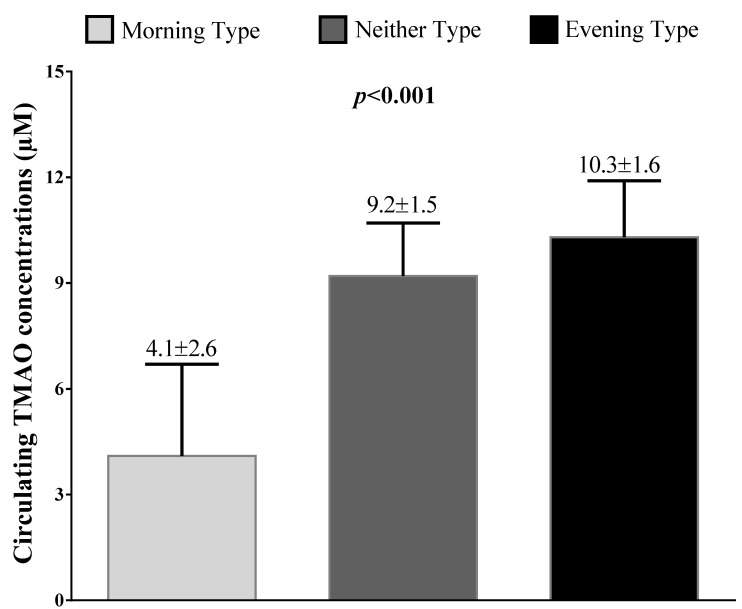
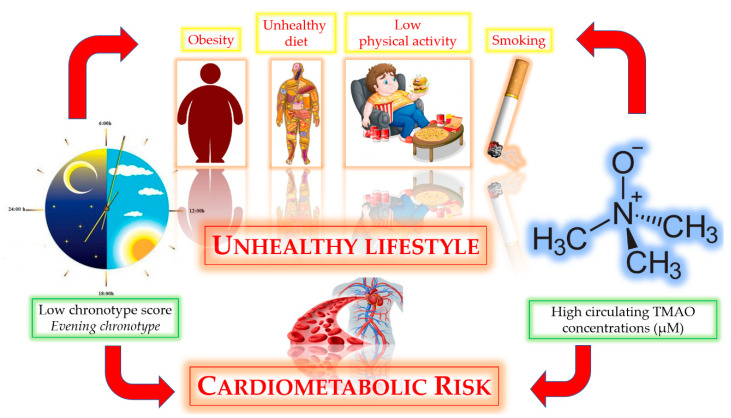
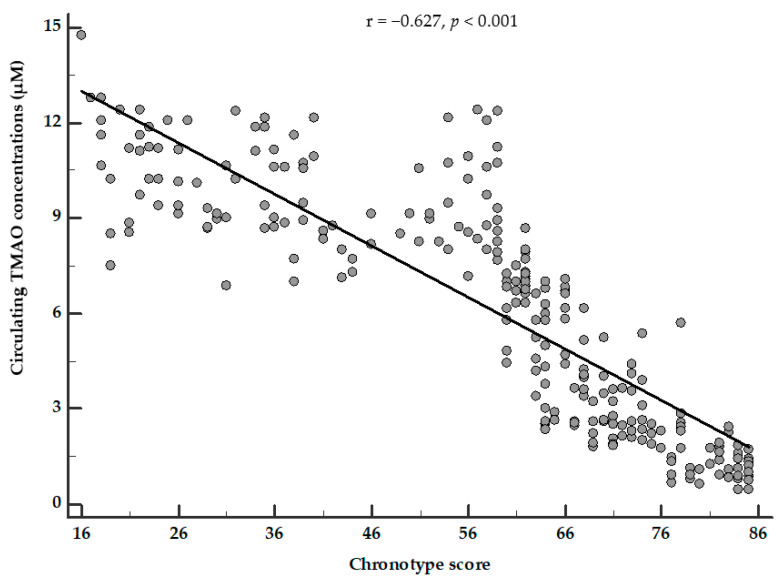
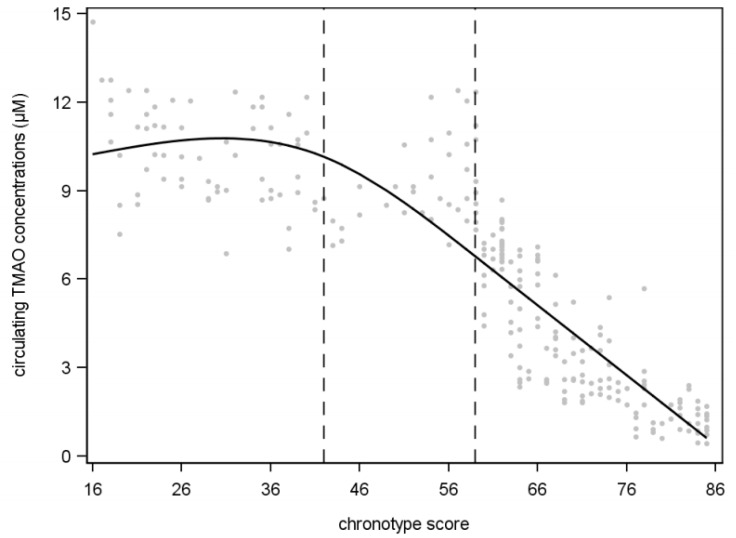
Individual differences in the chronotype, an attitude that best expresses the individual circadian preference in behavioral and biological rhythms, have been associated with cardiometabolic risk and gut dysbiosis. Up to now, there are no studies evaluating the association between chronotypes and circulating TMAO concentrations, a predictor of cardiometabolic risk and a useful marker of gut dysbiosis. In this study population (147 females and 100 males), subjects with the morning chronotype had the lowest BMI and waist circumference ( < 0.001), and a better metabolic profile compared to the other chronotypes. In addition, the morning chronotype had the highest adherence to the Mediterranean diet ( < 0.001) and the lowest circulating TMAO concentrations ( < 0.001). After adjusting for BMI and adherence to the Mediterranean diet, the correlation between circulating TMAO concentrations and chronotype score was still kept (r = -0.627, < 0.001). Using a linear regression analysis, higher chronotype scores were mostly associated with lower circulating TMAO concentrations (β = -0.479, = -12.08, and < 0.001). Using a restricted cubic spline analysis, we found that a chronotype score ≥59 ( < 0.001, R = -0.824) demonstrated a more significant inverse linear relationship with circulating TMAO concentrations compared with knots <59 (neither chronotype) and <41 (evening chronotype). The current study reported the first evidence that higher circulating TMAO concentrations were associated with the evening chronotype that, in turn, is usually linked to an unhealthy lifestyle mostly characterized by low adherence to the MD.
个体在时型上的差异,即行为和生物节律中个体昼夜节律偏好的最佳表达,与心脏代谢风险和肠道菌群失调有关。到目前为止,还没有研究评估时型与循环 TMAO 浓度之间的关系,循环 TMAO 浓度是心脏代谢风险的预测指标,也是肠道菌群失调的有用标志物。在本研究人群中(147 名女性和 100 名男性),晨型的受试者 BMI 和腰围最低(<0.001),与其他时型相比,代谢状况更好。此外,晨型对地中海饮食的依从性最高(<0.001),循环 TMAO 浓度最低(<0.001)。在调整 BMI 和地中海饮食的依从性后,循环 TMAO 浓度与时型评分之间的相关性仍然存在(r=-0.627,<0.001)。使用线性回归分析,较高的时型评分与较低的循环 TMAO 浓度密切相关(β=-0.479,=-12.08,<0.001)。使用限制立方样条分析,我们发现时型评分≥59(<0.001,R=-0.824)与循环 TMAO 浓度之间存在更显著的负线性关系,而<59(既非晨型也非晚型)和<41(晚型)的切点则没有这种关系。本研究首次报道了较高的循环 TMAO 浓度与晚型时型相关的证据,而晚型时型通常与不健康的生活方式有关,主要表现为对 MD 的依从性低。