Faculty of Chemical-Biological Sciences, Universidad Autónoma de Guerrero, Chilpancingo 39087, Mexico.
Department of Physical Education, Sport, and Recreation, Universidad de La Frontera, Temuco 4780000, Chile.
Int J Environ Res Public Health. 2021 May 19;18(10):5450. doi: 10.3390/ijerph18105450.
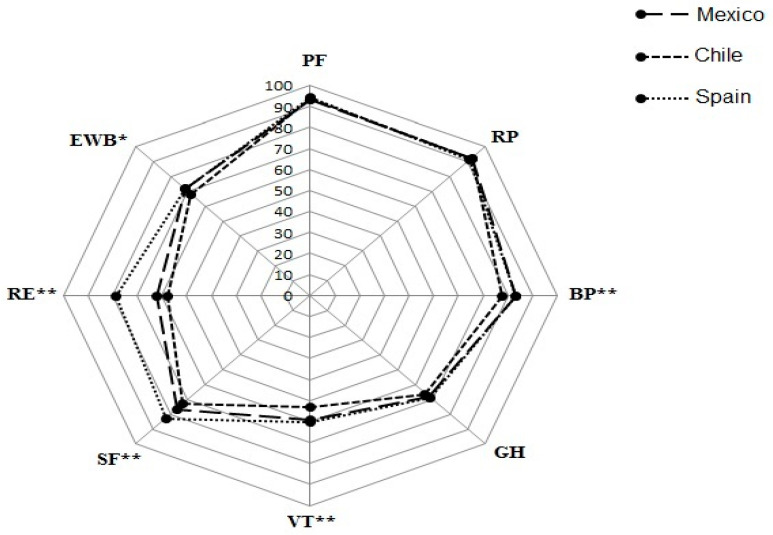
The aim of the present study was to determine the association between the health-related quality of life (HRQoL) with sociodemographic parameters and lifestyle during COVID-19 confinement in Mexico, Chile, and Spain.
A cross-sectional pilot study, with 742 observations of online surveys in 422, 190, and 130 individuals from Mexico, Chile, and Spain, respectively. Sociodemographic data, presence of comorbidities, food habits, and physical activity (PA) patterns were evaluated. The HRQoL was evaluated according to the SF-36 Health Survey. The multilinear regression analysis was developed to determine the association of variables with HRQoL and its physical and mental health dimensions.
The female sex in the three countries reported negative association with HRQoL (Mexico: β -4.45, = 0.004; Chile: β -8.48, < 0.001; Spain: β -6.22, = 0.009). Similarly, bad eating habits were associated negatively with HRQoL (Mexico: β -6.64, < 0.001; Chile: β -6.66, = 0.005; Spain: β -5.8, = 0.032). In Mexico, PA limitations presented a negative association with HRQoL (β -4.71, = 0.011). In Chile, a sedentary lifestyle (h/day) was linked negatively with HRQoL (β -0.64, = 0.005). In Spain, the highest associations with HRQoL were the presence of comorbidity (β -11.03, < 0.001) and smoking (β -6.72, = 0.02). Moreover, the PA limitation in Mexico (β -5.67, = 0.023) and Chile (β -9.26, = 0.035) was linked negatively with mental health.
The bad eating habits, PA limitations, female sex, comorbidity presence, and smoking were parameters linked negatively with HRQoL.
本研究旨在确定在 COVID-19 封城期间,墨西哥、智利和西班牙的健康相关生活质量(HRQoL)与社会人口学参数和生活方式之间的关系。
这是一项横断面试点研究,对来自墨西哥、智利和西班牙的 422、190 和 130 名个体的在线调查进行了 742 次观察。评估了社会人口学数据、合并症的存在、饮食习惯和身体活动(PA)模式。根据 SF-36 健康调查评估 HRQoL。采用多元线性回归分析确定变量与 HRQoL 及其身心健康维度的关系。
在这三个国家,女性的 HRQoL 呈负相关(墨西哥:β-4.45,p=0.004;智利:β-8.48,p<0.001;西班牙:β-6.22,p=0.009)。同样,不良饮食习惯与 HRQoL 呈负相关(墨西哥:β-6.64,p<0.001;智利:β-6.66,p=0.005;西班牙:β-5.8,p=0.032)。在墨西哥,PA 受限与 HRQoL 呈负相关(β-4.71,p=0.011)。在智利,久坐不动的生活方式(h/d)与 HRQoL 呈负相关(β-0.64,p=0.005)。在西班牙,与 HRQoL 相关性最高的是合并症的存在(β-11.03,p<0.001)和吸烟(β-6.72,p=0.02)。此外,墨西哥(β-5.67,p=0.023)和智利(β-9.26,p=0.035)的 PA 受限与心理健康呈负相关。
不良饮食习惯、PA 受限、女性、合并症的存在和吸烟与 HRQoL 呈负相关。