Gu Meichen, Gao Yanli, Chang Pengyu
Department of Radiation Oncology & Therapy, The First Hospital of Jilin University, Changchun 130021, China.
Department of Pediatric Ultrasound, The First Hospital of Jilin University, Changchun 130021, China.
Cancers (Basel). 2021 May 18;13(10):2429. doi: 10.3390/cancers13102429.
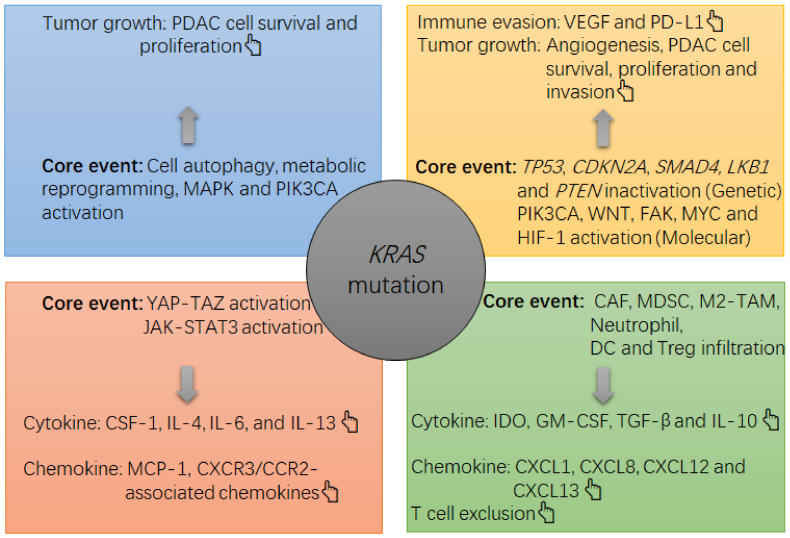
Generally, patients with pancreatic ductal adenocarcinoma, especially those with wide metastatic lesions, have a poor prognosis. Recently, a breakthrough in improving their survival has been achieved by using first-line chemotherapy, such as gemcitabine plus nab-paclitaxel or oxaliplatin plus irinotecan plus 5-fluorouracil plus calcium folinate. Unfortunately, regimens with high effectiveness are still absent in second- or later-line settings. In addition, although immunotherapy using checkpoint inhibitors definitively represents a novel method for metastatic cancers, monotherapy using checkpoint inhibitors is almost completely ineffective for pancreatic ductal adenocarcinomas largely due to the suppressive immune milieu in such tumors. Critically, the genomic alteration pattern is believed to impact cancer immune environment. Surprisingly, gene mutation is found in almost all pancreatic ductal adenocarcinomas. Moreover, mutation is indispensable for pancreatic carcinogenesis. On these bases, a relationship likely exists between this oncogene and immunosuppression in this cancer. During pancreatic carcinogenesis, mutation-driven events, such as metabolic reprogramming, cell autophagy, and persistent activation of the yes-associated protein pathway, converge to cause immune evasion. However, intriguingly, mutation can dictate a different immune environment in other types of adenocarcinoma, such as colorectal adenocarcinoma and lung adenocarcinoma. Overall, the mutation can drive an immunosuppression in pancreatic ductal adenocarcinomas or in colorectal carcinomas, but this mechanism is not true in -mutant lung adenocarcinomas, especially in the presence of inactivation. As a result, the response of these adenocarcinomas to checkpoint inhibitors will vary.
一般来说,胰腺导管腺癌患者,尤其是那些有广泛转移病灶的患者,预后较差。最近,通过使用一线化疗,如吉西他滨加纳米白蛋白结合型紫杉醇或奥沙利铂加伊立替康加5-氟尿嘧啶加亚叶酸钙,在提高他们的生存率方面取得了突破。不幸的是,二线或后续治疗方案中仍然缺乏高效的方案。此外,尽管使用检查点抑制剂的免疫疗法无疑是治疗转移性癌症的一种新方法,但使用检查点抑制剂的单药治疗对胰腺导管腺癌几乎完全无效,这主要是由于此类肿瘤中存在免疫抑制环境。至关重要的是,基因组改变模式被认为会影响癌症免疫环境。令人惊讶的是,几乎所有胰腺导管腺癌中都发现了基因突变。此外,该突变对于胰腺癌的发生是不可或缺的。基于这些,这种癌基因与该癌症中的免疫抑制之间可能存在关联。在胰腺癌发生过程中,由该突变驱动的事件,如代谢重编程、细胞自噬和Yes相关蛋白通路的持续激活,共同导致免疫逃逸。然而,有趣的是,该突变在其他类型的腺癌中,如结直肠癌和肺腺癌中,会决定不同的免疫环境。总体而言,该突变可在胰腺导管腺癌或结直肠癌中引发免疫抑制,但在该突变的肺腺癌中,尤其是在存在该基因失活的情况下,这种机制并不成立。因此,这些腺癌对检查点抑制剂的反应会有所不同。