Department of Computer Science, Kent State University, Kent, OH 44242, USA.
Department of Health Care and Science, Donga University, Nakdong-Daero 550 beongil 37, Saha-Gu, Busan 49315, Korea.
Int J Environ Res Public Health. 2021 May 18;18(10):5386. doi: 10.3390/ijerph18105386.
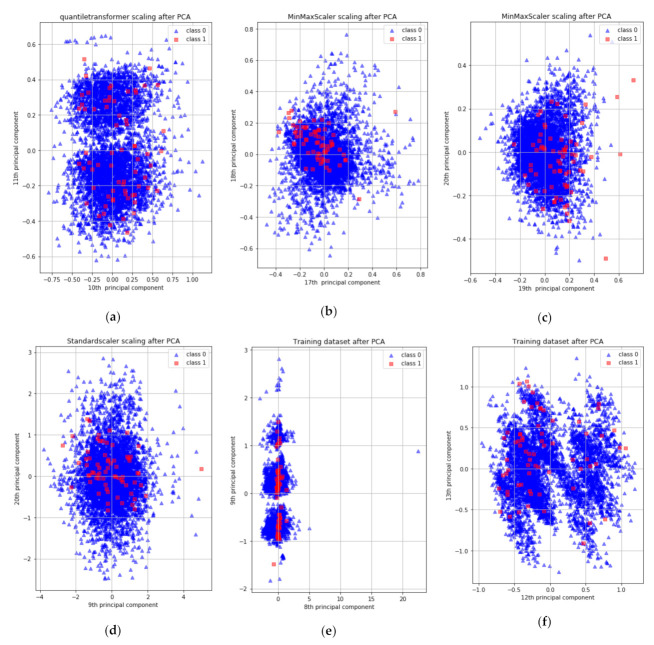
The rise in dementia among the aging Korean population will quickly create a financial burden on society, but timely recognition of early warning for dementia and proper responses to the occurrence of dementia can enhance medical treatment. Health behavior and medical service usage data are relatively more accessible than clinical data, and a prescreening tool with easily accessible data could be a good solution for dementia-related problems. In this paper, we apply a deep neural network (DNN) to prediction of dementia using health behavior and medical service usage data, using data from 7031 subjects aged over 65 collected from the Korea National Health and Nutrition Examination Survey (KNHANES) in 2001 and 2005. In the proposed model, principal component analysis (PCA) featuring and min/max scaling are used to preprocess and extract relevant background features. We compared our proposed methodology, a DNN/scaled PCA, with five well-known machine learning algorithms. The proposed methodology shows 85.5% of the area under the curve (AUC), a better result than that using other algorithms. The proposed early prescreening method for possible dementia can be used by both patients and doctors.
随着老龄化人口中痴呆症的增加,这将给社会带来沉重的经济负担,但及时发现痴呆症的预警信号并对痴呆症的发生做出适当反应,可以提高医疗水平。健康行为和医疗服务使用数据比临床数据更容易获得,使用容易获得的数据的预筛选工具可能是解决与痴呆症相关问题的好方法。在本文中,我们应用深度神经网络(DNN)使用来自 2001 年和 2005 年韩国国家健康和营养检查调查(KNHANES)的 7031 名 65 岁以上受试者的健康行为和医疗服务使用数据,对痴呆症进行预测。在所提出的模型中,主成分分析(PCA)和 min/max 缩放用于预处理和提取相关的背景特征。我们将我们提出的方法(DNN/缩放 PCA)与五种著名的机器学习算法进行了比较。所提出的方法的曲线下面积(AUC)为 85.5%,优于使用其他算法的结果。所提出的用于可能痴呆症的早期预筛选方法可以由患者和医生共同使用。