Obstetrics and Gynecology Service, Virgen de las Nieves University Hospital, 18014 Granada, Spain.
Anesthesiology, Resuscitation and Pain Therapy Service, Virgen de las Nieves University Hospital, 18014 Granada, Spain.
Medicina (Kaunas). 2021 May 25;57(6):528. doi: 10.3390/medicina57060528.
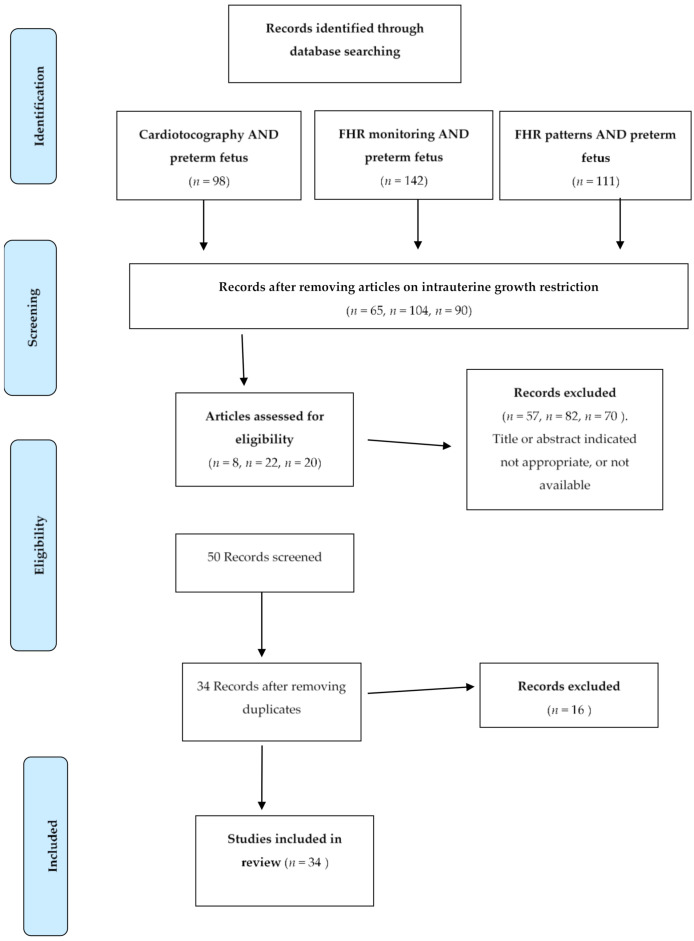
Prematurity is currently a serious public health issue worldwide, because of its high associated morbidity and mortality. Optimizing the management of these pregnancies is of high priority to improve perinatal outcomes. One tool frequently used to determine the degree of fetal wellbeing is cardiotocography (CTG). A review of the available literature on fetal heart rate (FHR) monitoring in preterm fetuses shows that studies are scarce, and the evidence thus far is unclear. The lack of reference standards for CTG patterns in preterm fetuses can lead to misinterpretation of the changes observed in electronic fetal monitoring (EFM). The aims of this narrative review were to summarize the most relevant concepts in the field of CTG interpretation in preterm fetuses, and to provide a practical approach that can be useful in clinical practice. A MEDLINE search was carried out, and the published articles thus identified were reviewed. Compared to term fetuses, preterm fetuses have a slightly higher baseline FHR. Heart rate is faster in more immature fetuses, and variability is lower and increases in more mature fetuses. Transitory, low-amplitude decelerations are more frequent during the second trimester. Transitory increases in FHR are less frequent and become more frequent and increase in amplitude as gestational age increases. The main characteristics of FHR tracings changes as gestation proceeds, and it is of fundamental importance to be aware of these changes in order to correctly interpret CTG patterns in preterm fetuses.
早产目前是全球范围内一个严重的公共卫生问题,因为它与高发病率和高死亡率有关。优化这些妊娠的管理是优先考虑的事项,以改善围产期结局。常用于确定胎儿健康状况的工具之一是胎心监护(cardiotocography,CTG)。对早产儿胎心率(fetal heart rate,FHR)监测的现有文献进行综述表明,相关研究较少,目前的证据尚不清楚。由于缺乏早产儿 CTG 模式的参考标准,可能会导致对电子胎儿监护(electronic fetal monitoring,EFM)中观察到的变化的误解。本综述的目的是总结早产儿 CTG 解读领域的最相关概念,并提供一种在临床实践中可能有用的实用方法。进行了 MEDLINE 检索,并对已确定的已发表文章进行了回顾。与足月胎儿相比,早产儿的基线 FHR 略高。胎心率在更不成熟的胎儿中更快,在更成熟的胎儿中变异性更低且增加。在第二个三个月中,短暂、低幅度的减速更为频繁。随着胎龄的增加,短暂的 FHR 增加不太频繁,但变得更加频繁且幅度增加。FHR 轨迹的主要特征随胎龄的变化而变化,了解这些变化对于正确解读早产儿的 CTG 模式至关重要。