Bioengineering Department, University of Louisville, Louisville, KY 40292, USA.
Faculty of Computers and Information, Mansoura University, Dakahlia 35516, Egypt.
Sensors (Basel). 2021 May 25;21(11):3664. doi: 10.3390/s21113664.
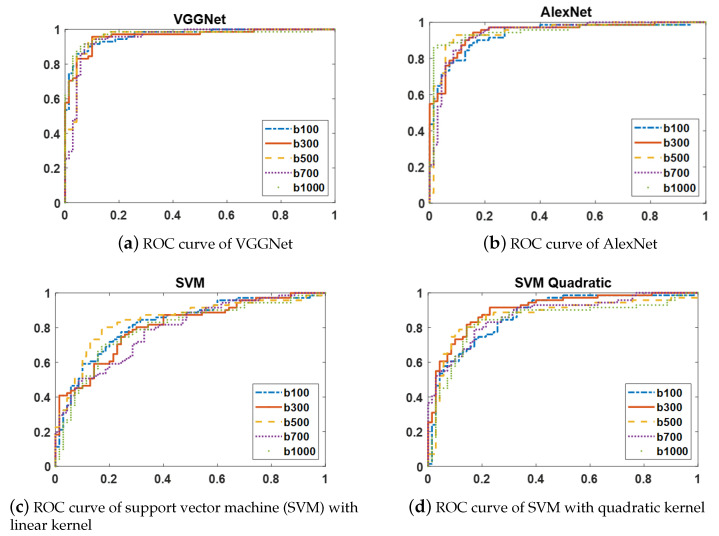
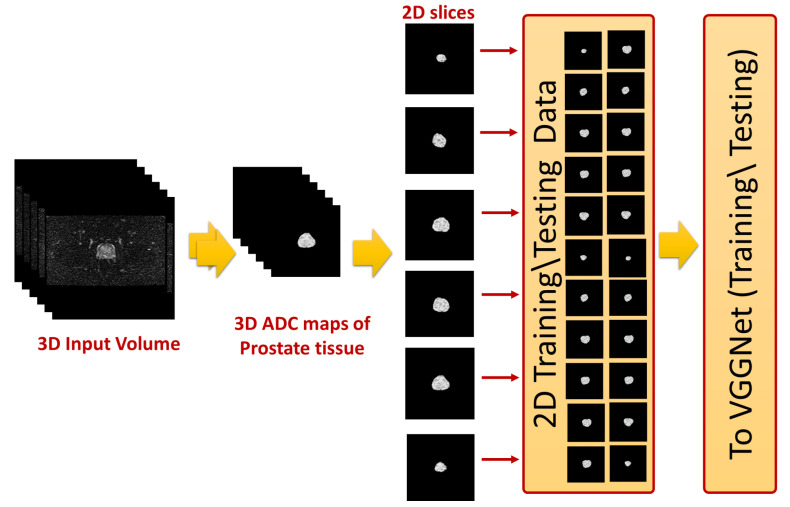
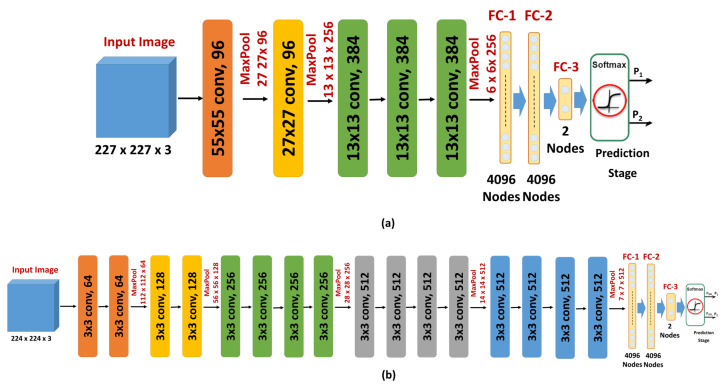
The use of computer-aided detection (CAD) systems can help radiologists make objective decisions and reduce the dependence on invasive techniques. In this study, a CAD system that detects and identifies prostate cancer from diffusion-weighted imaging (DWI) is developed. The proposed system first uses non-negative matrix factorization (NMF) to integrate three different types of features for the accurate segmentation of prostate regions. Then, discriminatory features in the form of apparent diffusion coefficient (ADC) volumes are estimated from the segmented regions. The ADC maps that constitute these volumes are labeled by a radiologist to identify the ADC maps with malignant or benign tumors. Finally, transfer learning is used to fine-tune two different previously-trained convolutional neural network (CNN) models (AlexNet and VGGNet) for detecting and identifying prostate cancer. Multiple experiments were conducted to evaluate the accuracy of different CNN models using DWI datasets acquired at nine distinct b-values that included both high and low b-values. The average accuracy of AlexNet at the nine b-values was 89.2±1.5% with average sensitivity and specificity of 87.5±2.3% and 90.9±1.9%. These results improved with the use of the deeper CNN model (VGGNet). The average accuracy of VGGNet was 91.2±1.3% with sensitivity and specificity of 91.7±1.7% and 90.1±2.8%. The results of the conducted experiments emphasize the feasibility and accuracy of the developed system and the improvement of this accuracy using the deeper CNN.
计算机辅助检测 (CAD) 系统的使用可以帮助放射科医生做出客观的决策,并减少对有创技术的依赖。本研究开发了一种从扩散加权成像 (DWI) 中检测和识别前列腺癌的 CAD 系统。该系统首先使用非负矩阵分解 (NMF) 整合三种不同类型的特征,以准确分割前列腺区域。然后,从分割区域中估计以表观扩散系数 (ADC) 体积形式的判别特征。这些体积构成的 ADC 图由放射科医生进行标记,以识别具有恶性或良性肿瘤的 ADC 图。最后,使用迁移学习微调两个不同的预先训练的卷积神经网络 (CNN) 模型(AlexNet 和 VGGNet),以检测和识别前列腺癌。进行了多项实验,使用在九个不同 b 值下采集的 DWI 数据集评估不同 CNN 模型的准确性,这些数据集包括高 b 值和低 b 值。AlexNet 在九个 b 值下的平均准确率为 89.2±1.5%,平均灵敏度和特异性分别为 87.5±2.3%和 90.9±1.9%。使用更深的 CNN 模型(VGGNet)可以提高这些结果。VGGNet 的平均准确率为 91.2±1.3%,灵敏度和特异性分别为 91.7±1.7%和 90.1±2.8%。进行的实验结果强调了所开发系统的可行性和准确性,以及使用更深的 CNN 可以提高这种准确性。