Nappi Francesco, Iervolino Adelaide, Avtaar Singh Sanjeet Singh
Centre Cardiologique du Nord de Saint-Denis, Department of Cardiac Surgery, 93200 Saint-Denis, France.
Department of Cardiovascular Sciences, Fondazione Policlinico Universitario A. Gemelli IRCSS, 00168 Rome, Italy.
Metabolites. 2021 May 25;11(6):341. doi: 10.3390/metabo11060341.
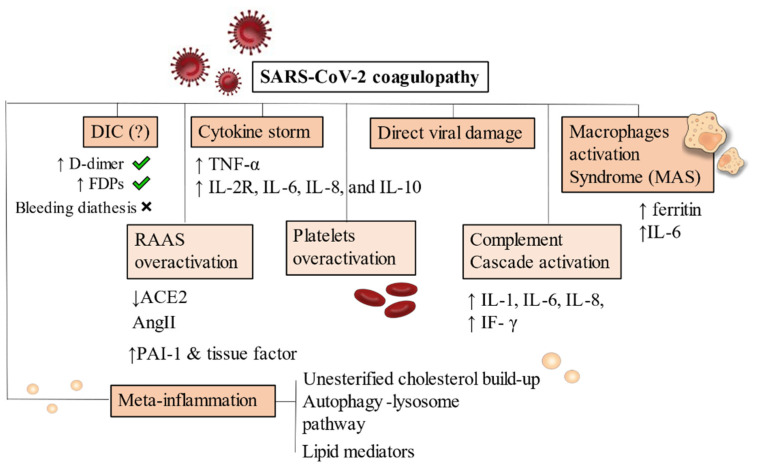
Severe Acute Respiratory Syndrome (SARS) Coronavirus (CoV)-2 is a recently identified positive sense single-strand RNA (ssRNA) β-coronavirus. The viral spike proteins infect human hosts by binding to the cellular receptor angiotensin-converting enzyme 2 (ACE2). The infection causes a systemic illness involving cell metabolism. This widespread involvement is implicated in the pathophysiology of the illness which ranges from mild to severe, requiring multi organ support, ranging from oxygen supplementation to full cardiovascular and respiratory support. Patients with multiple co-existing comorbidities are also at a higher risk. The aim of this review is to explore the exact mechanisms by which COVID-19 affects patients systemically with a primary focus on the bleeding and thrombotic complications linked with the disease. Issues surrounding the thrombotic complications following administration of the ChAdOx1 nCoV-19 (Astra-Zeneca-Oxford) vaccine have also been illustrated. Risk stratification and treatment options in these patients should be tailored according to clinical severity with input from a multidisciplinary team.
严重急性呼吸综合征冠状病毒2型(SARS-CoV-2)是一种最近发现的正链单股RNA(ssRNA)β冠状病毒。病毒刺突蛋白通过与细胞受体血管紧张素转换酶2(ACE2)结合来感染人类宿主。该感染会引发一种涉及细胞代谢的全身性疾病。这种广泛的累及与该疾病的病理生理学相关,疾病严重程度从轻度到重度不等,需要多器官支持,从补充氧气到全面的心血管和呼吸支持。患有多种并存合并症的患者风险也更高。本综述的目的是探讨2019冠状病毒病(COVID-19)对患者产生全身性影响的确切机制,主要关注与该疾病相关的出血和血栓形成并发症。还阐述了接种ChAdOx1 nCoV-19(阿斯利康-牛津)疫苗后出现的血栓形成并发症相关问题。这些患者的风险分层和治疗方案应根据临床严重程度进行调整,并由多学科团队提供指导。