Department of Pharmacology, All India Institute of Medical Sciences (AIIMS), Rishikesh 249203, India.
Department of Zoology, Shivaji College, University of Delhi, Delhi 110027, India.
Cells. 2021 Apr 6;10(4):821. doi: 10.3390/cells10040821.
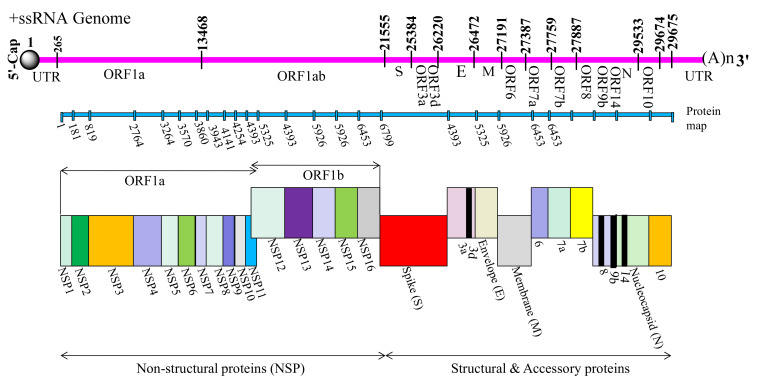
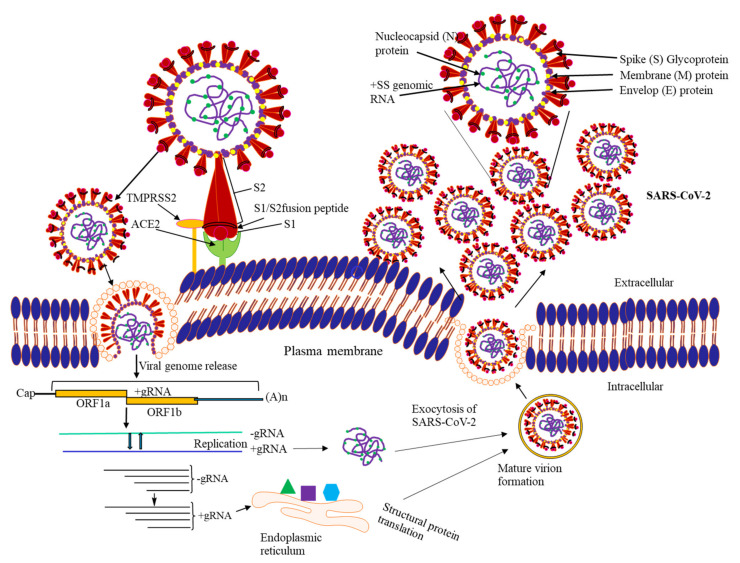
Coronavirus belongs to the family of Coronaviridae, comprising single-stranded, positive-sense RNA genome (+ ssRNA) of around 26 to 32 kilobases, and has been known to cause infection to a myriad of mammalian hosts, such as humans, cats, bats, civets, dogs, and camels with varied consequences in terms of death and debilitation. Strikingly, novel coronavirus (2019-nCoV), later renamed as severe acute respiratory syndrome coronavirus-2 (SARS-CoV-2), and found to be the causative agent of coronavirus disease-19 (COVID-19), shows 88% of sequence identity with bat-SL-CoVZC45 and bat-SL-CoVZXC21, 79% with SARS-CoV and 50% with MERS-CoV, respectively. Despite key amino acid residual variability, there is an incredible structural similarity between the receptor binding domain (RBD) of spike protein (S) of SARS-CoV-2 and SARS-CoV. During infection, spike protein of SARS-CoV-2 compared to SARS-CoV displays 10-20 times greater affinity for its cognate host cell receptor, angiotensin-converting enzyme 2 (ACE2), leading proteolytic cleavage of S protein by transmembrane protease serine 2 (TMPRSS2). Following cellular entry, the ORF-1a and ORF-1ab, located downstream to 5' end of + ssRNA genome, undergo translation, thereby forming two large polyproteins, pp1a and pp1ab. These polyproteins, following protease-induced cleavage and molecular assembly, form functional viral RNA polymerase, also referred to as replicase. Thereafter, uninterrupted orchestrated replication-transcription molecular events lead to the synthesis of multiple nested sets of subgenomic mRNAs (sgRNAs), which are finally translated to several structural and accessory proteins participating in structure formation and various molecular functions of virus, respectively. These multiple structural proteins assemble and encapsulate genomic RNA (gRNA), resulting in numerous viral progenies, which eventually exit the host cell, and spread infection to rest of the body. In this review, we primarily focus on genomic organization, structural and non-structural protein components, and potential prospective molecular targets for development of therapeutic drugs, convalescent plasm therapy, and a myriad of potential vaccines to tackle SARS-CoV-2 infection.
冠状病毒属于冠状病毒科,由单链、正链 RNA 基因组(+ ssRNA)组成,约 26 到 32 千碱基,已知可感染多种哺乳动物宿主,如人类、猫、蝙蝠、果子狸、狗和骆驼,导致死亡和衰弱的后果各不相同。引人注目的是,新型冠状病毒(2019-nCoV),后来更名为严重急性呼吸系统综合征冠状病毒 2(SARS-CoV-2),并被发现是导致冠状病毒病 19(COVID-19)的病原体,与蝙蝠-SL-CoVZC45 和蝙蝠-SL-CoVZXC21 的序列同一性分别为 88%,与 SARS-CoV 的序列同一性为 79%,与 MERS-CoV 的序列同一性为 50%。尽管关键氨基酸残基的变异性很大,但 SARS-CoV-2 的刺突蛋白(S)的受体结合域(RBD)与 SARS-CoV 之间存在惊人的结构相似性。在感染过程中,与 SARS-CoV 相比,SARS-CoV-2 的刺突蛋白对其同源宿主细胞受体血管紧张素转换酶 2(ACE2)的亲和力高 10-20 倍,导致 S 蛋白被跨膜蛋白酶丝氨酸 2(TMPRSS2)的蛋白水解切割。进入细胞后,位于+ ssRNA 基因组 5'端下游的 ORF-1a 和 ORF-1ab 进行翻译,从而形成两个大的多蛋白,pp1a 和 pp1ab。这些多蛋白在蛋白酶诱导的切割和分子组装后,形成功能性病毒 RNA 聚合酶,也称为复制酶。此后,连续协调的复制转录分子事件导致多个嵌套的亚基因组 mRNA(sgRNA)的合成,最终翻译为参与病毒结构形成和各种分子功能的几个结构和辅助蛋白。这些多种结构蛋白组装并包裹基因组 RNA(gRNA),导致大量病毒后代,最终离开宿主细胞,并将感染传播到身体的其他部位。在这篇综述中,我们主要关注基因组组织、结构和非结构蛋白成分,以及开发治疗药物、恢复期血浆治疗和针对 SARS-CoV-2 感染的多种潜在疫苗的潜在前瞻性分子靶点。