Palmiero Giuseppe, Cesaro Arturo, Vetrano Erica, Pafundi Pia Clara, Galiero Raffaele, Caturano Alfredo, Moscarella Elisabetta, Gragnano Felice, Salvatore Teresa, Rinaldi Luca, Calabrò Paolo, Sasso Ferdinando Carlo
Department of Translational Medical Sciences, University of Campania "Luigi Vanvitelli", I-80131 Naples, Italy.
Division of Cardiology, A.O.R.N. "Sant'Anna & San Sebastiano", I-81100 Caserta, Italy.
Int J Mol Sci. 2021 May 30;22(11):5863. doi: 10.3390/ijms22115863.
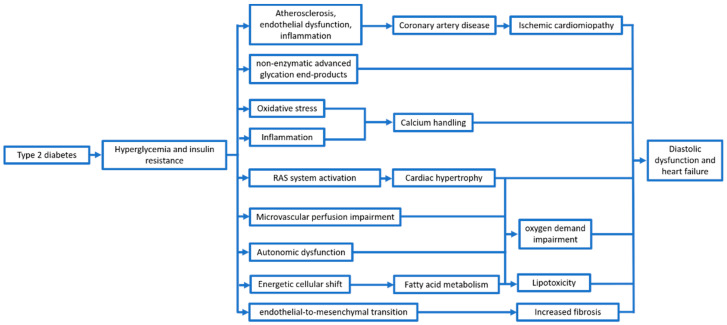
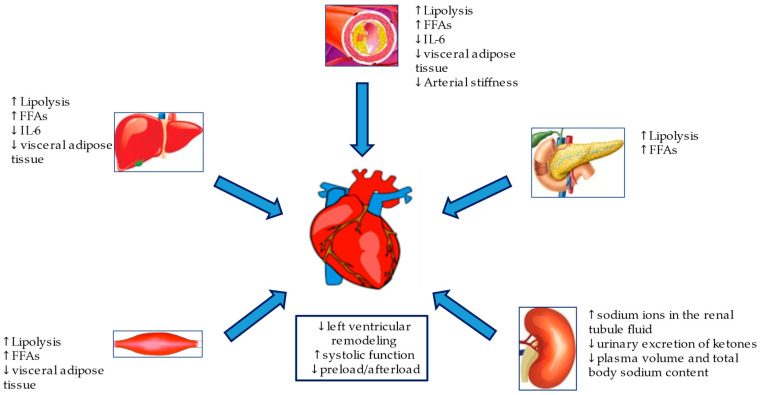
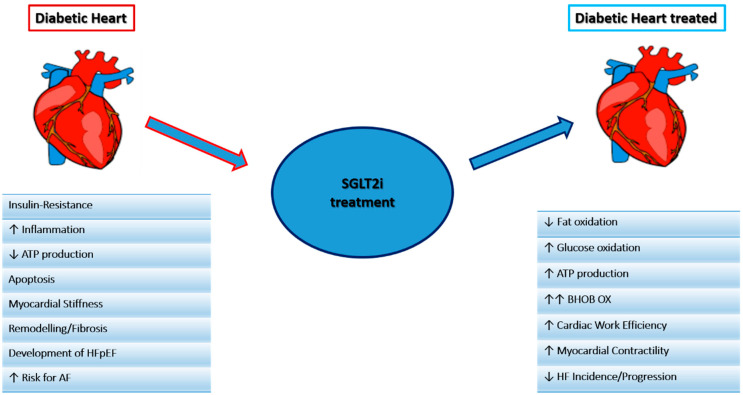
Heart failure (HF) affects up to over 20% of patients with type 2 diabetes (T2DM), even more in the elderly. Although, in T2DM, both hyperglycemia and the proinflammatory status induced by insulin resistance are crucial in cardiac function impairment, SGLT2i cardioprotective mechanisms against HF are several. In particular, these beneficial effects seem attributable to the significant reduction of intracellular sodium levels, well-known to exert a cardioprotective role in the prevention of oxidative stress and consequent cardiomyocyte death. From a molecular perspective, patients' exposure to gliflozins' treatment mimics nutrient and oxygen deprivation, with consequent autophagy stimulation. This allows to maintain the cellular homeostasis through different degradative pathways. Thus, since their introduction in the clinical practice, the hypotheses on SGLT2i mechanisms of action have changed: from simple glycosuric drugs, with consequent glucose lowering, erythropoiesis enhancing and ketogenesis stimulating, to intracellular sodium-lowering molecules. This provides their consequent cardioprotective effect, which justifies its significant reduction in CV events, especially in populations at higher risk. Finally, the updated clinical evidence of SGLT2i benefits on HF was summarized. Thus, this review aimed to analyze the cardioprotective mechanisms of sodium glucose transporter 2 inhibitors (SGLT2i) in patients with HF, as well as their clinical impact on cardiovascular events.
心力衰竭(HF)影响高达20%以上的2型糖尿病(T2DM)患者,在老年人中比例更高。虽然在T2DM中,高血糖和胰岛素抵抗诱导的促炎状态在心脏功能损害中都很关键,但钠-葡萄糖协同转运蛋白2抑制剂(SGLT2i)对HF的心脏保护机制有多种。特别是,这些有益作用似乎归因于细胞内钠水平的显著降低,众所周知,这在预防氧化应激及随之而来的心肌细胞死亡方面发挥着心脏保护作用。从分子角度来看,患者接受格列净类药物治疗类似于营养和氧气剥夺,从而刺激自噬。这使得通过不同的降解途径维持细胞内稳态。因此,自SGLT2i引入临床实践以来,其作用机制的假设已经发生了变化:从单纯的降糖药物,随之带来血糖降低、促红细胞生成增强和生酮刺激,转变为降低细胞内钠的分子。这产生了相应的心脏保护作用,这也解释了其能显著降低心血管事件,尤其是在高风险人群中。最后,总结了SGLT2i对HF有益作用的最新临床证据。因此,本综述旨在分析钠-葡萄糖协同转运蛋白2抑制剂(SGLT2i)在HF患者中的心脏保护机制,以及它们对心血管事件的临床影响。