Marzilli Eleonora, Cerniglia Luca, Cimino Silvia
Department of Dynamic and Clinical Psychology, Sapienza, University of Rome, Via degli Apuli, 1, 00185 Rome, Italy.
Faculty of Psychology, International Telematic University Uninettuno, 00186 Rome, Italy.
Brain Sci. 2021 May 23;11(6):687. doi: 10.3390/brainsci11060687.
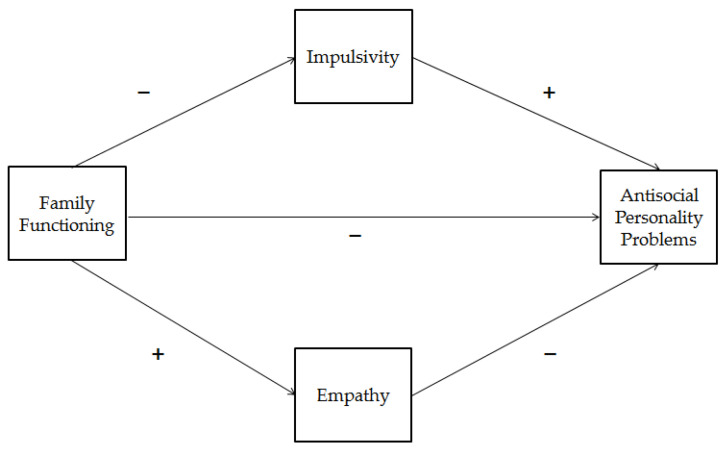
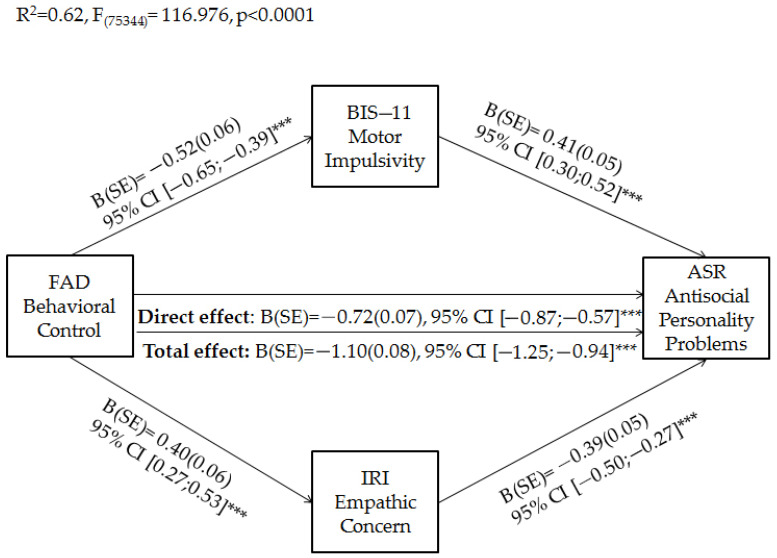
International research has evidenced the key role played by adults' and adolescents' family functioning, impulsivity, and empathy in antisocial personality problems. To date, no study has assessed the complex interaction between these variables during emerging adulthood. This study aimed to explore the possible interplay between antisocial personality problems, the quality of family functioning, impulsivity, and empathetic problems in a community sample of 350 emerging adults. Descriptive, correlational, hierarchical regression, and mediation analyses were performed, controlling relevant socio-demographic variables. Results showed a predictive effect of parental behavioral control, motor impulsivity, and empathetic concern in antisocial personality problems. Moreover, motor impulsivity and empathetic concern partially mediated the relationship between parental behavioral control and emerging adults' antisocial personality problems. This study supports the recent evidence on the complex relationship between individual and relational protective and risk factors involved in antisocial personality problems during emerging adulthood, with important implications for their intervention treatments.
国际研究已经证明了成年人和青少年的家庭功能、冲动性和同理心在反社会人格问题中所起的关键作用。迄今为止,尚无研究评估这些变量在成年初期的复杂相互作用。本研究旨在探讨350名成年初期个体的社区样本中反社会人格问题、家庭功能质量、冲动性和同理心问题之间可能存在的相互作用。进行了描述性、相关性、层次回归和中介分析,并控制了相关的社会人口统计学变量。结果显示,父母行为控制、运动冲动性和同理心关怀对反社会人格问题具有预测作用。此外,运动冲动性和同理心关怀部分中介了父母行为控制与成年初期个体反社会人格问题之间的关系。本研究支持了近期有关成年初期反社会人格问题中个体和关系性保护因素与风险因素之间复杂关系的证据,这对其干预治疗具有重要意义。