Proboste Tatiana, Deressa Feyissa Begna, Li Yanjin, Kal David Onafruo, Gelalcha Benti Deressa, Soares Magalhães Ricardo J
UQ Spatial Epidemiology Laboratory, School of Veterinary Science, The University of Queensland, Gatton, QLD 4343, Australia.
School of Veterinary Medicine, College of Agriculture and Veterinary Medicine, Jimma University, Jimma P.O. Box 307, Ethiopia.
Pathogens. 2021 May 23;10(6):646. doi: 10.3390/pathogens10060646.
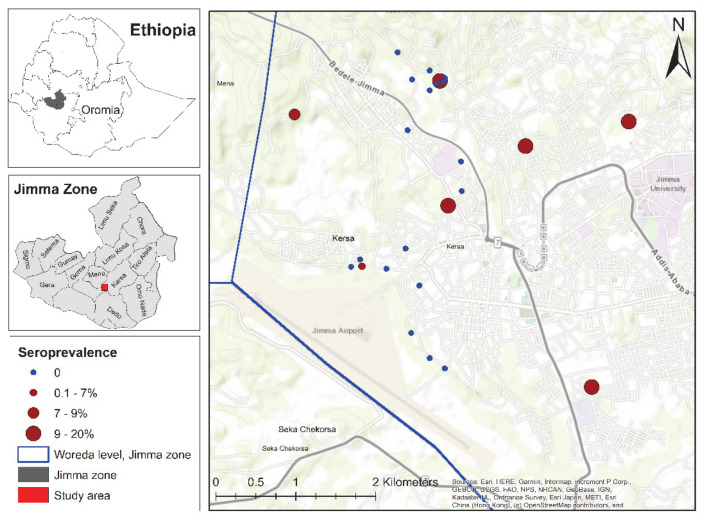
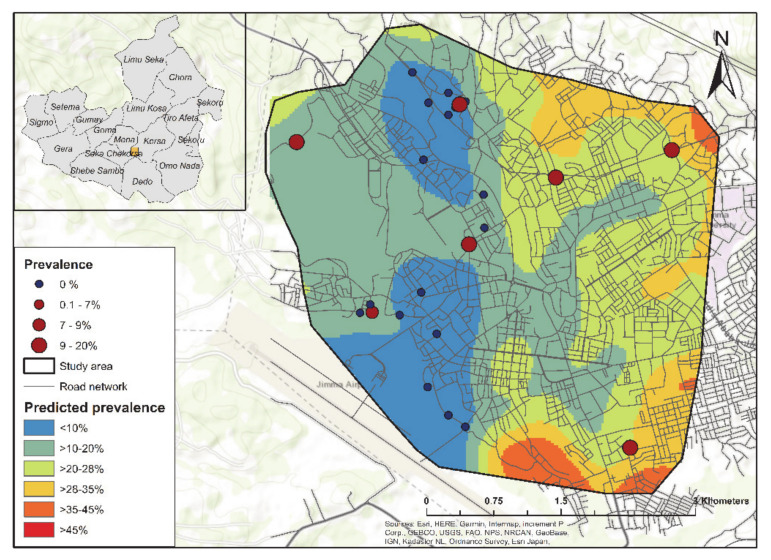
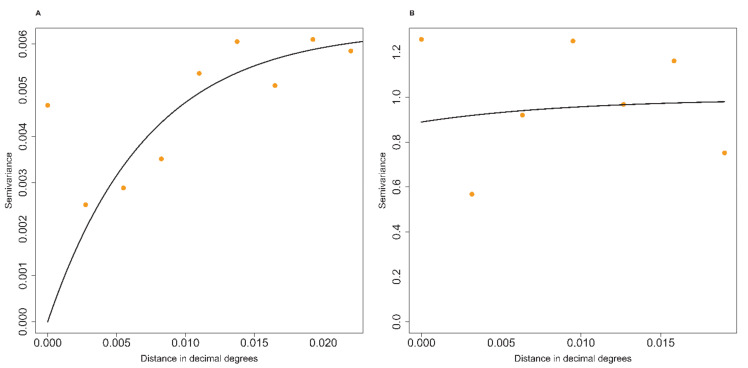
Q fever is a zoonotic disease that is caused by and leads to abortion and infertility in ruminants and debilitating disease in humans. Jimma zone, including Jimma town, located in the Oromia region of Ethiopia, was affected by an outbreak of abortions in ruminants related to Q fever infection between 2013 and 2015. This study aimed to investigate the geo-clustering of seroprevalence in dairy farms of Jimma town and identify the environmental risk factors associated with seroprevalence distribution. A total of 227 cattle were tested for antibodies against in 25 farms. We explored the clustering of seroprevalence using semivariograms. A geostatistical regression-based model was implemented to quantify the risk factors and to predict the geographical variation in seroprevalence at unsampled locations in Jimma town using OpenBugs. Our results demonstrated that the risk of exposure in dairy cattle varied across the landscape of Jimma town and was associated with environmental risk factors. The predictive map of seroprevalence showed that communities in the eastern part of Jimma town had the highest risk of exposure. Our results can inform community-level investigations of human seroprevalence in the high-risk areas to the east of Jimma.
Q热是一种人畜共患病,由其引起的疾病会导致反刍动物流产和不育,以及人类患上使人虚弱的疾病。包括吉马镇在内的吉马地区位于埃塞俄比亚奥罗米亚州,在2013年至2015年期间受到与Q热感染相关的反刍动物流产疫情影响。本研究旨在调查吉马镇奶牛场血清阳性率的地理聚集情况,并确定与血清阳性率分布相关的环境风险因素。在25个农场对总共227头牛进行了针对[病原体名称未给出]的抗体检测。我们使用半变异函数探索了[病原体名称未给出]血清阳性率的聚集情况。实施了基于地理统计回归的模型,以量化风险因素,并使用OpenBugs预测吉马镇未采样地点[病原体名称未给出]血清阳性率的地理变化。我们的结果表明,奶牛的暴露风险在吉马镇各地有所不同,并且与环境风险因素有关。[病原体名称未给出]血清阳性率的预测地图显示,吉马镇东部的社区暴露风险最高。我们的结果可为吉马以东高风险地区人类血清阳性率的社区层面调查提供信息。