Magallares Berta, Lobo-Prat David, Castellví Ivan, Moya Patricia, Gich Ignasi, Martinez-Martinez Laura, Park Hye, Millán Ana Milena, Laiz Ana, Díaz-Torné César, Fernandez Susana, Corominas Hèctor
Department of Rheumatology, Hospital de la Santa Creu i Sant Pau, 08025 Barcelona, Spain.
Sant Pau Biomedical Research Institute (IIB Sant Pau), 08025 Barcelona, Spain.
J Clin Med. 2021 May 28;10(11):2377. doi: 10.3390/jcm10112377.
Different classification criteria for systemic lupus erythematosus (SLE) have been launched over the years. Our aim was to evaluate the performance of the EULAR/ACR-2019, SLICC-2012 and ACR-1997 classification criteria in a cohort of SLE patients with longstanding disease.
Descriptive observational study in 79 patients with established and longstanding SLE. The three classification criteria sets were applied to those patients.
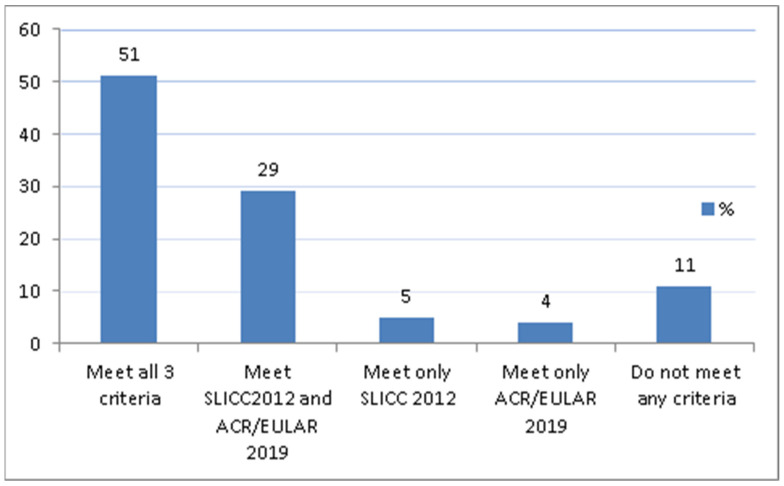
Of the 79 patients, 70 were women (88.6%), with a mean age of 51.8 ± 14 years and a mean disease duration of 15.2 ± 11.5 years. The sensitivity of the different criteria were: 51.9%, 87.3% and 86.1% for ACR-1997, SLICC-2012 and EULAR/ACR-2019, respectively. In total, 68 out of 79 patients (53.7%) met all three classification criteria; 11.4% did not meet any classification criteria and were characterized by low SLEDAI (0.6 ± 0.9), low SLICC/ACR Damage Index (0.88 ± 0.56) and fulfilling only skin domains, antiphospholipid antibodies or hypocomplementemia. To fulfill EULAR/ACR-2019 criteria was associated with low complement levels ( < 0.04), high anti-dsDNA levels ( < 0.001), presence of lupus nephritis III-IV ( < 0.05) and arthritis ( < 0.001).
The EULAR/ACR-2019 classification criteria showed high sensitivity, similar to SLICC-2012, in SLE patients with longstanding disease. Patients with serological, articular or renal involvement are more likely to fulfill SLICC-2012 or EULAR/ACR-2019 criteria.
多年来已推出不同的系统性红斑狼疮(SLE)分类标准。我们的目的是评估欧洲抗风湿病联盟/美国风湿病学会(EULAR/ACR)2019年、系统性红斑狼疮国际协作临床联盟(SLICC)2012年和美国风湿病学会(ACR)1997年分类标准在一组患有长期疾病的SLE患者中的表现。
对79例确诊且患有长期SLE的患者进行描述性观察研究。将这三种分类标准应用于这些患者。
79例患者中,70例为女性(88.6%),平均年龄为51.8±14岁,平均病程为15.2±11.5年。不同标准的敏感性分别为:ACR-1997为51.9%,SLICC-2012为87.3%,EULAR/ACR-2019为86.1%。79例患者中共有68例(53.7%)符合所有三种分类标准;11.4%的患者不符合任何分类标准,其特点是系统性红斑狼疮疾病活动指数(SLEDAI)较低(0.6±0.9)、系统性红斑狼疮国际协作临床联盟/美国风湿病学会损伤指数(SLICC/ACR)较低(0.88±0.56),仅满足皮肤领域、抗磷脂抗体或低补体血症。符合EULAR/ACR-2019标准与低补体水平(<0.04)、高抗双链DNA水平(<0.001)、狼疮性肾炎III-IV期(<0.05)和关节炎(<0.001)相关。
EULAR/ACR-2019分类标准在患有长期疾病的SLE患者中显示出与SLICC-2012相似的高敏感性。有血清学、关节或肾脏受累的患者更有可能符合SLICC-2012或EULAR/ACR-2019标准。