Barickman T Casey, Olorunwa Omolayo J, Sehgal Akanksha, Walne C Hunt, Reddy K Raja, Gao Wei
North Mississippi Research and Extension Center, Mississippi State University, Verona, MS 38879, USA.
Department of Plant and Soil Sciences, Mississippi State University, Mississippi State, MS 39762, USA.
Plants (Basel). 2021 May 27;10(6):1072. doi: 10.3390/plants10061072.
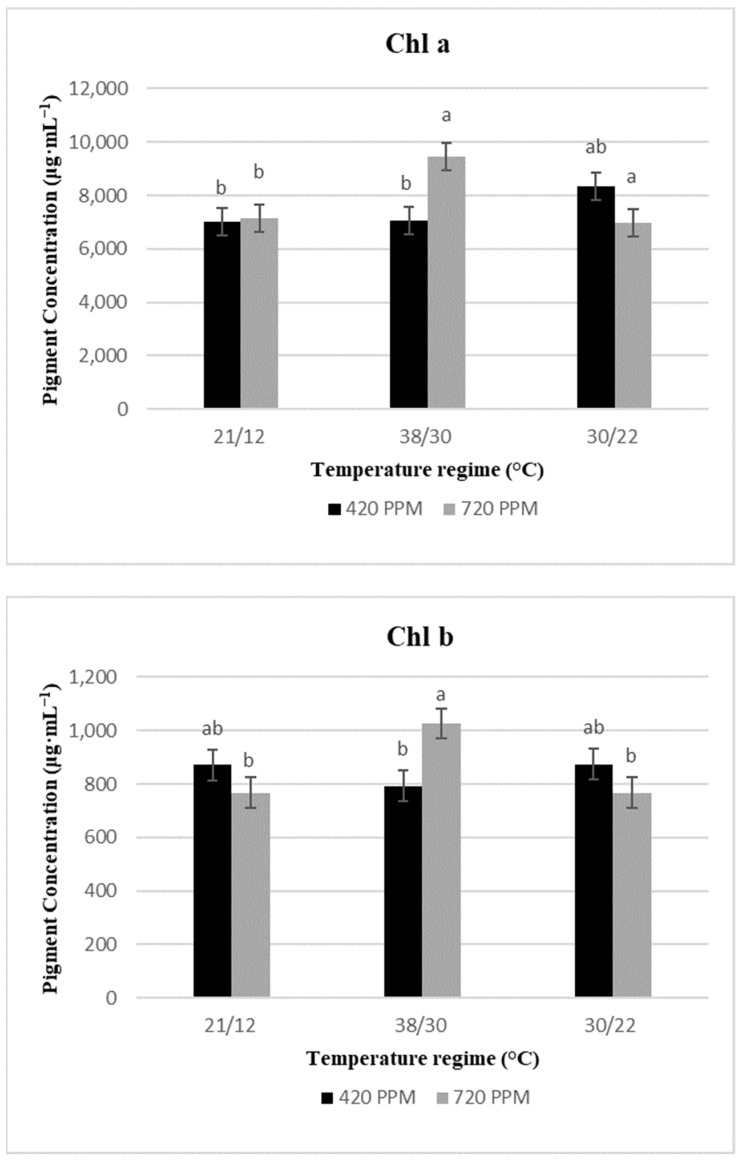
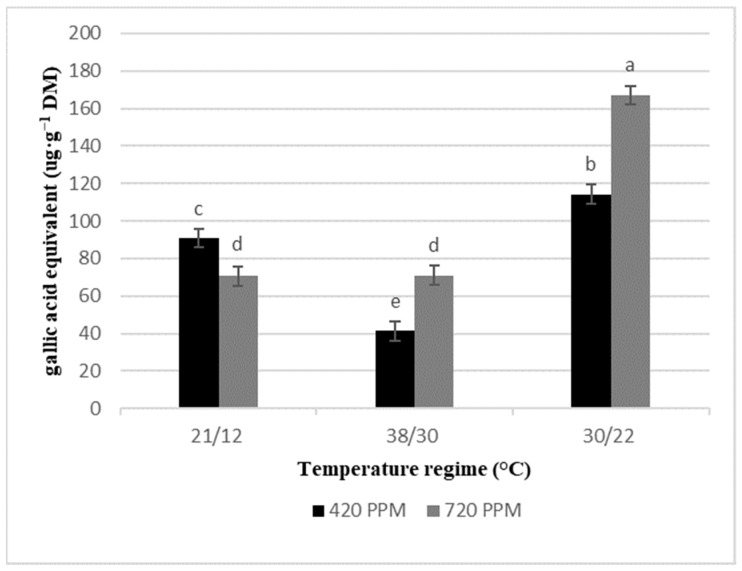
Early season sowing is one of the methods for avoiding yield loss for basil due to high temperatures. However, basil could be exposed to sub-optimal temperatures by planting it earlier in the season. Thus, an experiment was conducted that examines how temperature changes and carbon dioxide (CO) levels affect basil growth, development, and phytonutrient concentrations in a controlled environment. The experiment simulated temperature stress, low (20/12 °C), and high (38/30 °C), under ambient (420 ppm) and elevated (720 ppm) CO concentrations. Low-temperature stress prompted the rapid closure of stomata resulting in a 21% decline in net photosynthesis. Chlorophylls and carotenoids decreased when elevated CO interacted with low-temperature stress. Basil exhibited an increase in stomatal conductance, intercellular CO concentration, apparent quantum yield, maximum photosystem II efficiency, and maximum net photosynthesis rate when subjected to high-temperature stress. Under elevated CO, increasing the growth temperature from 30/22 °C to 38/30 °C markedly increased the antioxidants content of basil. Taken together, the evidence from this research recommends that varying the growth temperature of basil plants can significantly affect the growth and development rates compared to increasing the CO concentrations, which mitigates the adverse effects of temperature stress.
早季播种是避免罗勒因高温导致产量损失的方法之一。然而,在季节早期种植罗勒可能会使其暴露在次优温度下。因此,进行了一项实验,研究在可控环境中温度变化和二氧化碳(CO)水平如何影响罗勒的生长、发育和植物营养素浓度。该实验模拟了环境(420 ppm)和升高(720 ppm)的CO浓度下的温度胁迫,低温(20/12°C)和高温(38/30°C)。低温胁迫促使气孔迅速关闭,导致净光合作用下降21%。当升高的CO与低温胁迫相互作用时,叶绿素和类胡萝卜素减少。罗勒在遭受高温胁迫时,气孔导度、细胞间CO浓度、表观量子产率、最大光系统II效率和最大净光合速率均有所增加。在升高的CO条件下,将生长温度从30/22°C提高到38/30°C显著增加了罗勒的抗氧化剂含量。综上所述,该研究的证据表明,与增加CO浓度相比,改变罗勒植株的生长温度对其生长和发育速率有显著影响,增加CO浓度可减轻温度胁迫的不利影响。