Ludwig Boltzmann Institute for Arthritis and Rehabilitation, 5760 Saalfelden, Austria.
Department of Orthopedics and Trauma, Medical University Graz, 8036 Graz, Austria.
Int J Mol Sci. 2021 May 31;22(11):5959. doi: 10.3390/ijms22115959.
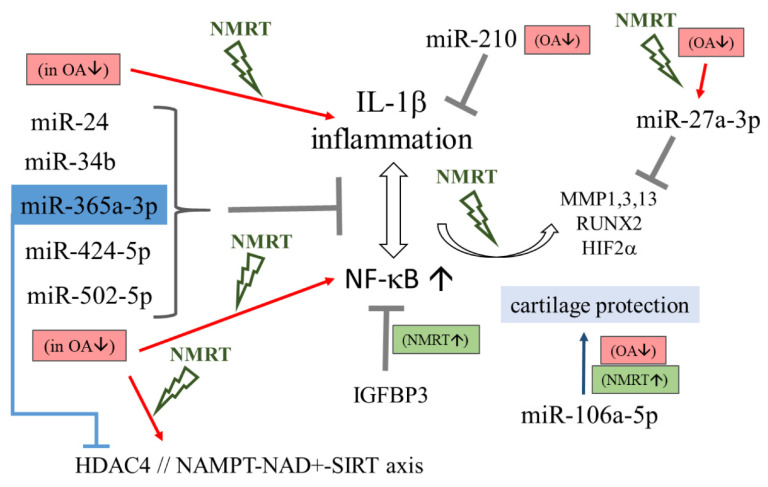
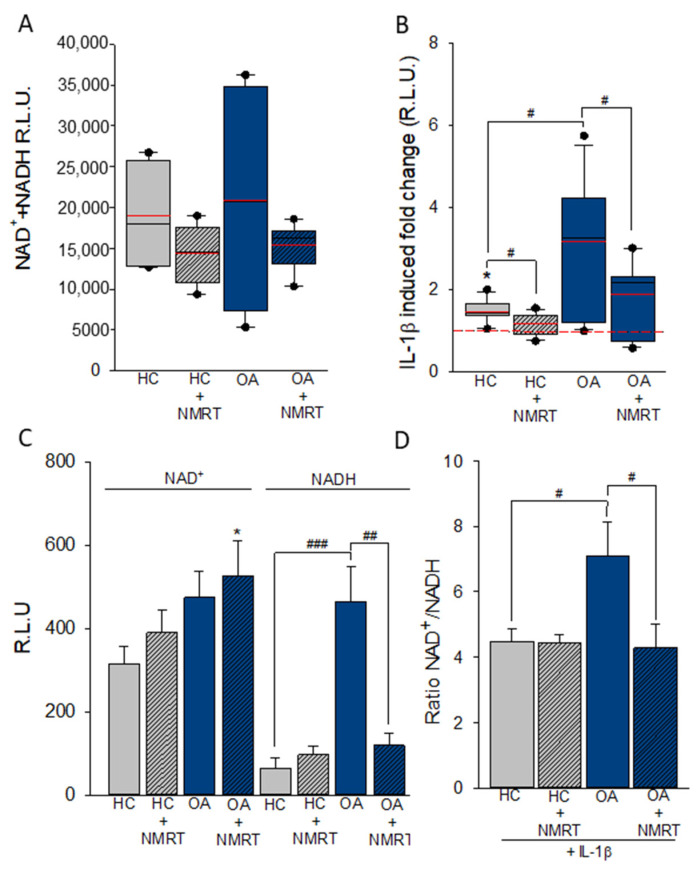
Nuclear magnetic resonance therapy (NMRT) is discussed as a participant in repair processes regarding cartilage and as an influence in pain signaling. To substantiate the application of NMRT, the underlying mechanisms at the cellular level were studied. In this study microRNA (miR) was extracted from human primary healthy and osteoarthritis (OA) chondrocytes after NMR treatment and was sequenced by the Ion PI Hi-Q™ Sequencing 200 system. In addition, T/C-28a2 chondrocytes grown under hypoxic conditions were studied for IL-1β induced changes in expression on RNA and protein level. HDAC activity an NAD/NADH was measured by luminescence detection. In OA chondrocytes miR-106a, miR-27a, miR-34b, miR-365a and miR-424 were downregulated. This downregulation was reversed by NMRT. miR-365a-5p is known to directly target HDAC and NF-ĸB, and a decrease in HDAC activity by NMRT was detected. NAD/NADH was reduced by NMR treatment in OA chondrocytes. Under hypoxic conditions NMRT changed the expression profile of HIF1, HIF2, IGF2, MMP3, MMP13, and RUNX1. We conclude that NMRT changes the miR profile and modulates the HDAC and the NAD/NADH signaling in human chondrocytes. These findings underline once more that NMRT counteracts IL-1β induced changes by reducing catabolic effects, thereby decreasing inflammatory mechanisms under OA by changing NF-ĸB signaling.
核磁共振治疗(NMRT)被讨论作为一种参与软骨修复过程的方法,以及一种影响疼痛信号的方法。为了证实 NMRT 的应用,在细胞水平上研究了其潜在的机制。在这项研究中,从人类原代健康和骨关节炎(OA)软骨细胞中提取了 microRNA(miR),并通过 Ion PI Hi-Q™Sequencing 200 系统进行测序。此外,还研究了在缺氧条件下生长的 T/C-28a2 软骨细胞中,IL-1β诱导的 RNA 和蛋白质水平表达变化。通过发光检测测量 HDAC 活性和 NAD/NADH。在 OA 软骨细胞中,miR-106a、miR-27a、miR-34b、miR-365a 和 miR-424 的表达下调。NMRT 逆转了这种下调。miR-365a-5p 已知可直接靶向 HDAC 和 NF-ĸB,并且通过 NMRT 检测到 HDAC 活性降低。NMR 处理在 OA 软骨细胞中降低了 NAD/NADH。在缺氧条件下,NMRT 改变了 HIF1、HIF2、IGF2、MMP3、MMP13 和 RUNX1 的表达谱。我们得出结论,NMRT 改变了人类软骨细胞的 miR 谱,并调节了 HDAC 和 NAD/NADH 信号通路。这些发现再次强调,NMRT 通过降低分解代谢作用来对抗 IL-1β诱导的变化,从而通过改变 NF-ĸB 信号来减少 OA 下的炎症机制。