Rodríguez-Pupo Eya Caridad, Pérez-Llano Yordanis, Tinoco-Valencia José Raunel, Sánchez Norma Silvia, Padilla-Garfias Francisco, Calahorra Martha, Sánchez Nilda Del C, Sánchez-Reyes Ayixón, Rodríguez-Hernández María Del Rocío, Peña Antonio, Sánchez Olivia, Aguirre Jesús, Batista-García Ramón Alberto, Folch-Mallol Jorge Luis, Sánchez-Carbente María Del Rayo
Centro de Investigación en Biotecnología, Universidad Autónoma del Estado de Morelos (UAEM), Av. Universidad 1001, Col. Chamilpa, Cuernavaca C.P. 62209, Morelos, Mexico.
Centro de Investigación en Dinámica Celular, IICBA, UAEM, Av. Universidad 1001, Col. Chamilpa, Cuernavaca C.P. 62209, Morelos, Mexico.
J Fungi (Basel). 2021 May 26;7(6):414. doi: 10.3390/jof7060414.
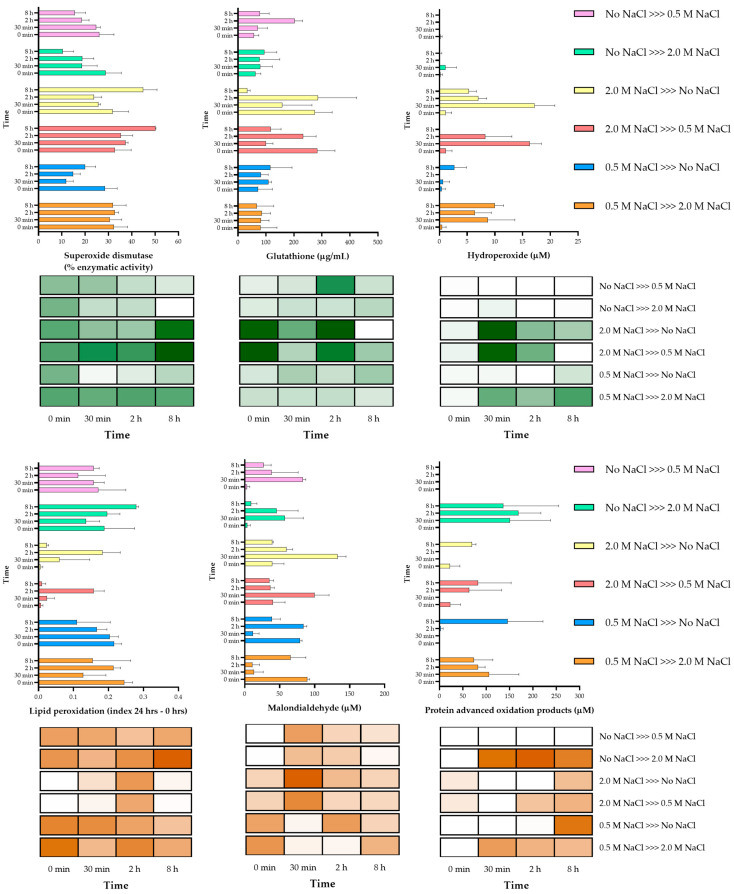
is a moderate halophile fungus extensively studied for its biotechnological potential and halophile responses, which has also been reported as a coral reef pathogen. In a recent publication, the transcriptomic analysis of this fungus, when growing on wheat straw, showed that genes related to cell wall modification and cation transporters were upregulated under hypersaline conditions but not under 0.5 M NaCl, the optimal salinity for growth in this strain. This led us to study osmolyte accumulation as a mechanism to withstand moderate salinity. In this work, we show that accumulates trehalose, arabitol, mannitol, and glycerol with different temporal dynamics, which depend on whether the fungus is exposed to hypo- or hyperosmotic stress. The transcripts coding for enzymes responsible for polyalcohol synthesis were regulated in a stress-dependent manner. Interestingly, contains three homologs (Hog1, Hog2 and MpkC) of the Hog1 MAPK, the master regulator of hyperosmotic stress response in and other fungi. We show a differential regulation of these MAPKs under different salinity conditions, including sustained basal Hog1/Hog2 phosphorylation levels in the absence of NaCl or in the presence of 2.0 M NaCl, in contrast to what is observed in . These findings indicate that halophilic fungi such as utilize different osmoadaptation mechanisms to hypersaline conditions.
是一种中度嗜盐真菌,因其生物技术潜力和嗜盐反应而受到广泛研究,它也被报道为一种珊瑚礁病原体。在最近的一篇出版物中,对这种真菌在小麦秸秆上生长时的转录组分析表明,与细胞壁修饰和阳离子转运蛋白相关的基因在高盐条件下上调,但在0.5M NaCl(该菌株生长的最佳盐度)条件下未上调。这促使我们研究渗透溶质积累作为一种耐受中度盐度的机制。在这项工作中,我们表明该真菌积累海藻糖、阿拉伯糖醇、甘露醇和甘油的时间动态不同,这取决于真菌是暴露于低渗还是高渗胁迫。负责多元醇合成的酶的编码转录本以应激依赖的方式受到调节。有趣的是,该真菌含有Hog1 MAPK的三个同源物(Hog1、Hog2和MpkC),Hog1 MAPK是酿酒酵母和其他真菌中高渗应激反应的主要调节因子。我们展示了这些MAPK在不同盐度条件下的差异调节,包括在无NaCl或存在2.0M NaCl时Hog1/Hog2持续的基础磷酸化水平,这与在酿酒酵母中观察到的情况相反。这些发现表明,像该真菌这样的嗜盐真菌利用不同的渗透适应机制来应对高盐条件。