VTT Technical Research Centre of Finland, Tampere, Finland.
Health Sciences, Faculty of Social Sciences, Tampere University, Tampere, Finland.
J Med Internet Res. 2021 Jun 28;23(6):e25529. doi: 10.2196/25529.
Frequent self-weighing is associated with successful weight loss and weight maintenance during and after weight loss interventions. Less is known about self-weighing behaviors and associated weight change in free-living settings.
This study aimed to investigate the association between the frequency of self-weighing and changes in body weight in a large international cohort of smart scale users.
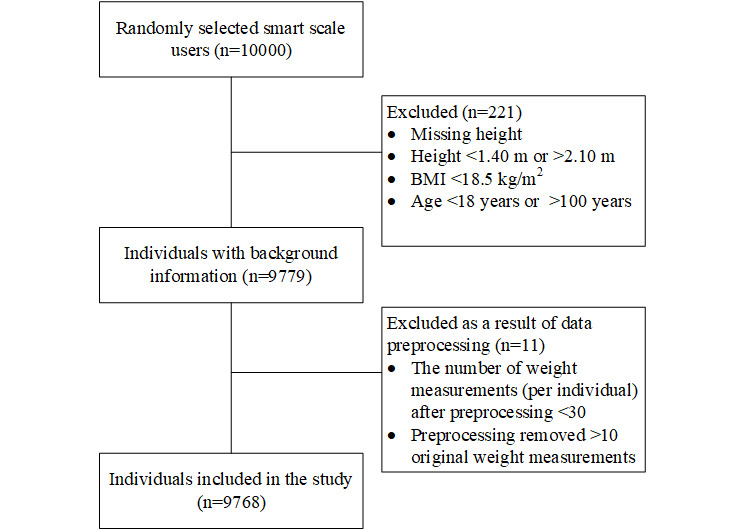
This was an observational cohort study with 10,000 randomly selected smart scale users who had used the scale for at least 1 year. Longitudinal weight measurement data were analyzed. The association between the frequency of self-weighing and weight change over the follow-up was investigated among normal weight, overweight, and obese users using Pearson's correlation coefficient and linear models. The association between the frequency of self-weighing and temporal weight change was analyzed using linear mixed effects models.
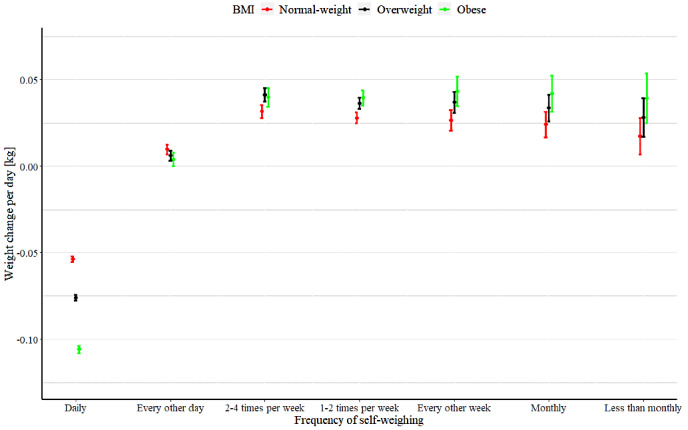
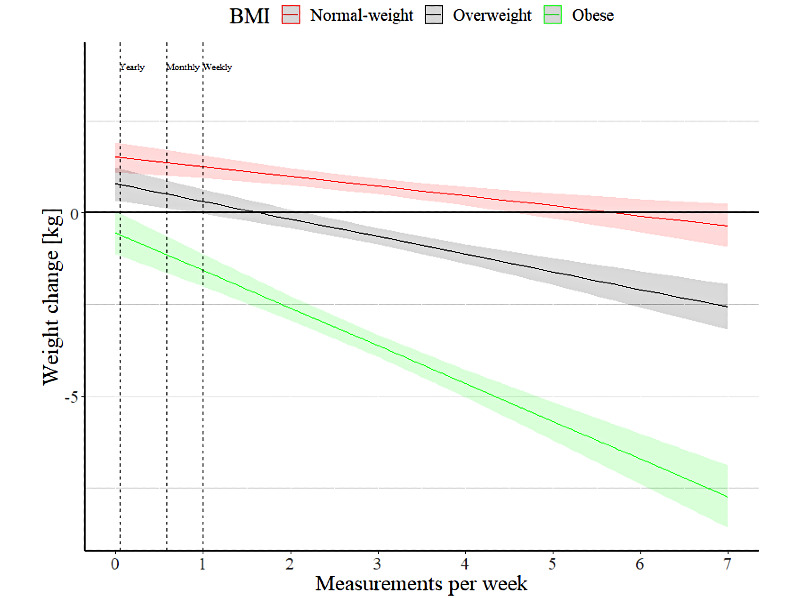
The eligible sample consisted of 9768 participants (6515/9768, 66.7% men; mean age 41.5 years; mean BMI 26.8 kg/m2). Of the participants, 4003 (4003/9768, 41.0%), 3748 (3748/9768, 38.4%), and 2017 (2017/9768, 20.6%) were normal weight, overweight, and obese, respectively. During the mean follow-up time of 1085 days, the mean weight change was -0.59 kg, and the mean percentage of days with a self-weigh was 39.98%, which equals 2.8 self-weighs per week. The percentage of self-weighing days correlated inversely with weight change, r=-0.111 (P<.001). Among normal weight, overweight, and obese individuals, the correlations were r=-0.100 (P<.001), r=-0.125 (P<.001), and r=-0.148 (P<.001), respectively. Of all participants, 72.5% (7085/9768) had at least one period of ≥30 days without weight measurements. During the break, weight increased, and weight gains were more pronounced among overweight and obese individuals: 0.58 kg in the normal weight group, 0.93 kg in the overweight group, and 1.37 kg in the obese group (P<.001).
Frequent self-weighing was associated with favorable weight loss outcomes also in an uncontrolled, free-living setting, regardless of specific weight loss interventions. The beneficial associations of regular self-weighing were more pronounced for overweight or obese individuals.
频繁的自我称重与减肥期间和减肥后的成功减肥和体重维持有关。在自由生活环境中,自我称重行为及其与体重变化的关系知之甚少。
本研究旨在调查在大量智能秤用户的国际队列中,自我称重频率与体重变化之间的关联。
这是一项观察性队列研究,共有 10000 名随机选择的智能秤用户使用该秤至少 1 年。对纵向体重测量数据进行了分析。使用 Pearson 相关系数和线性模型,在正常体重、超重和肥胖用户中研究了自我称重频率与随访期间体重变化之间的关系。使用线性混合效应模型分析自我称重频率与时间体重变化之间的关系。
合格样本包括 9768 名参与者(9768/9768,65.1%为男性;平均年龄 41.5 岁;平均 BMI 26.8kg/m2)。参与者中,4003 名(4003/9768,41.0%)、3748 名(3748/9768,38.4%)和 2017 名(2017/9768,20.6%)分别为正常体重、超重和肥胖。在平均 1085 天的随访期间,平均体重变化为-0.59kg,平均每周自我称重 2.8 次。自我称重天数的百分比与体重变化呈负相关,r=-0.111(P<.001)。在正常体重、超重和肥胖个体中,相关性分别为 r=-0.100(P<.001)、r=-0.125(P<.001)和 r=-0.148(P<.001)。在所有参与者中,72.5%(7085/9768)至少有一个 30 天以上没有体重测量的时期。在休息期间,体重增加,超重和肥胖个体的体重增加更为明显:正常体重组 0.58kg,超重组 0.93kg,肥胖组 1.37kg(P<.001)。
在不受控制的自由生活环境中,频繁的自我称重也与有利的减肥结果相关,无论特定的减肥干预措施如何。对于超重或肥胖个体,定期自我称重的有益关联更为明显。