Sanders Sarah Annalise, Wallace Meredith L, Burke Lora E, Tapia Amanda L, Rathbun Stephen L, Casas Andrea D, Gary-Webb Tiffany L, Davis Esa M, Méndez Dara D
Department of Behavioral & Community Health Sciences, School of Public Health, University of Pittsburgh, Pittsburgh, PA, United States.
Department of Epidemiology, School of Public Health, University of Pittsburgh, Pittsburgh, PA, United States.
Prev Med Rep. 2023 Jul 13;35:102320. doi: 10.1016/j.pmedr.2023.102320. eCollection 2023 Oct.
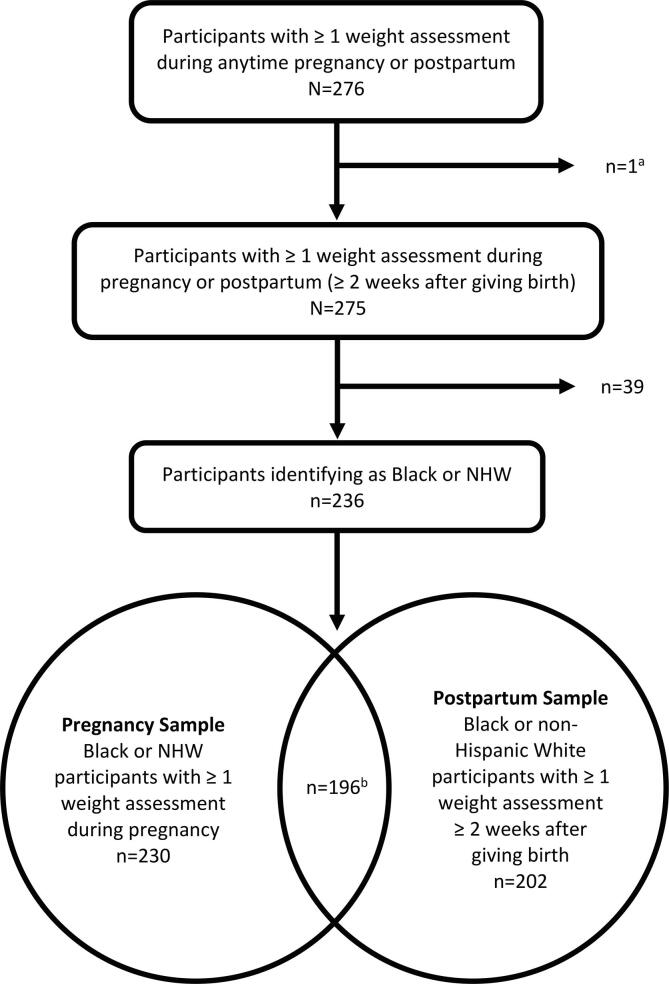
Black childbearing individuals in the US experience a higher risk of postpartum weight retention (PPWR) compared to their White counterparts. Given that PPWR is related to adverse health outcomes, it is important to investigate predictors of weight-related health behaviors, such as self-weighing (i.e., using a scale at home). Regular self-weighing is an evidence-based weight management strategy, but there is minimal insight into sociodemographic factors related to frequency. The Postpartum Mothers Mobile Study (PMOMS) facilitated longitudinal ambulatory weight assessments to investigate racial inequities in PPWR. Our objective for the present study was to describe self-weighing behavior during and after pregnancy in the PMOMS cohort, as well as related demographic and psychosocial factors. Applying tree modeling and multiple regression, we examined self-weighing during and after pregnancy. Participants (N = 236) were 30.2 years old on average (SD = 4.7), with the majority being college-educated (53.8%, n = 127), earning at least $30,000 annually (61.4%, n = 145), and self-identifying as non-Hispanic White (NHW; 68.2%, n = 161). Adherence to regular self-weighing (at least once weekly) was highest among participants during pregnancy, with a considerable decline after giving birth. Low-income Black participants (earning < $30,000) were significantly less likely to reach a completion rate of ≥ 80% during pregnancy (AOR = 0.10) or the postpartum period (AOR = 0.16), compared to NHW participants earning at least $30,000 annually. Increases in perceived stress were associated with decreased odds of sustained self-weighing after delivery (AOR = 0.79). Future research should consider behavioral differences across demographic intersections, such as race and socioeconomic status, and the impact on efficacy of self-weighing.
与美国白人育龄人群相比,黑人育龄人群产后体重滞留(PPWR)的风险更高。鉴于PPWR与不良健康后果相关,调查体重相关健康行为的预测因素很重要,比如自我称重(即在家使用体重秤)。定期自我称重是一种基于证据的体重管理策略,但对于与称重频率相关的社会人口学因素了解甚少。产后母亲移动研究(PMOMS)促进了纵向动态体重评估,以调查PPWR中的种族不平等现象。我们本研究的目的是描述PMOMS队列中孕期及产后的自我称重行为,以及相关的人口统计学和心理社会因素。应用树状模型和多元回归,我们研究了孕期及产后的自我称重情况。参与者(N = 236)平均年龄为30.2岁(标准差 = 4.7),大多数人受过大学教育(53.8%,n = 127),年收入至少3万美元(61.4%,n = 145),自我认定为非西班牙裔白人(NHW;68.2%,n = 161)。参与者在孕期坚持定期自我称重(至少每周一次)的比例最高,产后则大幅下降。与年收入至少3万美元的NHW参与者相比,低收入黑人参与者(年收入<3万美元)在孕期(调整后比值比 = 0.10)或产后达到≥80%完成率的可能性显著更低(调整后比值比 = 0.16)。感知压力增加与产后持续自我称重的几率降低相关(调整后比值比 = 0.79)。未来的研究应考虑不同人口统计学交叉点(如种族和社会经济地位)的行为差异,以及对自我称重效果的影响。