Boye Kristina S, Lage Maureen J, Shinde Shraddha, Thieu Vivian, Bae Jay Patrick
Eli Lilly and Company, Lilly Corporate Center, Indianapolis, IN, 46285, USA.
HealthMetrics Outcomes Research, 27576 River Reach Drive, Bonita Springs, FL, 34134, USA.
Diabetes Ther. 2021 Jul;12(7):2077-2087. doi: 10.1007/s13300-021-01084-0. Epub 2021 Jun 2.
Given the high rates of obesity and poor glycemic control among individuals with type 2 diabetes (T2D), this study examines current trends in HbA1c and body mass index (BMI) as well as the association between HbA1c and BMI among adults with T2D.
Data from the IBM® MarketScan® Explorys® Claims-EMR Data were used to construct eight annual cohorts for the years 2012-2019. Each annual cohort included adults identified with T2D who had at least one recorded HbA1c laboratory result and BMI value in the year of interest. Given these cohorts, trends in HbA1c and BMI were described over time using generalized estimating equation (GEE) tests.
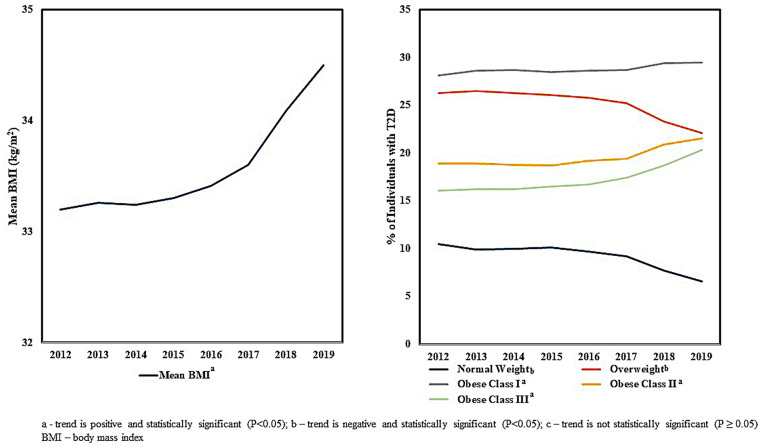
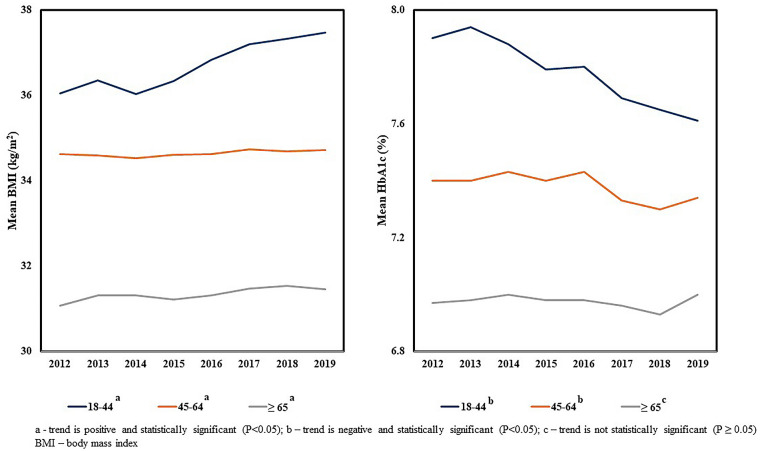
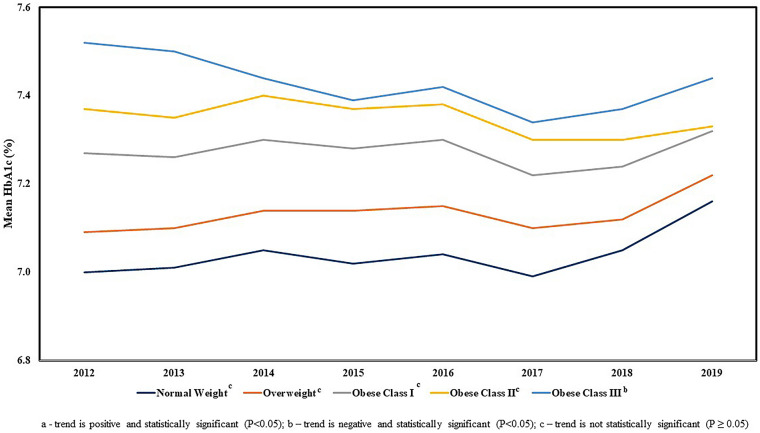
Results indicate that, over the study period from 2012-2019, average BMI increased significantly and there was a decrease in the percentage of adults with T2D who achieved glycemic control. In addition, for all years, higher BMI classification was associated with higher HbA1c values. When examining results for patients in different age groups, the findings were generally consistent with the overall population. In each age group, but most notably the age 18-44 group, the mean BMI increased over time and higher BMI was associated with higher HbA1c.
Given the increase in BMI and decreasing percentage of individuals achieving glycemic control among adults with T2D found over the study period, therapies which decrease BMI as well as HbA1c can potentially have a significant impact on the management of T2D. The growing proportion of the younger age group with higher mean BMI may remain a key subgroup of interest.
鉴于2型糖尿病(T2D)患者中肥胖率高且血糖控制不佳,本研究调查了糖化血红蛋白(HbA1c)和体重指数(BMI)的当前趋势,以及成年T2D患者中HbA1c与BMI之间的关联。
使用来自IBM® MarketScan® Explorys® 理赔电子病历数据构建2012 - 2019年的八个年度队列。每个年度队列包括确诊为T2D的成年人,他们在感兴趣的年份至少有一次记录的HbA1c实验室结果和BMI值。基于这些队列,使用广义估计方程(GEE)检验描述HbA1c和BMI随时间的趋势。
结果表明,在2012 - 2019年的研究期间,平均BMI显著增加,实现血糖控制的T2D成年患者百分比下降。此外,在所有年份中,较高的BMI分类与较高的HbA1c值相关。在检查不同年龄组患者的结果时,这些发现与总体人群基本一致。在每个年龄组中,但最显著的是18 - 44岁组,平均BMI随时间增加,较高的BMI与较高的HbA1c相关。
鉴于在研究期间发现成年T2D患者中BMI增加且实现血糖控制的个体百分比下降,降低BMI以及HbA1c的疗法可能对T2D的管理产生重大影响。平均BMI较高的年轻年龄组比例不断增加可能仍然是一个关键的关注亚组。