Infectious Disease Service, Department of Medicine, Memorial Hospital, Memorial Sloan Kettering Cancer Center, New York, New York, USA.
Immunology Program, Sloan Kettering Institute, Memorial Sloan Kettering Cancer Center, New York, New York, USA.
mSphere. 2021 Jun 30;6(3):e0026021. doi: 10.1128/mSphere.00260-21. Epub 2021 Jun 2.
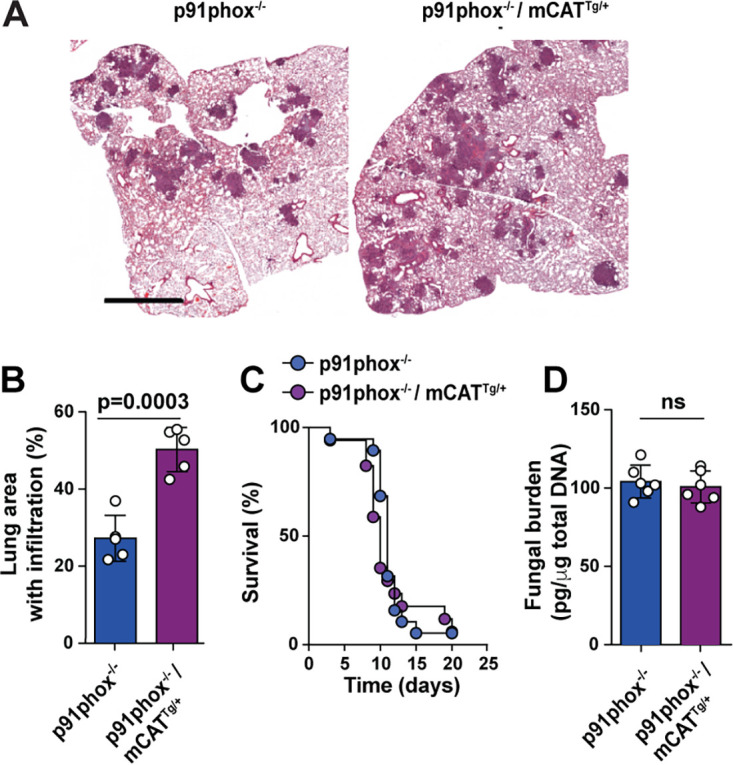
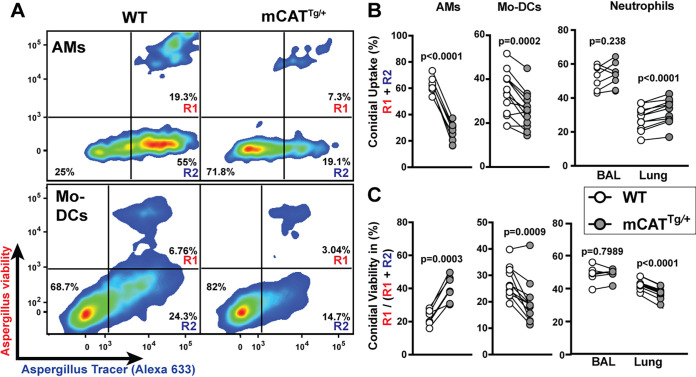
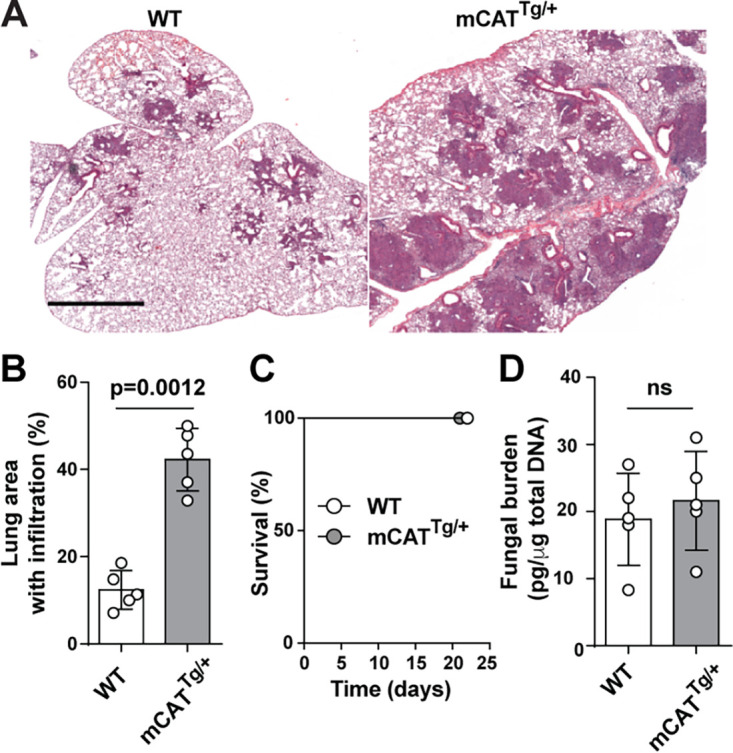
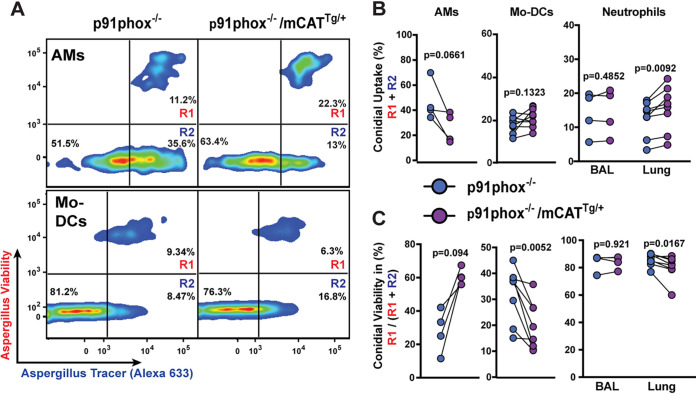
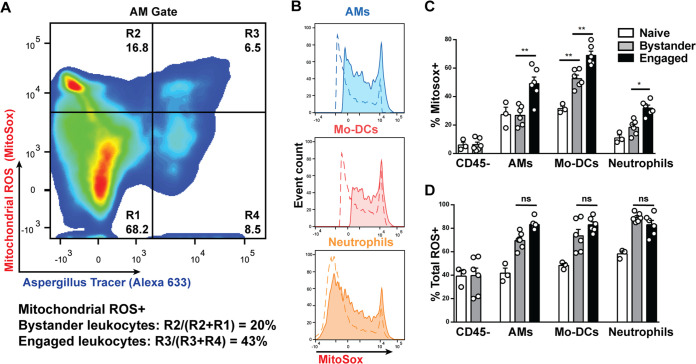
Aspergillus fumigatus is the most common cause of mold pneumonia worldwide, and a significant cause of infectious morbidity and mortality in immunocompromised individuals. The oxidative burst, which generates reactive oxidative species (ROS), plays a pivotal role in host defense against aspergillosis and induces regulated cell death in Aspergillus conidia, the infectious propagules. Beyond the well-established role of NADP (NADPH) oxidase in ROS generation by neutrophils and other innate effector cells, mitochondria represent a major ROS production site in many cell types, though it is unclear whether mitochondrial ROS (mtROS) contribute to antifungal activity in the lung. Following A. fumigatus infection, we observed that innate effector cells, including alveolar macrophages (AMs), monocyte-derived dendritic cells (Mo-DCS), and neutrophils, generated mtROS, primarily in fungus-infected cells. To examine the functional role of mtROS, specifically the HO component, in pulmonary host defense against A. fumigatus, we infected transgenic mice that expressed a mitochondrion-targeted catalase. Using a reporter of fungal viability during interactions with leukocytes, mitochondrial HO (mtHO) was essential for optimal AM, but not for neutrophil phagocytic and conidiacidal activity in the lung. Catalase-mediated mtHO neutralization did not lead to invasive aspergillosis in otherwise immunocompetent mice and did not shorten survival in mice that lack NADPH oxidase function. Collectively, these studies indicate that mtROS-associated defects in AM antifungal activity can be functionally compensated by the action of NADPH oxidase and by nonoxidative effector mechanisms during murine A. fumigatus lung infection. Aspergillus fumigatus is a fungal pathogen that causes invasive disease in humans with defects in immune function. Airborne conidia, the infectious propagules, are ubiquitous and inhaled on a daily basis. In the respiratory tree, conidia are killed by the coordinated actions of phagocytes, including alveolar macrophages, neutrophils, and monocyte-derived dendritic cells. The oxidative burst represents a central killing mechanism and relies on the assembly of the NADPH oxidase complex on the phagosomal membrane. However, NADPH oxidase-deficient leukocytes have significant residual fungicidal activity , indicating the presence of alternative effector mechanisms. Here, we report that murine innate immune cells produce mitochondrial reactive oxygen species (mtROS) in response to fungal interactions. Neutralizing the mtROS constituent hydrogen peroxide (HO) via a catalase expressed in mitochondria of innate immune cells substantially diminished fungicidal properties of alveolar macrophages, but not of other innate immune cells. These data indicate that mtHO represent a novel AM killing mechanism against Aspergillus conidia. mtHO neutralization is compensated by other killing mechanisms in the lung, demonstrating functional redundancy at the level of host defense in the respiratory tree. These findings have important implications for the development of host-directed therapies against invasive aspergillosis in susceptible patient populations.
烟曲霉是世界范围内最常见的霉菌性肺炎病因,也是免疫功能低下个体中传染性发病和死亡的重要原因。氧化爆发会产生活性氧物质(ROS),在宿主对抗曲霉病的防御中起着关键作用,并诱导曲霉属分生孢子(感染性繁殖体)的程序性细胞死亡。除了 NADP(NADPH)氧化酶在中性粒细胞和其他先天效应细胞中产生 ROS 的作用得到充分证实外,线粒体在许多细胞类型中也是主要的 ROS 产生部位,尽管尚不清楚线粒体 ROS(mtROS)是否有助于肺部的抗真菌活性。在烟曲霉感染后,我们观察到先天效应细胞,包括肺泡巨噬细胞(AMs)、单核细胞衍生的树突状细胞(Mo-DCS)和中性粒细胞,产生 mtROS,主要在真菌感染的细胞中。为了研究 mtROS(特别是 HO 成分)在宿主防御烟曲霉中的功能作用,我们感染了表达线粒体靶向过氧化氢酶的转基因小鼠。使用真菌与白细胞相互作用时的真菌活力报告,发现线粒体 HO(mtHO)对 AM 的最佳功能至关重要,但对中性粒细胞的吞噬和分生孢子杀伤活性则不然。过氧化氢酶介导的 mtHO 中和不会导致免疫功能正常的小鼠发生侵袭性曲霉病,也不会缩短 NADPH 氧化酶功能缺失小鼠的存活时间。总之,这些研究表明,在烟曲霉肺部感染期间,与 mtROS 相关的 AM 抗真菌活性缺陷可以通过 NADPH 氧化酶的作用和非氧化效应机制得到功能性补偿。
烟曲霉是一种真菌病原体,会导致免疫功能缺陷的人体发生侵袭性疾病。空气中的分生孢子(感染性繁殖体)无处不在,每天都会被吸入。在呼吸道中,分生孢子会被包括肺泡巨噬细胞、中性粒细胞和单核细胞衍生的树突状细胞在内的吞噬细胞的协同作用杀死。氧化爆发是一种核心杀伤机制,依赖于 NADPH 氧化酶复合物在吞噬体膜上的组装。然而,NADPH 氧化酶缺陷的白细胞仍具有显著的杀菌活性,这表明存在替代的效应机制。在这里,我们报告说,鼠类先天免疫细胞在与真菌相互作用时会产生线粒体活性氧物质(mtROS)。通过在先天免疫细胞的线粒体中表达过氧化氢酶来中和 mtROS 的组成部分过氧化氢(HO),会大大降低肺泡巨噬细胞的杀菌特性,但对其他先天免疫细胞则没有影响。这些数据表明,mtHO 代表了一种针对烟曲霉分生孢子的新型 AM 杀伤机制。mtHO 中和在肺部被其他杀伤机制所补偿,表明在呼吸道水平的宿主防御中存在功能冗余。这些发现对开发针对易感患者人群侵袭性曲霉病的宿主定向治疗具有重要意义。