Clinical Immunology Service, Institute for Immunology and Immunotherapy, University of Birmingham, Birmingham, UK.
Institute of Clinical Sciences, University of Birmingham, Birmingham, UK.
J Dent Res. 2021 Oct;100(11):1220-1227. doi: 10.1177/00220345211020270. Epub 2021 Jun 2.
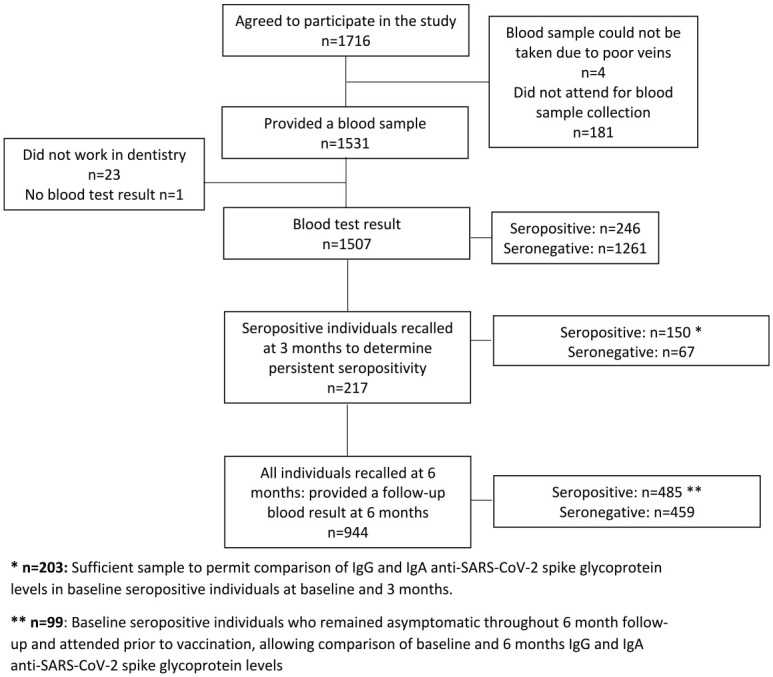
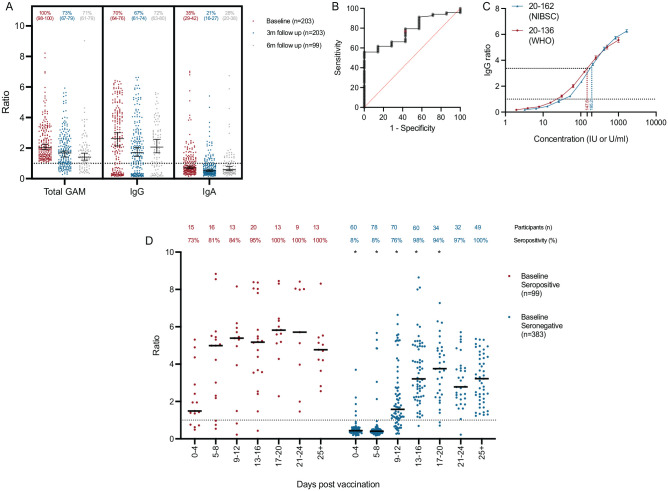
Dental care professionals (DCPs) are thought to be at enhanced risk of occupational exposure to severe acute respiratory syndrome coronavirus 2 (SARS-CoV-2). However, robust data to support this from large-scale seroepidemiological studies are lacking. We report a longitudinal seroprevalence analysis of antibodies to SARS-CoV-2 spike glycoprotein, with baseline sampling prior to large-scale practice reopening in July 2020 and follow-up postimplementation of new public health guidance on infection prevention control (IPC) and enhanced personal protective equipment (PPE). In total, 1,507 West Midlands DCPs were recruited into this study in June 2020. Baseline seroprevalence was determined using a combined IgGAM enzyme-linked immunosorbent assay and the cohort followed longitudinally for 6 mo until January/February 2021 through the second wave of the coronavirus disease 2019 pandemic in the United Kingdom and vaccination commencement. Baseline seroprevalence was 16.3%, compared to estimates in the regional population of 6% to 7%. Seropositivity was retained in over 70% of participants at 3- and 6-mo follow-up and conferred a 75% reduced risk of infection. Nonwhite ethnicity and living in areas of greater deprivation were associated with increased baseline seroprevalence. During follow-up, no polymerase chain reaction-proven infections occurred in individuals with a baseline anti-SARS-CoV-2 IgG level greater than 147.6 IU/ml with respect to the World Health Organization international standard 20-136. After vaccination, antibody responses were more rapid and of higher magnitude in those individuals who were seropositive at baseline. Natural infection with SARS-CoV-2 prior to enhanced PPE was significantly higher in DCPs than the regional population. Natural infection leads to a serological response that remains detectable in over 70% of individuals 6 mo after initial sampling and 9 mo from the peak of the first wave of the pandemic. This response is associated with protection from future infection. Even if serological responses wane, a single dose of the Pfizer-BioNTech 162b vaccine is associated with an antibody response indicative of immunological memory.
牙科保健专业人员(DCP)被认为面临更高的职业暴露于严重急性呼吸综合征冠状病毒 2(SARS-CoV-2)的风险。然而,缺乏大规模血清流行病学研究支持这一观点的有力数据。我们报告了一项针对 SARS-CoV-2 刺突糖蛋白抗体的纵向血清流行率分析,在 2020 年 7 月大规模重新开业前进行基线采样,并在实施新的感染预防控制(IPC)和增强个人防护设备(PPE)公共卫生指南后进行随访。总共招募了 2020 年 6 月 1507 名西米德兰兹 DCP 参加这项研究。使用 IgGAM 酶联免疫吸附试验联合检测确定基线血清流行率,并在英国 2019 年冠状病毒病(COVID-19)大流行的第二波和疫苗接种开始后的 6 个月内对队列进行纵向随访,直至 2021 年 1 月/2 月。基线血清流行率为 16.3%,而区域人群的估计值为 6%至 7%。在 3 个月和 6 个月的随访中,超过 70%的参与者保留了血清阳性,感染风险降低了 75%。非白人种族和居住在贫困程度较高地区与基线血清流行率增加有关。在随访期间,基线 SARS-CoV-2 IgG 水平大于 147.6 IU/ml 的个体中未发生聚合酶链反应(PCR)证实的感染,相对于世界卫生组织国际标准 20-136。接种疫苗后,基线时血清阳性的个体的抗体反应更快、幅度更高。与区域人群相比,DCP 中在增强 PPE 之前自然感染 SARS-CoV-2 的比例显著更高。自然感染会导致血清学反应,在初始采样后 6 个月和大流行第一波高峰后 9 个月,仍有超过 70%的个体可检测到该反应。这种反应与未来感染的保护有关。即使血清反应减弱,单次接种辉瑞-BioNTech 162b 疫苗也会引起免疫记忆的抗体反应。