From the Department of Pathology (Binkhamis, Alkadi, Alshafai), College of Medicine, King Saud University, Riyadh, Kingdom of Saudi Arabia; from the Infectious Diseases Unit, Department of Medicine (Almajid, Barry), College of Medicine, King Saud University, Riyadh, Kingdom of Saudi Arabia; from King Saud University Medical City (Binkhamis, Alkadi, Alshafai, Almajid, Barry), King Saud University, Riyadh, Kingdom of Saudi Arabia; from the College of Medicine (Bahatheg, Altahan, Alwakeel, Almutairi, Alsaeed), King Saud University, Riyadh, Kingdom of Saudi Arabia.
Saudi Med J. 2021 Jun;42(6):636-642. doi: 10.15537/smj.2021.42.6.20200832.
To determine the prevalence and outcome in patients with isoniazid-monoresistant complex and compare them to those in patients with non-isoniazid-monoresistant .
This cross-sectional analytical study was conducted at King Khalid University Hospital, Riyadh, Saudi Arabia. The data were retrospectively collected from the electronic medical records of patients who tested positive for between May 2015 and April 2019.
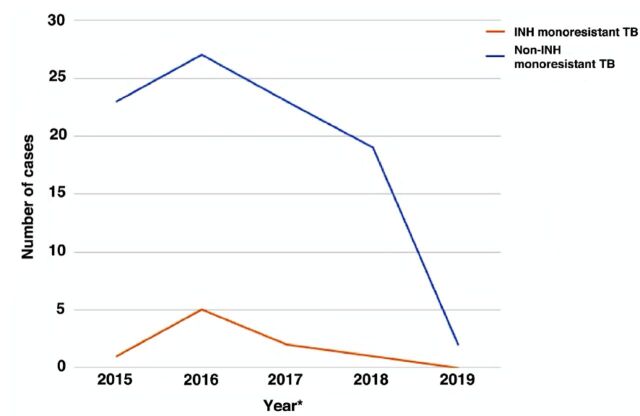
We identified 105 patients infected with . The prevalence proportion of isoniazid-monoresistant tuberculosis was 8.6% (n=9). Five patients with isoniazid-monoresistant tuberculosis (55.6%) were successfully treated, while one patient died. In the nonresistant population, 51 (53.1%) patients were successfully treated. However, 12 (12.5%) patients with no isoniazid resistance had an unsuccessful treatment outcome. The resistant group had a longer treatment duration with a mean of 12 months compared to the non-isoniazid-resistant group, with a mean treatment duration of 9.5 months. Twenty-eight patients (26.7%) had adverse events, with the majority of them being in the non-isoniazid-resistant group.
Isoniazid monoresistance is the most common form of drug resistance found in our population. Our study has not shown any significance in the outcome of isoniazid-resistant cases compared to non-isoniazid-resistant cases. This may be due to the low number of isoniazid-monoresistant cases in our population.
确定异烟肼单耐药 复合感染患者的患病率和结局,并将其与非异烟肼单耐药患者进行比较。
本横断面分析性研究在沙特阿拉伯利雅得的哈立德国王大学医院进行。数据是从 2015 年 5 月至 2019 年 4 月期间检测出阳性的患者的电子病历中回顾性收集的。
我们共发现 105 例感染结核分枝杆菌的患者。异烟肼单耐药结核病的患病率为 8.6%(n=9)。5 例异烟肼单耐药结核病患者(55.6%)治疗成功,1 例患者死亡。在非耐药人群中,51 例(53.1%)患者治疗成功。然而,有 12 例(12.5%)无异烟肼耐药的患者治疗结果不佳。耐药组的治疗时间较长,平均为 12 个月,而非异烟肼耐药组的平均治疗时间为 9.5 个月。28 例(26.7%)患者出现不良反应,其中大多数是非异烟肼耐药组患者。
异烟肼单耐药是我们人群中最常见的耐药形式。与非异烟肼耐药病例相比,我们的研究并未显示异烟肼耐药病例的结局有任何显著差异。这可能是由于我们人群中异烟肼单耐药病例数量较少所致。