Montoya Lupita D, Mendoza Lorelay M, Prouty Christine, Trotz Maya, Verbyla Matthew E
Department of Civil, Environmental and Architectural Engineering, University of Colorado Boulder, Boulder, Colorado, USA.
Department of Civil, Construction, and Environmental Engineering, San Diego State University, San Diego, California, USA.
Environ Eng Sci. 2021 May 1;38(5):288-297. doi: 10.1089/ees.2020.0148. Epub 2021 May 24.
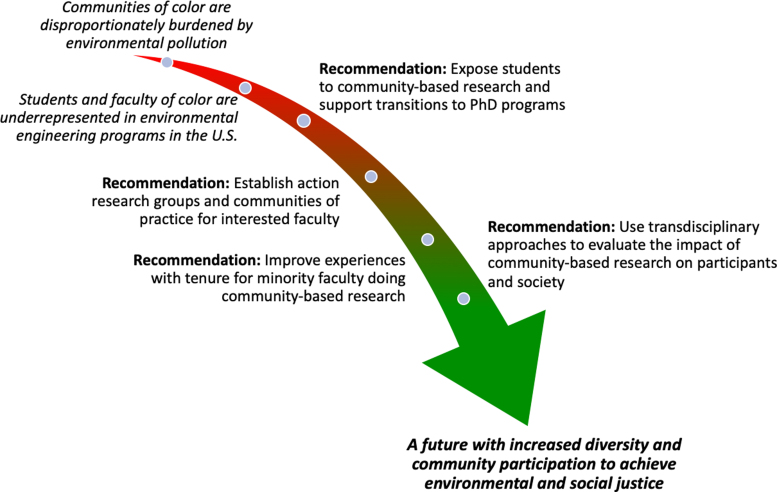
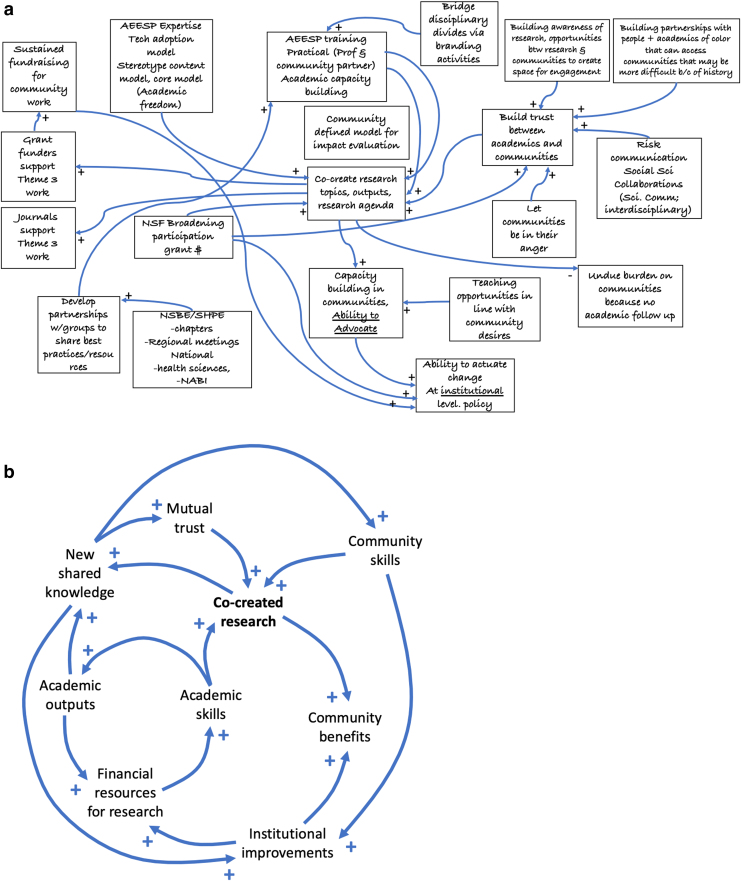
Communities of color are disproportionately burdened by environmental pollution and by obstacles to influence policies that impact environmental health. Black, Hispanic, and Native American students and faculty are also largely underrepresented in environmental engineering programs in the United States. Nearly 80 participants of a workshop at the 2019 Association of Environmental Engineering and Science Professors (AEESP) Research and Education Conference developed recommendations for reversing these trends. Workshop participants identified factors for success in academia, which included adopting a broader definition for the impact of research and teaching. Participants also supported the use of community-based participatory research and classroom action research methods in engineering programs for recruiting, retaining, and supporting the transition of underrepresented students into professional and academic careers. However, institutions must also evolve to recognize the academic value of community-based work to enable faculty, especially underrepresented minority faculty, who use it effectively, to succeed in tenure promotions. Workshop discussions elucidated potential causal relationships between factors that influence the co-creation of research related to academic skills, community skills, mutual trust, and shared knowledge. Based on the discussions from this workshop, we propose a pathway for increasing diversity and community participation in the environmental engineering discipline by exposing students to community-based participatory methods, establishing action research groups for faculty, broadening the definition of research impact to improve tenure promotion experiences for minority faculty, and using a mixed methods approach to evaluate its impact.
有色人种社区承受着不成比例的环境污染负担,并且在影响环境卫生的政策制定方面面临重重阻碍。在美国,黑人、西班牙裔和美国原住民学生及教师在环境工程专业项目中的占比也普遍较低。在2019年环境工程与科学教授协会(AEESP)研究与教育会议的一次研讨会上,近80名参与者针对扭转这些趋势提出了建议。研讨会参与者确定了在学术界取得成功的因素,其中包括对研究和教学的影响采用更广泛的定义。参与者还支持在工程项目中使用基于社区的参与式研究和课堂行动研究方法,以招募、留住和支持代表性不足的学生向专业和学术职业的转变。然而,各机构也必须不断发展,认识到基于社区的工作的学术价值,以使有效利用这种工作的教师,尤其是代表性不足的少数族裔教师,能够在终身教职晋升中取得成功。研讨会讨论阐明了影响与学术技能、社区技能、相互信任和共享知识相关的研究共同创造的因素之间的潜在因果关系。基于本次研讨会的讨论,我们提出了一条途径,通过让学生接触基于社区的参与式方法、为教师建立行动研究小组、拓宽研究影响的定义以改善少数族裔教师的终身教职晋升经历,以及使用混合方法评估其影响,来增加环境工程学科的多样性和社区参与度。