Wei Fuqun, Huang Qizhen, He Jian, Luo Liuping, Zeng Yongyi
Department of Hepatopancreatobiliary Surgery, Mengchao Hepatobiliary Hospital of Fujian Medical University, Fuzhou, 350025, People's Republic of China.
Department of Radiation Oncology, Mengchao Hepatobiliary Hospital of Fujian Medical University, Fuzhou, 350025, People's Republic of China.
Cancer Manag Res. 2021 May 27;13:4233-4240. doi: 10.2147/CMAR.S304820. eCollection 2021.
Compared the outcomes between lenvatinib plus camrelizumab therapy and lenvatinib monotherapy as post-progression treatment for advanced hepatocellular carcinoma (HCC) with progressive disease (PD).
A total of 48 advanced HCC patients were included in this retrospective study between June 2019 and March 2020. The patients were divided into the lenvatinib plus camrelizumab group (n=21) and the lenvatinib group (n=27). Primary endpoints were overall survival (OS) and progression-free survival (PFS), and secondary endpoints were the objective response rate (ORR) and adverse events (AEs).
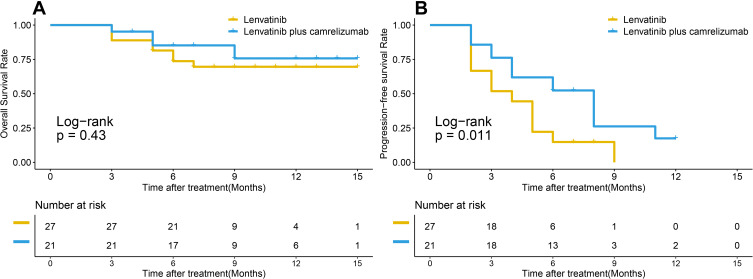
The median follow-up time was 8.4 months. The median OS was not obtained. The median PFS of lenvatinib plus camrelizumab group was significantly longer than that of lenvatinib group (8.0 months vs 4.0 months, =0.011). Compared with lenvatinib group, lenvatinib plus camrelizumab group had higher ORR (28.57% vs 7.41%) and disease control rate (DCR) (71.43% vs 51.85%). The most common adverse events (AEs) included hand-foot skin reaction, hypertensions and abnormal hepatic function damage. Overall, 23.81% and 25.93% of patients experienced grade ≥3AEs in the lenvatinib plus camrelizumab group and the lenvatinib group, respectively.
Lenvatinib plus camrelizumab as post-progression treatment is effective and safe for advanced hepatocellular carcinoma with PD.
比较乐伐替尼联合卡瑞利珠单抗治疗与乐伐替尼单药治疗作为晚期肝细胞癌(HCC)疾病进展(PD)后的进展后治疗的疗效。
本回顾性研究纳入了2019年6月至2020年3月期间的48例晚期HCC患者。患者被分为乐伐替尼联合卡瑞利珠单抗组(n = 21)和乐伐替尼组(n = 27)。主要终点为总生存期(OS)和无进展生存期(PFS),次要终点为客观缓解率(ORR)和不良事件(AE)。
中位随访时间为8.4个月。未获得中位OS。乐伐替尼联合卡瑞利珠单抗组的中位PFS显著长于乐伐替尼组(8.0个月对4.0个月,P = 0.011)。与乐伐替尼组相比,乐伐替尼联合卡瑞利珠单抗组的ORR(28.57%对7.41%)和疾病控制率(DCR)(71.43%对51.85%)更高。最常见的不良事件包括手足皮肤反应、高血压和肝功能异常损害。总体而言,乐伐替尼联合卡瑞利珠单抗组和乐伐替尼组分别有23.81%和25.93%的患者发生≥3级AE。
乐伐替尼联合卡瑞利珠单抗作为进展后治疗对伴有PD的晚期肝细胞癌有效且安全。