Price David, Jones Rupert, Pfister Pascal, Cao Hui, Carter Victoria, Kemppinen Anu, Holzhauer Björn, Kaplan Alan, Clark Allan, Halpin David M G, Pinnock Hilary, Chalmers James D, van Boven Job F M, Beeh Kai M, Kostikas Konstantinos, Roche Nicolas, Usmani Omar, Mastoridis Paul
Observational and Pragmatic Research Institute, Singapore, Singapore.
Centre of Academic Primary Care, Division of Applied Health Sciences, University of Aberdeen, Aberdeen, UK.
Pragmat Obs Res. 2021 May 24;12:25-35. doi: 10.2147/POR.S302809. eCollection 2021.
Poor treatment adherence in COPD patients is associated with poor clinical outcomes and increased healthcare burden. Personalized approaches for adherence management, supported with technology-based interventions, may offer benefits to patients and providers but are currently unproven in terms of clinical outcomes as opposed to adherence outcomes.
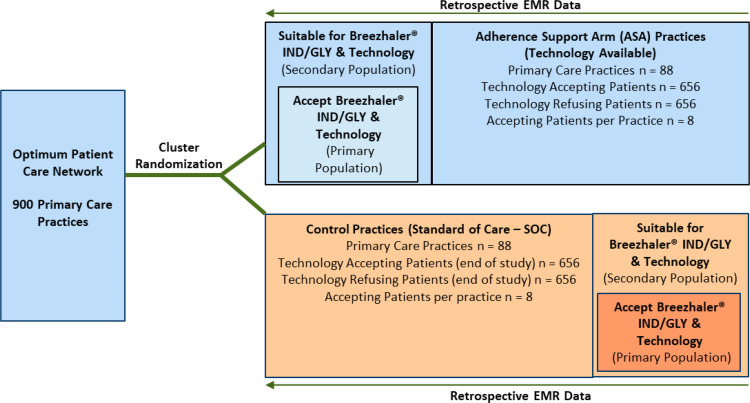
Maximizing Adherence and Gaining New Information For Your COPD (MAGNIFY COPD study), a pragmatic cluster randomized trial, aims to evaluate the impact of an adherence technology package (interventional package), comprising an adherence review, ongoing provision of a dual bronchodilator but with an add-on inhaler sensor device and a connected mobile application. This will compare time to treatment failure and other clinical outcomes in patients identified at high risk of exacerbations with historic poor treatment adherence as measured by prescription collection to mono/dual therapy over one year (1312 patients) versus usual care. Treatment failure is defined as the first occurrence of one of the following: (1) moderate/severe COPD exacerbation, (2) prescription of triple therapy (inhaled corticosteroid/long-acting β-agonist/long-acting muscarinic antagonist [ICS/LABA/LAMA]), (3) prescription of additional chronic therapy for COPD, or (4) respiratory-related death. Adherence, moderate/severe exacerbations, respiratory-related healthcare resource utilization and costs, and intervention package acceptance rate will also be assessed. Eligible primary care practices (N=176) participating in the Optimum Patient Care Quality Improvement Program will be randomized (1:1) to either adherence support cluster arm (suitable patients already receiving or initiated Ultibro Breezhaler [indacaterol/glycopyrronium] will be offered interventional package) or the control cluster arm (suitable patients continue to receive usual clinical care). Patients will be identified and outcomes collected from anonymized electronic medical records within the Optimum Patient Care Research Database. On study completion, electronic medical record data will be re-extracted to analyze outcomes in both study groups.
ISRCTN10567920.
MAGNIFY will explore patient benefits of technology-based interventions for electronic adherence monitoring.
慢性阻塞性肺疾病(COPD)患者治疗依从性差与临床预后不良及医疗负担增加相关。采用基于技术的干预措施支持的个性化依从性管理方法,可能会给患者和医疗服务提供者带来益处,但就临床预后而言,目前尚未得到证实,不过在依从性结果方面已得到验证。
优化慢性阻塞性肺疾病患者的依从性并获取新信息(MAGNIFY COPD研究)是一项实用的整群随机试验,旨在评估一种依从性技术包(干预包)的影响,该技术包包括一次依从性评估、持续提供双支气管扩张剂,但附加一个吸入器传感器设备和一个联网的移动应用程序。这将比较在一年时间内(1312例患者)通过单药/双药治疗的处方收集情况确定为有病情加重高风险且既往治疗依从性差的患者与接受常规治疗的患者出现治疗失败及其他临床预后的时间。治疗失败定义为首次出现以下情况之一:(1)中度/重度COPD加重;(2)三联疗法(吸入性糖皮质激素/长效β受体激动剂/长效毒蕈碱拮抗剂[ICS/LABA/LAMA])的处方;(3)COPD额外慢性治疗的处方;或(4)与呼吸相关的死亡。还将评估依从性、中度/重度加重、与呼吸相关的医疗资源利用和成本以及干预包接受率。参与最佳患者护理质量改进计划的符合条件的初级医疗保健机构(N = 176)将按1:1随机分配至依从性支持整群组(已接受或开始使用Ultibro Breezhaler[茚达特罗/格隆溴铵]的合适患者将获得干预包)或对照组(合适患者继续接受常规临床护理)。将从最佳患者护理研究数据库中的匿名电子病历中识别患者并收集结局。研究完成后,将重新提取电子病历数据以分析两个研究组的结局。
ISRCTN10567920。
MAGNIFY研究将探索基于技术的干预措施对电子依从性监测的患者益处。