Departamento de Biología Molecular, Centro de Biología Molecular Severo Ochoa, Consejo Superior de Investigaciones Científicas-Universidad Autónoma de Madrid (CSIC-UAM), Madrid, Spain.
Cardiovascular Branch, National Heart, Lung and Blood Institute, NIH, Bethesda, MD, United States.
Front Immunol. 2021 May 17;12:657293. doi: 10.3389/fimmu.2021.657293. eCollection 2021.
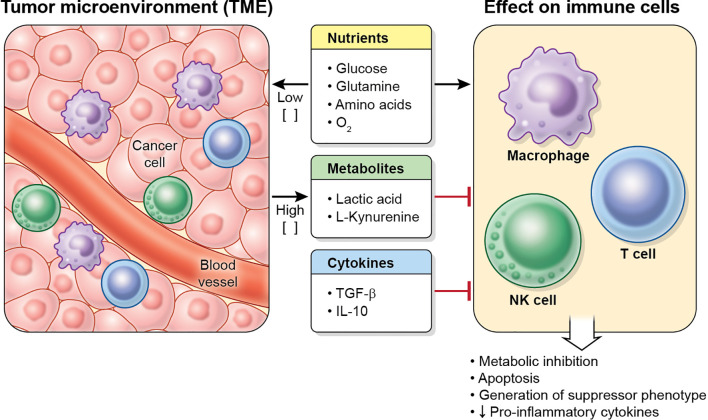
Constitutive activity of the immune surveillance system detects and kills cancerous cells, although many cancers have developed strategies to avoid detection and to resist their destruction. Cancer immunotherapy entails the manipulation of components of the endogenous immune system as targeted approaches to control and destroy cancer cells. Since one of the major limitations for the antitumor activity of immune cells is the immunosuppressive tumor microenvironment (TME), boosting the immune system to overcome the inhibition provided by the TME is a critical component of oncotherapeutics. In this article, we discuss the main effects of the TME on the metabolism and function of immune cells, and review emerging strategies to potentiate immune cell metabolism to promote antitumor effects either as monotherapeutics or in combination with conventional chemotherapy to optimize cancer management.
免疫监视系统的组成性活性可检测并杀死癌细胞,尽管许多癌症已开发出逃避检测和抵抗破坏的策略。癌症免疫疗法涉及对内源性免疫系统成分的操纵,作为控制和破坏癌细胞的靶向方法。由于免疫细胞抗肿瘤活性的主要限制之一是免疫抑制性肿瘤微环境(TME),因此增强免疫系统以克服 TME 提供的抑制作用是肿瘤治疗学的关键组成部分。在本文中,我们讨论了 TME 对免疫细胞代谢和功能的主要影响,并回顾了新兴策略,以增强免疫细胞代谢,以促进抗肿瘤作用,无论是作为单一疗法还是与常规化疗联合使用,以优化癌症管理。